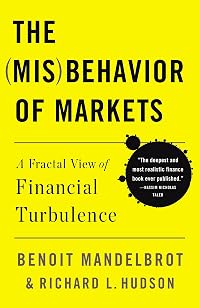
The Misbehavior of Markets: A Fractal View of Financial Turbulence
by Benoit Mandelbrot
On This Page
Description
Mathematical superstar and inventor of fractal geometry, Benoit Mandelbrot, has spent the past forty years studying the underlying mathematics of space and natural patterns. What many of his followers don't realize is that he has also been watching patterns of market change. In The (Mis)Behavior of Markets, Mandelbrot joins with science journalist and former Wall Street Journal editor Richard L. Hudson to reveal what a fractal view of the world of finance looks like. The result is a show more revolutionary reevaluation of the standard tools and models of modern financial theory. Markets, we learn, are far riskier than we have wanted to believe. From the gyrations of IBM's stock price and the Dow, to cotton trading, and the dollar-Euro exchange rate--Mandelbrot shows that the world of finance can be understood in more accurate, and volatile, terms than the tired theories of yesteryear.The ability to simplify the complex has made Mandelbrot one of the century's most influential mathematicians. With The (Mis)Behavior of Markets, he puts the tools of higher mathematics into the hands of every person involved with markets, from financial analysts to economists to 401(k) holders. Markets will never be seen as "safe bets" again. show lessTags
Recommendations





Member Reviews
Mandelbrot is the "father of fractal geometry." He's a mathematician who has spent much of his career looking at prices and markets. He argues pretty forcefully that any of the risk management techniques used by Wall Street are based on false assumptions and have been proven to fail time and again.
Mandelbrot is Nassim Taleb's mentor. I've gotten to the point where I wonder if, as a Christian, I can still teach economic orthodoxy (much less finance classes like risk management) with a clear conscience. The models and systems that modern finance uses to calculate risk are unrealistic and fail. Econometric modeling is guilty of the same sins.
It shakes the foundations of my learning to the core. Here's another blogger's review of the book, show more the comments are very insightful.
4.5 stars out of 5. show less
A bit disappointing, but probably one of those books that is a victim of its own success. Perhaps when it was originally written, the views were considered more heretical than they are now. I would recommend that a close reader of taleb's anti-fragile and/or the black swan skip this book since taleb's works rehash the main thesis of Misbehavior (down to the self-aggrandizement, almost every time Fama is mentioned, Mandelbrot claims him as his doctoral student, and Mandelbrot spends a fair amount of time praising his own work/ describing his maverickiness [though to be fair, I suppose that's fair for a mathematician of his status]). In Misbehavior, Mandelbrot lays out the case against the foundational assumptions of modern portfolio show more theory, mainly its reliance on the gaussian distributions. Mandelbrot makes the simple observation that many of the observed drops in the markets should not have occurred under standard assumptions (technically the standard bell curve allows the possibility, but the chances are so remote that such events should not be observable in several billion lifetimes, let alone recurring several times in a few hundred years). Mandelbrot attacks the assumptions of normal distribution, independence of events, and constant volatility. Mandelbrot shows that the data just does not bear out the milder swings the normal distribution anticipates (that actual price data exhibit fatter tails than the normal distribution). Mandelbrot argues that analysis shows a long term dependence, that prices exhibit a certain type of memory that is endogenous but also moves are clustered. He develops a measure H, to show the persistence of momentum or anti-momentum as opposed to the standard random walk (which incidentally has an H of 0.5). Mandelbrot criticizes methods such as GARCH as building on a flawed foundation in fixing changing volatility. Instead Mandelbrot advocates the use of power laws, so-called Cauchy-levy functions and fractals in creating models. He claims that fractals, especially ones that accounting for trading time that stretch or compress can model price movements in a more accurate way. The work seems pretty technical, and Mandelbrot admits freely that research in using multi-fractal models is only developing. More interestingly (at least in my opinion) is the crash course lesson in fractals (the three steps to form a complex pattern, initiator, generator and rule of recursion) and measures of roughness. Mandelbrot believes fractals can be used to explain many naturally occurring phenomenon as well as complex systems as the economy.
On the whole, the book is written for a non-technical audience. Mandelbrot helpfully summarizes basic modern portfolio theory (from Bachelier's thesis on bonds, to Markowitz, CAPM (Sharpe), finally to Black Scholes). That portion was relatively well done, I thought it was a fair and accurate representation of what I had learned in basic finance in college. Mandelbrot also convincingly shows that the normal curve is not a good assumption, and that reliance on it can lead to blow ups. However, Mandelbrot is not as convincing when it comes to proposing fractals as a solution. Perhaps it's the limits of my technical knowledge, but it just did not seem convincing. On many parts of Mandelbrot's analysis, I just had to take him at his word that a certain analysis produced the conclusion he claims, despite his admissions at the end that scholars disagree over metrics like H. An interesting read, but it lacked the scholarly rigor to convince me that his solution could be the new foundation for risk analysis. The ideas seem to move and jump, seeming more like an interesting collection of Mandelbrot's works and thoughts rather than a coherent rigorous argument. On the other hand, I might not be able to understand a comprehensive scholarly defense without a deeper mathematical background. I suppose we'll never know. show less
On the whole, the book is written for a non-technical audience. Mandelbrot helpfully summarizes basic modern portfolio theory (from Bachelier's thesis on bonds, to Markowitz, CAPM (Sharpe), finally to Black Scholes). That portion was relatively well done, I thought it was a fair and accurate representation of what I had learned in basic finance in college. Mandelbrot also convincingly shows that the normal curve is not a good assumption, and that reliance on it can lead to blow ups. However, Mandelbrot is not as convincing when it comes to proposing fractals as a solution. Perhaps it's the limits of my technical knowledge, but it just did not seem convincing. On many parts of Mandelbrot's analysis, I just had to take him at his word that a certain analysis produced the conclusion he claims, despite his admissions at the end that scholars disagree over metrics like H. An interesting read, but it lacked the scholarly rigor to convince me that his solution could be the new foundation for risk analysis. The ideas seem to move and jump, seeming more like an interesting collection of Mandelbrot's works and thoughts rather than a coherent rigorous argument. On the other hand, I might not be able to understand a comprehensive scholarly defense without a deeper mathematical background. I suppose we'll never know. show less
Excellently written though poorly on-topic. Only the last four chapters (of 11 or so) had anything novel than a history of the industry. The meatiest two of these four chapters were difficult to follow, so poor marks there.
Ultimately, the points are depressing: 1) markets are riskier and more volatile than standard methods suggest, 2) (intrinsic) "value" is not really useful and 3) the reiteration that despite 150 years of research so far, we don't seem to know much more than that we don't know much.
Ultimately, the points are depressing: 1) markets are riskier and more volatile than standard methods suggest, 2) (intrinsic) "value" is not really useful and 3) the reiteration that despite 150 years of research so far, we don't seem to know much more than that we don't know much.
Everyone should carefully read this text, the significance of Mandelbrot's points remains unfortunately as important as ever and still largely ignored by the average person.
Many aspects which we believe to be true measures or robust facts are actually, under the surface, ruled by distributions that can fluctuate wildly. What does an average price index of a stock mean, if the underlying distribution doesn't really have a mean?
Many aspects which we believe to be true measures or robust facts are actually, under the surface, ruled by distributions that can fluctuate wildly. What does an average price index of a stock mean, if the underlying distribution doesn't really have a mean?
A Fresh Look at Financial Orthodoxy
This book details one of this generation’s finest mathematical minds offers “obvious” observations he calls his “Ten Heresies of Finance.”
Benoit Mandelbrot is known for making mathematical sense of facts everybody accepts but that geometers never assimilated. Clouds are not round. Mountains are not cones. Coastlines are not smooth. Add another: financial markets are not the safe bet your broker claims. In his first general audience book, Mandelbrot, with co-author Richard L. Hudson, reveal today’s assumptions about the behavior of markets simply do not work.
“What passes for orthodoxy in economics and finance,” the authors conclude, “proves on closer examination to be shaky show more business.”
Among the book’s observations:
1. Markets are turbulent. After spending a lifetime studying wind and ocean currents, he applies his multi-fractal math to analyze financial markets. “The tell-tale traces of turbulence are plainly there, in the price charts,” he writes. The bell curve does not capture its changes.
2. Markets are inherently risky. Turbulence is dangerous. Market swings are wild and sudden. They are difficult to predict, more difficult to hedge and even more difficult from which to profit.
3. Marketing timing matters. Big gains and losses are concentrated into small time periods. News events such as earnings or economic announcements drive stock market prices.
4. Prices leap suddenly. This adds to risk. News announcements compel investors to act simultaneously and instantaneously.
Using his fractal tools, Mandelbrot describes how financial markets work. He describes the volatile, dangerous and in a unique way, strangely beautiful properties that for which few financial experts account.
This book is a must read for any serious investor. By pin-pointing flaws in accepted market wisdom, it provides a platform for a serious re-consideration of finance. show less
This book details one of this generation’s finest mathematical minds offers “obvious” observations he calls his “Ten Heresies of Finance.”
Benoit Mandelbrot is known for making mathematical sense of facts everybody accepts but that geometers never assimilated. Clouds are not round. Mountains are not cones. Coastlines are not smooth. Add another: financial markets are not the safe bet your broker claims. In his first general audience book, Mandelbrot, with co-author Richard L. Hudson, reveal today’s assumptions about the behavior of markets simply do not work.
“What passes for orthodoxy in economics and finance,” the authors conclude, “proves on closer examination to be shaky show more business.”
Among the book’s observations:
1. Markets are turbulent. After spending a lifetime studying wind and ocean currents, he applies his multi-fractal math to analyze financial markets. “The tell-tale traces of turbulence are plainly there, in the price charts,” he writes. The bell curve does not capture its changes.
2. Markets are inherently risky. Turbulence is dangerous. Market swings are wild and sudden. They are difficult to predict, more difficult to hedge and even more difficult from which to profit.
3. Marketing timing matters. Big gains and losses are concentrated into small time periods. News events such as earnings or economic announcements drive stock market prices.
4. Prices leap suddenly. This adds to risk. News announcements compel investors to act simultaneously and instantaneously.
Using his fractal tools, Mandelbrot describes how financial markets work. He describes the volatile, dangerous and in a unique way, strangely beautiful properties that for which few financial experts account.
This book is a must read for any serious investor. By pin-pointing flaws in accepted market wisdom, it provides a platform for a serious re-consideration of finance. show less
According to conventional financial theory, the odds of calamitous events in the market are extremely long. So long they ought not to happen. But as any investor will tell you companies go bust all the time. Markets crash. And products we supposed were safe turn out to be leaky junks sinking into the ocean swell. Mandelbrot has an alternative model, fractals, the geometry he invented to describe coastlines, the inside of your lung and the distribution of earthquakes. It might one day change the way we value investments
In these turbulent economy we seem to be victims of the financial markets. Benoit Mandelbrot, famous mathematician and inventor of fractal geometry, joined forces with Richard Hudson, to write a book about financial theory. “The (Mis)behavior of Markets” falls in the popular science genre. It is low on formulas, instead you can find lots of historical anecdotes and opinions.
1. Risk, Ruin and Reward
We start with a brief history of finance. The author asks us to play a game. Out of 4 charts we need to select the ones that are real and the ones that are fake.
2. By the Toss of a Coin or the Flight of an Arrow?
Chance is important in finance. There is the mild form of chance, described by the bell curve. On the other hand, there is the show more more extreme Cauchy probability distribution. Financial theory follows the mild path, but Mandelbrot is convinced that this is wrong and a more wild variability is to be expected.
3. Bachelier and His Legacy
The third chapter is about Bachelier and his coin-tossing view of finance. His work led to the theory of the efficient market. According to this theory, the market is so efficient that all information is directly reflected in the price of financial assets.
4. The House of Modern Finance
People who helped build the house of modern finance and their theories are mentioned – Markowitz, Sharpe, Black and Scholes. Even though some received Nobel Prizes, they still lost a lot of money in the markets.
5. The Case Against the Modern Theory of Finance
Mandelbrot tries to demolish the house of modern finance starting with shaky assumptions. He tries to disprove these assumptions. More evidence is presented, such as the low price earnings and price book anomalies. These anomalies are in direct conflict with current theory.
6. Turbulent Markets: A Preview
Turbulence is a nice metaphor for trading. Mandelbrot tries to convince us, that we should be thinking of fractals, when we look at stock charts. He uses cartoons of stock charts to achieve that.
7. Studies in Roughness: A Fractal Primer
Fractal geometry deals with roughness. It introduces a measure called fractal dimension, which is similar to the normal dimension in geometry, but is not an integer.
8. The Mystery of Cotton
This chapter describes a research project of Mandelbrot, when he worked at an IBM laboratory. He discovered a power law in the log returns of cotton prices. The evidence pointed at a L-stable probability distribution with features somewhere between a normal and Cauchy distribution.
9. Long Memory, from the Nile to the Marketplace
Hurst, a famous hydrologist, faced the challenge of figuring out a pattern to the Nile river. Hurst discovered a long term dependence in his data set. It is suggested, that the so called Hurst exponent could be a new yardstick, that would explain better long memory effects in financial markets.
10. Noah, Joseph, and Market Bubbles
The author refers to characters in the Bible to describe different forms of wild variability. For people familiar with the Bible this is a good example. In my opinion we can call it a shaky assumption at best.
11. The Multifractal Nature of Trading Time
Some days are slow, some days just fly by. Apparently this applies to trading too and it is due to the multifractal nature of time.
12. Ten Heresies of Finance
A list of ten big errors in financial theory. Markets are riskier, than we thought. Timing matters. Prices often leap.
13. In the Lab
Mandelbrot warns us that fractal finance is not mature yet. However, it is superior to the mainstream theories, since they dangerously underestimate risk.
The book ends with notes containing formulas and bibliography listing scientific articles. A thrilling book, that I could not put down, until I read it cover to cover. It is the finance equivalent of “A Brief History of Time”. I give it 5 stars out of 5. show less
1. Risk, Ruin and Reward
We start with a brief history of finance. The author asks us to play a game. Out of 4 charts we need to select the ones that are real and the ones that are fake.
2. By the Toss of a Coin or the Flight of an Arrow?
Chance is important in finance. There is the mild form of chance, described by the bell curve. On the other hand, there is the show more more extreme Cauchy probability distribution. Financial theory follows the mild path, but Mandelbrot is convinced that this is wrong and a more wild variability is to be expected.
3. Bachelier and His Legacy
The third chapter is about Bachelier and his coin-tossing view of finance. His work led to the theory of the efficient market. According to this theory, the market is so efficient that all information is directly reflected in the price of financial assets.
4. The House of Modern Finance
People who helped build the house of modern finance and their theories are mentioned – Markowitz, Sharpe, Black and Scholes. Even though some received Nobel Prizes, they still lost a lot of money in the markets.
5. The Case Against the Modern Theory of Finance
Mandelbrot tries to demolish the house of modern finance starting with shaky assumptions. He tries to disprove these assumptions. More evidence is presented, such as the low price earnings and price book anomalies. These anomalies are in direct conflict with current theory.
6. Turbulent Markets: A Preview
Turbulence is a nice metaphor for trading. Mandelbrot tries to convince us, that we should be thinking of fractals, when we look at stock charts. He uses cartoons of stock charts to achieve that.
7. Studies in Roughness: A Fractal Primer
Fractal geometry deals with roughness. It introduces a measure called fractal dimension, which is similar to the normal dimension in geometry, but is not an integer.
8. The Mystery of Cotton
This chapter describes a research project of Mandelbrot, when he worked at an IBM laboratory. He discovered a power law in the log returns of cotton prices. The evidence pointed at a L-stable probability distribution with features somewhere between a normal and Cauchy distribution.
9. Long Memory, from the Nile to the Marketplace
Hurst, a famous hydrologist, faced the challenge of figuring out a pattern to the Nile river. Hurst discovered a long term dependence in his data set. It is suggested, that the so called Hurst exponent could be a new yardstick, that would explain better long memory effects in financial markets.
10. Noah, Joseph, and Market Bubbles
The author refers to characters in the Bible to describe different forms of wild variability. For people familiar with the Bible this is a good example. In my opinion we can call it a shaky assumption at best.
11. The Multifractal Nature of Trading Time
Some days are slow, some days just fly by. Apparently this applies to trading too and it is due to the multifractal nature of time.
12. Ten Heresies of Finance
A list of ten big errors in financial theory. Markets are riskier, than we thought. Timing matters. Prices often leap.
13. In the Lab
Mandelbrot warns us that fractal finance is not mature yet. However, it is superior to the mainstream theories, since they dangerously underestimate risk.
The book ends with notes containing formulas and bibliography listing scientific articles. A thrilling book, that I could not put down, until I read it cover to cover. It is the finance equivalent of “A Brief History of Time”. I give it 5 stars out of 5. show less
Members
- Recently Added By
Lists

BusinessBooks
24 works; 5 members
Author Information

29+ Works 2,613 Members
Benoit Mandelbrot is Sterling Professor of Mathematical Sciences at Yale University and a Fellow Emeritus at IBM's Thomas J. Watson Laboratory.
All Editions
Awards and Honors
Common Knowledge
- Canonical title*
- Il disordine dei mercati: una visione frattale del rischio, rovina, redditività
- Original title
- The Misbehavior of Markets: A Fractal View of Financial Turbulence
- Original publication date
- 2004
*Some information comes from Common Knowledge in other languages. Click "Edit" for more information.
Classifications
Statistics
- Members
- 938
- Popularity
- 28,338
- Reviews
- 16
- Rating
- (3.90)
- Languages
- 7 — English, French, German, Italian, Japanese, Portuguese (Portugal), Russian
- Media
- Paper, Audiobook, Ebook
- ISBNs
- 17
- ASINs
- 13