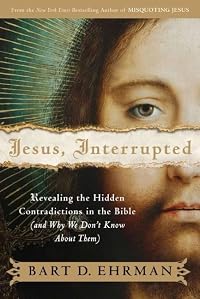
Jesus Interrupted
by Bart D. Ehrman
On This Page
Description
The problems with the Bible that New Testament scholar Bart Ehrman discussed in his bestseller Misquoting Jesus-and on The Daily Show with John Stewart, NPR, and Dateline NBC, among others-are expanded upon exponentially in his latest book: Jesus, Interrupted. This New York Times bestseller reveals how books in the Bible were actually forged by later authors, and that the New Testament itself is riddled with contradictory claims about Jesus-information that scholars know… but the general show more public does not. If you enjoy the work of Elaine Pagels, Marcus Borg, John Dominic Crossan, and John Shelby Spong, you'll find much to ponder in Jesus, Interrupted. show lessTags
Recommendations
Member Reviews
The "hidden contradictions" as promised in the title are only a small part of what this book is about, and I am glad for that. Jesus, Interrupted is a sort of biography of the Bible itself. Although Ehrman begins the book with a refutation of biblical inerrancy, the rhetoric set forward isn't actually academia versus religious fundamentalists (there's enough of that already). Instead it's a fairly level history of where the New Testament comes from, who controlled what was said and not said in it, and what social circumstances were surrounding its writings.
Ehrman stresses several times that the Bible is a "very human" book - whether a reader would say it's also divinely inspired is up to him or her, but the historical situations of the show more Bible are undeniably important. Responsible readership should keep in mind that it can and should be a dynamic book for believers, informing their spirituality, but it also is a collection of first century documents created by a culture very different from our own. Religious controversies swirled around the communities writing these books, and the so-called orthodox theology set forth in the Bible (more or less) was only one of many interpretations by self-proclaimed Christians as to who Jesus was and what his ministry actually *meant.*
The skepticism that Ehrman introduces with his book is not intended to obliterate faith, but perhaps better ground it in a historical reality, closer to the "real" (historical) Jesus and less infused with the later dogma set forth by Christian churches. show less
Ehrman stresses several times that the Bible is a "very human" book - whether a reader would say it's also divinely inspired is up to him or her, but the historical situations of the show more Bible are undeniably important. Responsible readership should keep in mind that it can and should be a dynamic book for believers, informing their spirituality, but it also is a collection of first century documents created by a culture very different from our own. Religious controversies swirled around the communities writing these books, and the so-called orthodox theology set forth in the Bible (more or less) was only one of many interpretations by self-proclaimed Christians as to who Jesus was and what his ministry actually *meant.*
The skepticism that Ehrman introduces with his book is not intended to obliterate faith, but perhaps better ground it in a historical reality, closer to the "real" (historical) Jesus and less infused with the later dogma set forth by Christian churches. show less
I really like Ehrman's writings. He is a very thoughtful writer on subjects that aren't discussed much in public because they involve, for some people, a radical reinterpretation of the Bible. In fact that is one of the reasons he wrote the book: so few lay people have been taught anything about the last 200 years of Biblical scholarship.
The book is something of a sequel to his previous work Misquoting Jesus. In both he points out that a view of the Bible as literally true and inerrant has been made impossible by facts. We do not have the original Biblical texts, first of all. Secondly, there are thousands of existing copies made prior to the invention of the printing press, and no two are alike... they all contain errors, some major, show more most minor, some deleting text found in other versions and some adding text. The errors in all of these copies add up to more words than are in the Bible.
Ehrman points out, however, that many if not most Biblical scholars are believing Jews or Christians, that knowing the Bible is not inerrant by no means mandates a loss of faith. Ehrman is candid in revealing that he has become an agnostic himself, but says it had nothing to do with the issue of inerrancy, but rather the issue of suffering (which he addressed in a different book).
Ehrman reconstructs the New Testament (he is a Greek scholar, not a Hebrew scholar, so does not treat the Old Testament), discussing who wrote the various books, which are forgeries, when they were written, etc. He talks some about the process by which the canonical books of the New Testament became canonical. Prior to this, around the fourth century, there were many competing Christianities (discussed in more depth in his book Lost Christianities). In some Christians had to follow Jewish law, in others they were not to do so, and then there were the Gnostics, a wholly different kettle of fish. Each group had its own set of works it considered sacred.
Ehrman has an extensive discussion of the value of reading the books "vertically" (comparing the same story in different books), rather than "horizontally" (reading the books in order straight through). By doing so the unique viewpoints of the authors come out. Mark, for example, was the earliest of the Gospels to be written, and is one of the sources for Luke and Matthew. Mark's view of Jesus is that he is the one who atones for the sin of the world, and so his emphasis is on Christ's suffering.
Bart Ehrman has produced another excellent book on Biblical scholarship for the lay reader. show less
The book is something of a sequel to his previous work Misquoting Jesus. In both he points out that a view of the Bible as literally true and inerrant has been made impossible by facts. We do not have the original Biblical texts, first of all. Secondly, there are thousands of existing copies made prior to the invention of the printing press, and no two are alike... they all contain errors, some major, show more most minor, some deleting text found in other versions and some adding text. The errors in all of these copies add up to more words than are in the Bible.
Ehrman points out, however, that many if not most Biblical scholars are believing Jews or Christians, that knowing the Bible is not inerrant by no means mandates a loss of faith. Ehrman is candid in revealing that he has become an agnostic himself, but says it had nothing to do with the issue of inerrancy, but rather the issue of suffering (which he addressed in a different book).
Ehrman reconstructs the New Testament (he is a Greek scholar, not a Hebrew scholar, so does not treat the Old Testament), discussing who wrote the various books, which are forgeries, when they were written, etc. He talks some about the process by which the canonical books of the New Testament became canonical. Prior to this, around the fourth century, there were many competing Christianities (discussed in more depth in his book Lost Christianities). In some Christians had to follow Jewish law, in others they were not to do so, and then there were the Gnostics, a wholly different kettle of fish. Each group had its own set of works it considered sacred.
Ehrman has an extensive discussion of the value of reading the books "vertically" (comparing the same story in different books), rather than "horizontally" (reading the books in order straight through). By doing so the unique viewpoints of the authors come out. Mark, for example, was the earliest of the Gospels to be written, and is one of the sources for Luke and Matthew. Mark's view of Jesus is that he is the one who atones for the sin of the world, and so his emphasis is on Christ's suffering.
Bart Ehrman has produced another excellent book on Biblical scholarship for the lay reader. show less
I have listened to a couple of Bart Ehrman's Great Courses lectures and read two of his books (one somewhat embarrassingly forgotten from more than a decade ago), and I decided I'd read several more, and reread that one, to start out 2021. Ehrman is not without controversy - the devout really don't like his findings - but he's a good scholar and his scholarship shows in all of his writings and lectures. This book covers the subtitle and more. He outlines what we know, what we don't know, what we can't know (that's vexes the evangelicals), connects the dots and explains his rationale for the paths of connection he's chosen. He's clear as to the historical unreliability of almost everything in the canon (that makes him immensely popular show more among the faithful). And, he politely denies that any of it is an attack on Christianity. He says "I have been trying, instead, to make serious scholarship on the Bible and earliest Christianity accessible and available to people who may be interested in the New Testament but who, for one reason or another, have never heard what scholars have long known and thought about it." I don't see it as attacks, but then I don't play at the faith that takes the exception and emotions run high when our convictions are threatened. So...I'm primed to accept what he's presented. I do check his notes (which he properly cited in the text), follow the threads, which is why it takes longer to read good nonfiction, make my own notes...
His analyses are logical. He's a New Testament scholar who just happens to be a former "serious" Christian. He's read the oldest manuscripts we have (none of which are original, nor copies of originals, nor even copies of copies...) in their original languages. He's read the other documents, traced the history, identified all of the contradictions, changes, morphology that led him to the only conclusion that the bible is a human document, not a divinely inspired or authored one. And...none of this is new!! All of it has been know, discussed, analyzed in academia and seminaries for at least a couple of centuries. But these facts are largely unknown and
Selected soundbite takeaways, because as usual with a good book, I have more notes than anyone needs to see in a review:
On seminary students
On mainline Protestant seminaries
Historians
Other historical contradictions
Jesus's life story varies widely (with convenient convergences that can only be attributed to direct lifting from other texts, and divergences that are easily explained by understanding the radically different schools of thought on Jesus during the early evoltuion of the church). Example: what did the voice at the baptism of Jesus say?
Ehrman is careful with pronouncements. He's a historian and a good one. He uses phrases such as "it seems unlikely." Pop book authors like O'Reilly will state things as fact with no sources. I will trust a historian whose positions come with caveats and rightful uncertainty.
For anyone who claims that Jesus was written about or even popularly known in or near his lifetime, ...
Jumping off points:
- other Ehrman books, obviously
- Pseudonymity, the New Testament, and Deception: An Inquiry into Intention and Reception by Terry. L. Wilder
- Synopsis of the Four Gospels by Kurt Auland show less
His analyses are logical. He's a New Testament scholar who just happens to be a former "serious" Christian. He's read the oldest manuscripts we have (none of which are original, nor copies of originals, nor even copies of copies...) in their original languages. He's read the other documents, traced the history, identified all of the contradictions, changes, morphology that led him to the only conclusion that the bible is a human document, not a divinely inspired or authored one. And...none of this is new!! All of it has been know, discussed, analyzed in academia and seminaries for at least a couple of centuries. But these facts are largely unknown and
...not only are most Americans (increasingly) ignorant of the contents of the Bible, but they are also almost completely in the dark about what scholars have been saying about the Bible for the past two centuries.So this should be required reading for anyone professing to be a Christian...and they won't read it. Even though he has "been trying, instead, to make serious scholarship on the Bible and earliest Christianity accessible and available to people who may be interested in the New Testament but who, for one reason or another, have never heard what scholars have long known and thought about it." He says
My view is that everyone already picks and chooses what they want to accept in the Bible. The most egregious instances of this can be found among people who claim not to be picking and choosing.I've been watching, accessing, evaluating that for more than 40 years and that is my view also.
Selected soundbite takeaways, because as usual with a good book, I have more notes than anyone needs to see in a review:
On seminary students
For the country’s mainline denominations—Presbyterian, Methodist, Lutheran, Episcopalian, and so on—a good number of these students are already what I would call liberal. They do not believe in the inerrancy of the Bible and are more committed to the church as an institution than to Scripture as a blueprint for what to believe and how to live one’s life. And many of them, frankly, don’t know very much about the Bible and have only a kind of vague sense of its religious value.The Institutions are strong.
On mainline Protestant seminaries
They are keen to make students knowledgeable about the Bible, rather than teach what is actually in the Bible.
Historians
have problems using the Gospels as historical sources, in view of their discrepancies and the fact that they were written decades after the life of Jesus by unknown authors who had inherited their accounts about him from the highly malleable oral tradition.And for scholarship of anything, especially the bible, "one should always know what the data are before deciding too quickly what the data mean."Knowing which books attributed to Paul or Peter could not have been written by the authors accepted to have written the other books is critical. Because when seeing obvious contradictions between two accepted books of the bible, "if you are creative enough, you can figure out a plausible explanation for both accounts being right." Apologists are extremely creative. I've known for decades that if the bible had a good editor, most of the problems would have been erased. Instead, it shows the collection to be what Ehrman says, a thoroughly human book, written by humans, with humans flaws, reflecting the human conflict that it (and the faith it represents) evolved from.
Other historical contradictions
The historical problems with Luke are even more pronounced. For one thing, we have relatively good records for the reign of Caesar Augustus, and there is no mention anywhere in any of them of an empire-wide census for which everyone had to register by returning to their ancestral home.Or logical contradictions coming from the need to put Jesus in Bethlehem (not a an early church problem or even a thought, but one for the gospel writers who came much later): "If Jesus is not a blood-relation to Joseph, why is it that Matthew and Luke trace Jesus’ bloodline precisely through Joseph?"
Jesus's life story varies widely (with convenient convergences that can only be attributed to direct lifting from other texts, and divergences that are easily explained by understanding the radically different schools of thought on Jesus during the early evoltuion of the church). Example: what did the voice at the baptism of Jesus say?
In Mark, however, the voice says, “You are my son, in whom I am well pleased.” In this case the voice appears to be speaking directly to Jesus, telling him, or confirming to him, who he really is.Selected notes, I said, and I've got many more for my use, for anyone who has read this far, why are there so many problems with all four of the gospels, even if three are Synoptic?
[And] In Luke we have something different (this is a bit complicated, because different manuscripts of Luke’s Gospel give the voice different words. I am taking here the original wording of the verse as found in some older manuscripts of the Bible, even though it is not found in most English translations).9 Here the voice says, “You are my son, today I have begotten you” (3:22), quoting the words of Psalm 2:7.
[...]we have an answer to our ultimate question of why these Gospels are so different from one another. They were not written by Jesus’ companions or by companions of his companions. They were written decades later by people who didn’t know Jesus, who lived in a different country or different countries from Jesus, and who spoke a different language from Jesus.Not generally known among most of the practicing Christians i have known, and if known among the clerical ones (chaplains and minister friends), ignored.
Ehrman is careful with pronouncements. He's a historian and a good one. He uses phrases such as "it seems unlikely." Pop book authors like O'Reilly will state things as fact with no sources. I will trust a historian whose positions come with caveats and rightful uncertainty.
For anyone who claims that Jesus was written about or even popularly known in or near his lifetime, ...
What do Greek and Roman sources have to say about Jesus? Or to make the question more pointed: if Jesus lived and died in the first century (death around 30 CE), what do the Greek and Roman sources from his own day through the end of the century (say, the year 100) have to say about him? The answer is breathtaking. They have absolutely nothing to say about him. He is never discussed, challenged, attacked, maligned, or talked about in any way in any surviving pagan source of the period. There are no birth records, accounts of his trial and death, reflections on his significance, or disputes about his teachings. In fact, his name is never mentioned once in any pagan source. And we have a lot of Greek and Roman sources from the period: religious scholars, historians, philosophers, poets, natural scientists; we have thousands of private letters; we have inscriptions placed on buildings in public places. In no first-century Greek or Roman (pagan) source is Jesus mentioned.Ehrman does believe Jesus existed. He doesn't believe he was any of the things that the myth grew to encompass, but he is convinced that there was an itinerant apocalyptic Jewish preacher sometime in the early first century of the common era. "The idea that Jesus was divine was a later Christian invention, one found, among our Gospels, only in John. [...] In many ways, what became Christianity represents a series of rather important departures from the teachings of Jesus. Christianity, as has long been recognized by critical historians, is the religion about Jesus, not the religion of Jesus." These things fascinate me.
[...]
The first time Jesus is mentioned in a pagan source is in the year 112 CE. The author, Pliny the Younger, was a governor of a Roman province. In a letter that he wrote to his emperor, Trajan, he indicates that there was a group of people called Christians who were meeting illegally; he wants to know how to handle the situation.
Jumping off points:
- other Ehrman books, obviously
- Pseudonymity, the New Testament, and Deception: An Inquiry into Intention and Reception by Terry. L. Wilder
- Synopsis of the Four Gospels by Kurt Auland show less
Scanning the reviews its' apparent I'm the odd one out with this book, but I'm sorry to say I wouldn't recommend it to anyone.
Despite the seemingly straightforward subheading, "Revealing the Hidden Contradictions in the Bible (And Why We Don't Know About Them)", the book doesn't really have a clear thesis. Probably since Ehrman got away from the Biblical text and tries to tackle the early development of contrary sects of Christianity, a subject way too involved to shoehorn into a book supposedly about Biblical contradictions. The result is chaotic. The chapters have little relation to each other and sometimes even the content within chapters is woefully desultory. There is some good research and theories here, but they have a tendency show more to get muddled up with less compelling content and some really poorly explained theories and superficial conclusions.
And then there's the last chapter, "Is Faith Possible?" or as I like to call it, "The Argument For Cognitive Dissonance". This isn't the first time I've read a book that dismantles the historical and theological foundations of the Bible only to turn around and assure it's readers that they don't really need any of that to be Christian. Previously I've really just been baffled by these assurances. But here I'm rather disgusted by them. Perhaps part of it is do to the building frustration of reading such a poorly delivered book but I had a hard time stomaching the last chapter. In it Ehrman not only says faith is still possible, he seems to be actively arguing that readers should maintain their faith even though he has spent a book demonstrating why that faith is unjustified. That bothers me. It's one thing to believe because you really and truly think that its the truth, its another thing entirely when you can't abandon a belief has been shown to be very problematic. As someone that holds knowledge dear it is a slap in the face to be told that hard-won knowledge is irrelevant to forming a concept of the world and that you might as well just cherry pick what "feels" right. It stinks of truthiness and I don't like it.
Ehrman clearly bit off more than he could chew with this book and it becomes painfully obvious that, top notch Bible scholar though he may be, he is not a historian, nor is he adequately familiar with the non Biblical sources he mentions and what they can tell us about the historicity of the Jesus (not much) and he certainly doesn't have the spine to follow his studies to their logical conclusion. It's hard to believe that this was written by the same guy that wrote Misquoting Jesus. I still planning on checking out Lost Christianities at some point, hopefully that one is more like Misquoting Jesus and less like Jesus, Interrupted. show less
Despite the seemingly straightforward subheading, "Revealing the Hidden Contradictions in the Bible (And Why We Don't Know About Them)", the book doesn't really have a clear thesis. Probably since Ehrman got away from the Biblical text and tries to tackle the early development of contrary sects of Christianity, a subject way too involved to shoehorn into a book supposedly about Biblical contradictions. The result is chaotic. The chapters have little relation to each other and sometimes even the content within chapters is woefully desultory. There is some good research and theories here, but they have a tendency show more to get muddled up with less compelling content and some really poorly explained theories and superficial conclusions.
And then there's the last chapter, "Is Faith Possible?" or as I like to call it, "The Argument For Cognitive Dissonance". This isn't the first time I've read a book that dismantles the historical and theological foundations of the Bible only to turn around and assure it's readers that they don't really need any of that to be Christian. Previously I've really just been baffled by these assurances. But here I'm rather disgusted by them. Perhaps part of it is do to the building frustration of reading such a poorly delivered book but I had a hard time stomaching the last chapter. In it Ehrman not only says faith is still possible, he seems to be actively arguing that readers should maintain their faith even though he has spent a book demonstrating why that faith is unjustified. That bothers me. It's one thing to believe because you really and truly think that its the truth, its another thing entirely when you can't abandon a belief has been shown to be very problematic. As someone that holds knowledge dear it is a slap in the face to be told that hard-won knowledge is irrelevant to forming a concept of the world and that you might as well just cherry pick what "feels" right. It stinks of truthiness and I don't like it.
Ehrman clearly bit off more than he could chew with this book and it becomes painfully obvious that, top notch Bible scholar though he may be, he is not a historian, nor is he adequately familiar with the non Biblical sources he mentions and what they can tell us about the historicity of the Jesus (not much) and he certainly doesn't have the spine to follow his studies to their logical conclusion. It's hard to believe that this was written by the same guy that wrote Misquoting Jesus. I still planning on checking out Lost Christianities at some point, hopefully that one is more like Misquoting Jesus and less like Jesus, Interrupted. show less
I’ve read a couple of Bart Ehrman’s books and listened to one of his on line lectures. He tells a fairly consistent tale and much of what is in the current book is also repeated in “Lost Christianities”. But I must say that I am impressed with his scholarship, his thoroughness and, I guess, his kindness to those in his community that reject what he says about the bible. In fact, this was something that stood out to me. He has to go to rather extraordinary lengths to cater for the evangelical Christians in the South of the USA (where he lives) to reassure them that just because he’s proven that the Bible is inconsistent and does not conform to their ideas of its infallibility.....that’s still ok.
I think if he was writing in show more Europe or in Australia, he would not feel the necessity of this sort of “apologetic”. I was also really interested in his description of his intellectual journey from a “Born again believer” to an atheist. At least it shows that he is prepared to change his thinking when confronted by the evidence. And I am impressed by that.
I guess the greatest “take-away” for me is that the orthodox teachings of Christianity, are not the views that were expressed by Christ or by his early disciples. And, in fact, much of what we now accept as Christian teaching were made up by adherents as they went along ...and decided that this is what God must have wanted etc. I’ve extracted some snippets from the book that resonated with me and I’ll let Ehrman’s own words speak for him in describing his message, as below.
“Whereas the New Testament, consisting of twenty-seven books, was written by maybe sixteen or seventeen authors over a period of seventy years, the Old Testament, the Jewish Scriptures, consists of thirty-nine books written by dozens of authors over at least six hundred years. [Not surprising then that discrepancies have crept in]. But why is it that casual, and even avid, readers of the Bible never detect these discrepancies,
There are discrepancies in the books of the New Testament. Some of these discrepancies cannot be reconciled. It is impossible that both Mark’s and John’s accounts are historically accurate, since they contradict each other on the question of when Jesus died.
What people know—or think they know—about the Christmas story comes exclusively from Matthew and Luke.....And the story that is told every December is in fact a conflation of the accounts of these two Gospels, a combination of the details of one with the details of the other,
The differences between the accounts are quite striking. Virtually everything said in Matthew is missing from Luke,....and all the stories of Luke are missing from Matthew......Now it may be that Matthew is simply telling some of the story and Luke is telling the rest of it,
If the Gospels are right that Jesus’ birth occurred during Herod’s reign, then Luke cannot also be right that it happened when Quirinius was the governor of Syria. We know from a range of other historical sources, including the Roman historian Tacitus, the Jewish historian Josephus, and several ancient inscriptions, that Quirinius did not become governor of Syria until 6 CE, ten years after the death of Herod.
If there is conflicting testimony about historical events, all the witnesses cannot be (historically) right, and we have to figure out ways to decide what most probably really happened.
Many of the differences among the biblical authors have to do
with the very heart of their message. Sometimes one author’s understanding of a major issue is at odds with another author’s, on such vital matters as who Christ is, how salvation is attained, and how the followers of Jesus are to live......It is s impossible to see these alternative portrayals if we do not allow each author to speak for himself. Most people do not read the Bible this way. They assume that since all the books in the Bible are found between the same hard covers, every author is basically saying the same thing......This also has very serious drawbacks, often creating unity of thought and belief where originally there was none. The biblical authors did not agree on everything they discussed; sometimes they had deeply rooted and significant disagreements......The discrepancies are not merely a matter of minutiae but are issues of great importance.
One story told very differently in the Gospels is the key story in them all: the crucifixion......Nowhere can this be seen more clearly than in the accounts of Jesus’ death in Mark and Luke......It is probably safe to assume that if Luke modified what Mark had to say, it was because he wanted to say it differently. Sometimes these differences are just minor changes in wording, but sometimes they affect in highly significant ways the way the entire story is told.
My point is not simply that there are discrepancies between John and the Synoptics but that the portrayals of Jesus are very different.
If your only Gospel was Mark—and in the early church, for some Christians it was the only Gospel—you would have no idea that Jesus’ birth was unusual in any way, that his mother was a virgin, or that he existed before appearing on earth.
The difference between Mark and John is not only that Jesus speaks about himself in John and identifies himself as divine but also that Jesus does not teach what he teaches in Mark, about the coming kingdom of God.
That’s what the “kingdom of God” means in John, the very few times it occurs: it means life in heaven, above, with God—not a new heaven and new earth down here below.
By the time John was written, probably from 90 to 95 CE, that earlier generation had died out and most if not all the disciples were already dead. That is, they died before the coming of the kingdom. What does one do with the teaching about an eternal kingdom here on earth if it never comes? One reinterprets the teaching.
Paul was writing before any of the Gospels were written. Most of his letters were composed in the fifties of the Christian Era......about ten or fifteen years before our earliest Gospel, Mark.
Whatever different Jews thought about the matter, they all agreed that the Messiah would be a figure of grandeur and power who would implement God’s purposes on earth in a forceful way.
Paul reasoned that Jesus must not have died for anything wrong that he did if he was the Messiah, who stood under God’s special favour. He must not have died for his own sins. For what, then? Evidently for the sins of others.
Why would God have Jesus die for others? Evidently because a human sacrifice was the only way a perfect sacrifice could be made.
It appears to be that everyone—not just gentiles, but also Jews—has violated God’s laws and needs the perfect sacrifice for their sins.
All of this means that keeping the Jewish law can have no place in salvation
In Matthew, there is not a word about Jesus being God; in John, that’s precisely who he is.
And so we have an answer to our ultimate question of why these Gospels are so different from one another. They were not written by Jesus’ companions or by companions of his companions. They were written decades later by people who didn’t know Jesus, who lived in a different country or different countries from Jesus, and who spoke a different language from Jesus.......Most of the books of the New Testament go under the names of people who didn’t actually write them.
As a result, most pastors know it as well. But for many people on the street and in the pews, this is “news.”
I will explain the most compelling reasons for thinking that Paul was not the author of six of the canonical letters that go under his name.....I believe all of these books were forged.
In a church, someone needs to take charge. Over time, that’s eventually what happened in Paul’s churches.....But you don’t find this kind of church structure in Paul’s day. You do find it in the Pastoral Epistles.......He thought the end was coming very soon. But the end didn’t come, and his churches had to get organized to survive.
The book called 2 Peter was written long after Peter’s death, by someone who was disturbed that some people were denying that the end was coming soon (one can understand why there might be doubters as the years rolled by);
Forging books in Peter’s name was a virtual cottage industry.
if Jesus claimed he was divine, it seemed very strange indeed that Matthew, Mark, and Luke all failed to say anything about it. Did they just forget to mention that part?.....I had come to realize that Jesus’ divinity was part of John’s theology, not a part of Jesus’ own teaching.
Q then is the source of material found in Matthew and Luke but not found in Mark. This material appears to have come from a lost Gospel accessible to the two later Gospel writers.
Only in the last Gospel, John, does Jesus no longer preach that this kingdom is arriving soon. And why is this teaching not in the last of our Gospels? No doubt because the kingdom never did arrive,
But look at it closely. Jesus doesn’t identify himself as the Son of Man. If you didn’t know any better (and for this kind of argument, you have to bracket your preconceptions), you would think that he was actually differentiating between himself and the Son of Man.
Jesus, in short, taught that the Son of Man was soon to arrive from heaven in judgment, and people needed to be ready for it by mending their ways and living as God wanted them to. This involved self-giving love for the sake of others.
All the pieces fall into place if Jesus taught his disciples in private that he would be their master not only now but in the age to come. When the kingdom arrived, he would be the king.....Judas did not simply tell the authorities where to find Jesus. He told them that Jesus had been calling himself the (future) king of the Jews....That is all the authorities needed to hear...
In response to the assertion, made by conservative evangelicals, that not a single important Christian doctrine is affected by any textual variant, I point out:...It simply isn’t true that important doctrines are not involved. As a key example: the only place in the entire New Testament where the doctrine of the Trinity is explicitly taught is in a passage that made it into the King James translation (1 John 5: 7–8) but is not found in the vast majority of the Greek manuscripts of the New Testament. I would suggest that the Trinity is a rather important Christian doctrine.
I think it is quite obvious that the manuscripts do matter.
Even the twenty-seven-book canon with which all of us are familiar did not ever get ratified by a church council of any kind—until the anti-Reformation Catholic Council of Trent in the sixteenth century, which also ratified the Old Testament Apocrypha, in response to the widespread Protestant rejection of these books as noncanonical.....The problem in the development of the canon of Scripture was that each and every one of the competitive groups of Christians—each of them insisting they were right, each trying to win converts—had sacred books that authorized their points of view. And most of these books claimed to be written by apostles
About a hundred fifty years after Jesus’ death we find a wide range of different Christian groups claiming to represent the views of Jesus and his disciples but having completely divergent perspectives, far more divergent than anything even that made it into the New Testament.... The Ebionites were a group of Christians who were converted Jews who insisted on maintaining their Jewishness and on following the laws God had given Moses. they did not think that Jesus was himself divine. For the Macionites, Jesus only seemed to be a human but was actually a divine being, pure and simple.....They were to be followers of Jesus and of Paul, the one apostle who understood Jesus.
There were multiple groups of Gnostics that had some basic theological views in common and that it is heuristically useful to think about these groups together, as “Gnostic.”....The Gnostics believed this world was an afterthought, the creation of lower, inferior, and ignorant divinities...... In the Christian Gnostic systems (there were also non-Christian varieties), Jesus is a divine being who has come down from the divine realm in order to communicate the secret knowledge of salvation...... Salvation came, not by having faith in Jesus’ death and resurrection, but by understanding the secret teaching that he revealed.
The “proto-orthodox” are the second-and third-century Christians we are best informed about, since it was their writings, not the writings of their opponents, that were preserved for posterity.....These authors were responsible for shaping the views that eventually became orthodox...They agreed with the Ebionites that Jesus was fully human,
They agreed with the Marcionites that Jesus was fully divine,
But how could the proto-orthodox have it both ways? By saying that Jesus was both things at once, God and man. This became the orthodox view.
Like all of their opponents, the proto-orthodox had a range of books that they considered sacred authorities and that they saw as authorizing their particular perspectives.
From the very beginning, when the competition for converts began, there were different Christian groups claiming to represent “the truth” as told by Jesus and his apostles.....Since Eusebius’s Church History (4th Century) is our only source of information about much of what happened in the second and third Christian centuries, it is no surprise that Eusebius’s perspective shaped how Christian scholars through the ages understood the relationship of orthodoxy and heresy in the period.
For Eusebius, certain beliefs were and always had been orthodox:
Heresy was always secondary (coming after orthodoxy).
However, Walter Bauer in his “Orthodoxy and Heresy in Earliest Christianity” (1934); looked at our earliest evidence for Christianity in a range of geographical regions throughout early Christendom—
In many places of early Christianity, forms of Christian belief that were later labelled heretical were the original form of Christianity....The clear theological distinctions of Eusebius’s day were not original to the faith, but were created later.....Early on there were all sorts of groups with all sorts of views in lots of different places....... The group that won out did not represent the teachings of Jesus or of his apostles. For example, none of the apostles claimed that Jesus was “fully God and fully man,” or that he was “begotten not made, of one substance with the Father,” as the fourth-century Nicene Creed maintained. The victorious group called itself orthodox. But it was not the original form of Christianity, and it won its victory only after many hard-fought battles.
The first time any author from Christian antiquity lists our twenty-seven books and indicates that they are the only twenty-seven books of the canon comes in the year 367 CE. The author is Athanasius, the famous bishop of Alexandria, Egypt.
Chapter Seven
In traditional Christianity the Bible itself has never been an object of faith.....For me it’s just one of the mysteries of the universe: how so many people can revere the Bible and think that in it is God’s inspired revelation to his people, and yet know so little about it.
In the Jewish tradition, before the appearance of Christianity, there was no expectation of a suffering Messiah....That the Messiah would be a powerful warrior-king was the expectation of many Jews in Jesus’ day.
all the Jewish expectations had in common was this: the future Messiah would be a figure of grandeur and real power, who would overthrow God’s enemies in a show of strength and rule over God’s people, and the other nations of earth, with a rod of iron.....Jesus did not overthrow the Romans. The Romans crushed him like a gnat.
The logic of the earliest Christians was impeccable. Jesus is the Messiah. Jesus suffered and died. Therefore, the Messiah had to suffer and die......So the earliest Christians began searching the Scriptures for hints of their new belief, and they found them, not in passages that referred to the Messiah but in other passages that describe the suffering of God’s righteous one....The Christians told stories about Jesus in light of what they believed about him, making sure that at every point, his life fulfilled Scripture, since he was, after all, the suffering Messiah.....In reality, the idea that Jesus was the suffering Messiah was an invention of the early Christians.
And Paul pushed this point a step further: it was only through the death of the Messiah that a person could be right with God—not, say, through the Jewish law.
When one reconstructs the actual sayings and deeds of Jesus, they all stand firmly within this Jewish apocalyptic framework....This is one of the real ironies of the early Christian tradition, that the original form of the religion came to be cast out and denounced....The followers of Jesus known as the Ebionites urged that Jesus never intended to abrogate the law; since he was the Jewish Messiah sent from the Jewish God to the Jewish people in fulfillment of the Jewish law.”
So what’s my overall take on the book? I’m really very impressed and convinced. And ashamed that I’ve read the Bible quite thoroughly but only picked up on a few of the obvious contradictions. Nor was I aware of the re-writing of the Gospel (John) to match the fact that the apocalypse had not yet arrived. An easy five stars from me. show less
I think if he was writing in show more Europe or in Australia, he would not feel the necessity of this sort of “apologetic”. I was also really interested in his description of his intellectual journey from a “Born again believer” to an atheist. At least it shows that he is prepared to change his thinking when confronted by the evidence. And I am impressed by that.
I guess the greatest “take-away” for me is that the orthodox teachings of Christianity, are not the views that were expressed by Christ or by his early disciples. And, in fact, much of what we now accept as Christian teaching were made up by adherents as they went along ...and decided that this is what God must have wanted etc. I’ve extracted some snippets from the book that resonated with me and I’ll let Ehrman’s own words speak for him in describing his message, as below.
“Whereas the New Testament, consisting of twenty-seven books, was written by maybe sixteen or seventeen authors over a period of seventy years, the Old Testament, the Jewish Scriptures, consists of thirty-nine books written by dozens of authors over at least six hundred years. [Not surprising then that discrepancies have crept in]. But why is it that casual, and even avid, readers of the Bible never detect these discrepancies,
There are discrepancies in the books of the New Testament. Some of these discrepancies cannot be reconciled. It is impossible that both Mark’s and John’s accounts are historically accurate, since they contradict each other on the question of when Jesus died.
What people know—or think they know—about the Christmas story comes exclusively from Matthew and Luke.....And the story that is told every December is in fact a conflation of the accounts of these two Gospels, a combination of the details of one with the details of the other,
The differences between the accounts are quite striking. Virtually everything said in Matthew is missing from Luke,....and all the stories of Luke are missing from Matthew......Now it may be that Matthew is simply telling some of the story and Luke is telling the rest of it,
If the Gospels are right that Jesus’ birth occurred during Herod’s reign, then Luke cannot also be right that it happened when Quirinius was the governor of Syria. We know from a range of other historical sources, including the Roman historian Tacitus, the Jewish historian Josephus, and several ancient inscriptions, that Quirinius did not become governor of Syria until 6 CE, ten years after the death of Herod.
If there is conflicting testimony about historical events, all the witnesses cannot be (historically) right, and we have to figure out ways to decide what most probably really happened.
Many of the differences among the biblical authors have to do
with the very heart of their message. Sometimes one author’s understanding of a major issue is at odds with another author’s, on such vital matters as who Christ is, how salvation is attained, and how the followers of Jesus are to live......It is s impossible to see these alternative portrayals if we do not allow each author to speak for himself. Most people do not read the Bible this way. They assume that since all the books in the Bible are found between the same hard covers, every author is basically saying the same thing......This also has very serious drawbacks, often creating unity of thought and belief where originally there was none. The biblical authors did not agree on everything they discussed; sometimes they had deeply rooted and significant disagreements......The discrepancies are not merely a matter of minutiae but are issues of great importance.
One story told very differently in the Gospels is the key story in them all: the crucifixion......Nowhere can this be seen more clearly than in the accounts of Jesus’ death in Mark and Luke......It is probably safe to assume that if Luke modified what Mark had to say, it was because he wanted to say it differently. Sometimes these differences are just minor changes in wording, but sometimes they affect in highly significant ways the way the entire story is told.
My point is not simply that there are discrepancies between John and the Synoptics but that the portrayals of Jesus are very different.
If your only Gospel was Mark—and in the early church, for some Christians it was the only Gospel—you would have no idea that Jesus’ birth was unusual in any way, that his mother was a virgin, or that he existed before appearing on earth.
The difference between Mark and John is not only that Jesus speaks about himself in John and identifies himself as divine but also that Jesus does not teach what he teaches in Mark, about the coming kingdom of God.
That’s what the “kingdom of God” means in John, the very few times it occurs: it means life in heaven, above, with God—not a new heaven and new earth down here below.
By the time John was written, probably from 90 to 95 CE, that earlier generation had died out and most if not all the disciples were already dead. That is, they died before the coming of the kingdom. What does one do with the teaching about an eternal kingdom here on earth if it never comes? One reinterprets the teaching.
Paul was writing before any of the Gospels were written. Most of his letters were composed in the fifties of the Christian Era......about ten or fifteen years before our earliest Gospel, Mark.
Whatever different Jews thought about the matter, they all agreed that the Messiah would be a figure of grandeur and power who would implement God’s purposes on earth in a forceful way.
Paul reasoned that Jesus must not have died for anything wrong that he did if he was the Messiah, who stood under God’s special favour. He must not have died for his own sins. For what, then? Evidently for the sins of others.
Why would God have Jesus die for others? Evidently because a human sacrifice was the only way a perfect sacrifice could be made.
It appears to be that everyone—not just gentiles, but also Jews—has violated God’s laws and needs the perfect sacrifice for their sins.
All of this means that keeping the Jewish law can have no place in salvation
In Matthew, there is not a word about Jesus being God; in John, that’s precisely who he is.
And so we have an answer to our ultimate question of why these Gospels are so different from one another. They were not written by Jesus’ companions or by companions of his companions. They were written decades later by people who didn’t know Jesus, who lived in a different country or different countries from Jesus, and who spoke a different language from Jesus.......Most of the books of the New Testament go under the names of people who didn’t actually write them.
As a result, most pastors know it as well. But for many people on the street and in the pews, this is “news.”
I will explain the most compelling reasons for thinking that Paul was not the author of six of the canonical letters that go under his name.....I believe all of these books were forged.
In a church, someone needs to take charge. Over time, that’s eventually what happened in Paul’s churches.....But you don’t find this kind of church structure in Paul’s day. You do find it in the Pastoral Epistles.......He thought the end was coming very soon. But the end didn’t come, and his churches had to get organized to survive.
The book called 2 Peter was written long after Peter’s death, by someone who was disturbed that some people were denying that the end was coming soon (one can understand why there might be doubters as the years rolled by);
Forging books in Peter’s name was a virtual cottage industry.
if Jesus claimed he was divine, it seemed very strange indeed that Matthew, Mark, and Luke all failed to say anything about it. Did they just forget to mention that part?.....I had come to realize that Jesus’ divinity was part of John’s theology, not a part of Jesus’ own teaching.
Q then is the source of material found in Matthew and Luke but not found in Mark. This material appears to have come from a lost Gospel accessible to the two later Gospel writers.
Only in the last Gospel, John, does Jesus no longer preach that this kingdom is arriving soon. And why is this teaching not in the last of our Gospels? No doubt because the kingdom never did arrive,
But look at it closely. Jesus doesn’t identify himself as the Son of Man. If you didn’t know any better (and for this kind of argument, you have to bracket your preconceptions), you would think that he was actually differentiating between himself and the Son of Man.
Jesus, in short, taught that the Son of Man was soon to arrive from heaven in judgment, and people needed to be ready for it by mending their ways and living as God wanted them to. This involved self-giving love for the sake of others.
All the pieces fall into place if Jesus taught his disciples in private that he would be their master not only now but in the age to come. When the kingdom arrived, he would be the king.....Judas did not simply tell the authorities where to find Jesus. He told them that Jesus had been calling himself the (future) king of the Jews....That is all the authorities needed to hear...
In response to the assertion, made by conservative evangelicals, that not a single important Christian doctrine is affected by any textual variant, I point out:...It simply isn’t true that important doctrines are not involved. As a key example: the only place in the entire New Testament where the doctrine of the Trinity is explicitly taught is in a passage that made it into the King James translation (1 John 5: 7–8) but is not found in the vast majority of the Greek manuscripts of the New Testament. I would suggest that the Trinity is a rather important Christian doctrine.
I think it is quite obvious that the manuscripts do matter.
Even the twenty-seven-book canon with which all of us are familiar did not ever get ratified by a church council of any kind—until the anti-Reformation Catholic Council of Trent in the sixteenth century, which also ratified the Old Testament Apocrypha, in response to the widespread Protestant rejection of these books as noncanonical.....The problem in the development of the canon of Scripture was that each and every one of the competitive groups of Christians—each of them insisting they were right, each trying to win converts—had sacred books that authorized their points of view. And most of these books claimed to be written by apostles
About a hundred fifty years after Jesus’ death we find a wide range of different Christian groups claiming to represent the views of Jesus and his disciples but having completely divergent perspectives, far more divergent than anything even that made it into the New Testament.... The Ebionites were a group of Christians who were converted Jews who insisted on maintaining their Jewishness and on following the laws God had given Moses. they did not think that Jesus was himself divine. For the Macionites, Jesus only seemed to be a human but was actually a divine being, pure and simple.....They were to be followers of Jesus and of Paul, the one apostle who understood Jesus.
There were multiple groups of Gnostics that had some basic theological views in common and that it is heuristically useful to think about these groups together, as “Gnostic.”....The Gnostics believed this world was an afterthought, the creation of lower, inferior, and ignorant divinities...... In the Christian Gnostic systems (there were also non-Christian varieties), Jesus is a divine being who has come down from the divine realm in order to communicate the secret knowledge of salvation...... Salvation came, not by having faith in Jesus’ death and resurrection, but by understanding the secret teaching that he revealed.
The “proto-orthodox” are the second-and third-century Christians we are best informed about, since it was their writings, not the writings of their opponents, that were preserved for posterity.....These authors were responsible for shaping the views that eventually became orthodox...They agreed with the Ebionites that Jesus was fully human,
They agreed with the Marcionites that Jesus was fully divine,
But how could the proto-orthodox have it both ways? By saying that Jesus was both things at once, God and man. This became the orthodox view.
Like all of their opponents, the proto-orthodox had a range of books that they considered sacred authorities and that they saw as authorizing their particular perspectives.
From the very beginning, when the competition for converts began, there were different Christian groups claiming to represent “the truth” as told by Jesus and his apostles.....Since Eusebius’s Church History (4th Century) is our only source of information about much of what happened in the second and third Christian centuries, it is no surprise that Eusebius’s perspective shaped how Christian scholars through the ages understood the relationship of orthodoxy and heresy in the period.
For Eusebius, certain beliefs were and always had been orthodox:
Heresy was always secondary (coming after orthodoxy).
However, Walter Bauer in his “Orthodoxy and Heresy in Earliest Christianity” (1934); looked at our earliest evidence for Christianity in a range of geographical regions throughout early Christendom—
In many places of early Christianity, forms of Christian belief that were later labelled heretical were the original form of Christianity....The clear theological distinctions of Eusebius’s day were not original to the faith, but were created later.....Early on there were all sorts of groups with all sorts of views in lots of different places....... The group that won out did not represent the teachings of Jesus or of his apostles. For example, none of the apostles claimed that Jesus was “fully God and fully man,” or that he was “begotten not made, of one substance with the Father,” as the fourth-century Nicene Creed maintained. The victorious group called itself orthodox. But it was not the original form of Christianity, and it won its victory only after many hard-fought battles.
The first time any author from Christian antiquity lists our twenty-seven books and indicates that they are the only twenty-seven books of the canon comes in the year 367 CE. The author is Athanasius, the famous bishop of Alexandria, Egypt.
Chapter Seven
In traditional Christianity the Bible itself has never been an object of faith.....For me it’s just one of the mysteries of the universe: how so many people can revere the Bible and think that in it is God’s inspired revelation to his people, and yet know so little about it.
In the Jewish tradition, before the appearance of Christianity, there was no expectation of a suffering Messiah....That the Messiah would be a powerful warrior-king was the expectation of many Jews in Jesus’ day.
all the Jewish expectations had in common was this: the future Messiah would be a figure of grandeur and real power, who would overthrow God’s enemies in a show of strength and rule over God’s people, and the other nations of earth, with a rod of iron.....Jesus did not overthrow the Romans. The Romans crushed him like a gnat.
The logic of the earliest Christians was impeccable. Jesus is the Messiah. Jesus suffered and died. Therefore, the Messiah had to suffer and die......So the earliest Christians began searching the Scriptures for hints of their new belief, and they found them, not in passages that referred to the Messiah but in other passages that describe the suffering of God’s righteous one....The Christians told stories about Jesus in light of what they believed about him, making sure that at every point, his life fulfilled Scripture, since he was, after all, the suffering Messiah.....In reality, the idea that Jesus was the suffering Messiah was an invention of the early Christians.
And Paul pushed this point a step further: it was only through the death of the Messiah that a person could be right with God—not, say, through the Jewish law.
When one reconstructs the actual sayings and deeds of Jesus, they all stand firmly within this Jewish apocalyptic framework....This is one of the real ironies of the early Christian tradition, that the original form of the religion came to be cast out and denounced....The followers of Jesus known as the Ebionites urged that Jesus never intended to abrogate the law; since he was the Jewish Messiah sent from the Jewish God to the Jewish people in fulfillment of the Jewish law.”
So what’s my overall take on the book? I’m really very impressed and convinced. And ashamed that I’ve read the Bible quite thoroughly but only picked up on a few of the obvious contradictions. Nor was I aware of the re-writing of the Gospel (John) to match the fact that the apocalypse had not yet arrived. An easy five stars from me. show less
Bart Ehrman is on a roll. A scholar of the New Testament (NT) at the University of North Carolina, Ehrman has published a new book on the history of early Christianity, NT, or the historical Jesus every other year or so since 2005. Ehrman's recent output has tended toward the popular rather than the scholarly. I haven't yet read any of Ehrman's more scholarly works (I mean to, I will), but I assume that books such as Jesus, Interrupted: Revaling the Hidden Contradictions in the Bible (and Why We Don't Know About Them) (2009) are more accessible distillations of his academic monographs.
Ehrman's thesis in Jesus, Interrupted is that the NT, early Christianity and, consequently, modern Christianity, is riddled with “hidden” show more contradictions. As Ehrman himself repeatedly points out, there is nothing “controversial” about the notion that the NT contradicts itself. It is obvious to any observant reader that the Jesus portrayed in Mark is different from that in Luke, and both versions of the Nazarene radically differ from the one in John. Ehrman notes that even readers familiar with the NT might miss such differences since they tend to read the books sequentially rather than “horizontally”; that is, they read Matthew, Mark, Luke and John in the order they appear in the Bible rather than comparing aspects of the stories to one another (for instance, Jesus' birth).
Having established the varied perspectives of the Gospels, Ehrman goes on to discuss issues of interest to both scholars and the reading public. In light of the differences in the Gospels, what can scholars say about the historical Jesus? Who wrote the NT? How was it compiled? Who were the early Christians and what did they believe? Readers unfamiliar with history or religion (as academic disciplines), or who consider themselves versed in the NT (without really having read much of it) might be surprised or disturbed by Ehrman's points. I read one user review that said something along the lines of, “As usual, Ehrman's facts are flawless but his conclusions are biased and totally off-base.” The conclusions to which the user was referring were unclear (Ehrman touches on a variety of topics, after all), but Ehrman builds arguments that, although sometimes based on a paucity of evidence and a heap of speculation, seem sound. Remember that this is not an academic work; Ehrman is permitted leeway in terms of expressing his “guesses” and “intuitions.”
Some readers will be concerned about the implications Jesus, Interrupted will have for faith (their own, Christians in general). My impression is that such readers needn't worry. Ehrman takes pains to point out that he is not attacking Christianity, nor is he interested in subverting anyone's faith. Ehrman began his academic career as an evangelical Christian and is now an agnostic. Lest anyone suspect that Ehrman's fall from grace is proof of the perversions rife in academe, he notes that his abandonment of Christianity had nothing to do with his studies and everything to do with his inability to reconcile the notion of a loving deity with the suffering evident in the world. Ehrman points out, rightly, that the discipline of history can neither prove nor disprove the assertions of faith, although it can inform particular schools of belief. Evangelical Christians who believe in the inerrancy of the Bible may find Jesus, Interrupted a difficult pill to swallow.
I will end on a personal note, a liberty I take in light of Ehrman's frequent personal asides. I am a Jew. I am not in any way invested in the truth of Christianity. (Although, I think, it would be sad to see my Christian friends and neighbors abandon their faith en masse as a result of the scholarship Ehrman shares.) That said, I completely embrace Ehrman's assertion that scholarship can enhance one's faith and one's understanding of one's religion. Liberal Jews have known this since biblical studies began in earnest in the nineteenth century. The majority of my fellow (liberal) Jews do not recognize Moses as the author of Torah, as tradition states. We are aware that Torah was compiled by at least four sources (“authors”) and put into its final form by a Redactor (or, if you prefer, redactors). The literary-historical approach to the text opens a vista of interpretations, understandings, and meanings. We find the multiplicity of meanings not threatening, but liberating. I don't presume to tell our Christian friends how to approach the NT, but to see them study it the way liberal Jews do Torah would provide us all a common ground from which to speak to one another. show less
Ehrman's thesis in Jesus, Interrupted is that the NT, early Christianity and, consequently, modern Christianity, is riddled with “hidden” show more contradictions. As Ehrman himself repeatedly points out, there is nothing “controversial” about the notion that the NT contradicts itself. It is obvious to any observant reader that the Jesus portrayed in Mark is different from that in Luke, and both versions of the Nazarene radically differ from the one in John. Ehrman notes that even readers familiar with the NT might miss such differences since they tend to read the books sequentially rather than “horizontally”; that is, they read Matthew, Mark, Luke and John in the order they appear in the Bible rather than comparing aspects of the stories to one another (for instance, Jesus' birth).
Having established the varied perspectives of the Gospels, Ehrman goes on to discuss issues of interest to both scholars and the reading public. In light of the differences in the Gospels, what can scholars say about the historical Jesus? Who wrote the NT? How was it compiled? Who were the early Christians and what did they believe? Readers unfamiliar with history or religion (as academic disciplines), or who consider themselves versed in the NT (without really having read much of it) might be surprised or disturbed by Ehrman's points. I read one user review that said something along the lines of, “As usual, Ehrman's facts are flawless but his conclusions are biased and totally off-base.” The conclusions to which the user was referring were unclear (Ehrman touches on a variety of topics, after all), but Ehrman builds arguments that, although sometimes based on a paucity of evidence and a heap of speculation, seem sound. Remember that this is not an academic work; Ehrman is permitted leeway in terms of expressing his “guesses” and “intuitions.”
Some readers will be concerned about the implications Jesus, Interrupted will have for faith (their own, Christians in general). My impression is that such readers needn't worry. Ehrman takes pains to point out that he is not attacking Christianity, nor is he interested in subverting anyone's faith. Ehrman began his academic career as an evangelical Christian and is now an agnostic. Lest anyone suspect that Ehrman's fall from grace is proof of the perversions rife in academe, he notes that his abandonment of Christianity had nothing to do with his studies and everything to do with his inability to reconcile the notion of a loving deity with the suffering evident in the world. Ehrman points out, rightly, that the discipline of history can neither prove nor disprove the assertions of faith, although it can inform particular schools of belief. Evangelical Christians who believe in the inerrancy of the Bible may find Jesus, Interrupted a difficult pill to swallow.
I will end on a personal note, a liberty I take in light of Ehrman's frequent personal asides. I am a Jew. I am not in any way invested in the truth of Christianity. (Although, I think, it would be sad to see my Christian friends and neighbors abandon their faith en masse as a result of the scholarship Ehrman shares.) That said, I completely embrace Ehrman's assertion that scholarship can enhance one's faith and one's understanding of one's religion. Liberal Jews have known this since biblical studies began in earnest in the nineteenth century. The majority of my fellow (liberal) Jews do not recognize Moses as the author of Torah, as tradition states. We are aware that Torah was compiled by at least four sources (“authors”) and put into its final form by a Redactor (or, if you prefer, redactors). The literary-historical approach to the text opens a vista of interpretations, understandings, and meanings. We find the multiplicity of meanings not threatening, but liberating. I don't presume to tell our Christian friends how to approach the NT, but to see them study it the way liberal Jews do Torah would provide us all a common ground from which to speak to one another. show less
To be honest this book confirmed what I have already thought about The Bible. My feelings about the Bible are that it's part history, part myth, part storytelling, part polemic and part propaganda. Ehrman establishes that he was once a "conservative Christian" who has left the Christian faith. He did not leave because of his research and findings from the Bible but because he cannot reconcile a loving God with all the suffering that he sees in the world. I can appreciate his feelings as they mirror mine partly.
Ehrman points out some of the discrepancies that can be found in the New Testament related to the life-and-death of Jesus Christ. Ehrman does believe that Christ existed but leaves the door wide open as to whether Christ was show more divine and the son of God. Much of the New Testament was written 60-70 or more years from Christ's death. It seems that the authors of the New Testament took great pains to reconcile Christ's life and deeds with previously held myths and speculations about the Messiah who was about to come.
Ehrman takes great pains to ensure his neutrality in presenting information in the book. He realizes that most Christians are unaware of the historical findings related to documents presented in the Bible. If you believe the Bible is the word of God and that literally everything is true within it, you may not like the conclusions or findings that Ehrman presents.
At some point in what remains of my life, I should read the Bible. Not as a believer but someone who appreciates the history of Christianity and would be interested to know more about its history and doctrines. show less
Ehrman points out some of the discrepancies that can be found in the New Testament related to the life-and-death of Jesus Christ. Ehrman does believe that Christ existed but leaves the door wide open as to whether Christ was show more divine and the son of God. Much of the New Testament was written 60-70 or more years from Christ's death. It seems that the authors of the New Testament took great pains to reconcile Christ's life and deeds with previously held myths and speculations about the Messiah who was about to come.
Ehrman takes great pains to ensure his neutrality in presenting information in the book. He realizes that most Christians are unaware of the historical findings related to documents presented in the Bible. If you believe the Bible is the word of God and that literally everything is true within it, you may not like the conclusions or findings that Ehrman presents.
At some point in what remains of my life, I should read the Bible. Not as a believer but someone who appreciates the history of Christianity and would be interested to know more about its history and doctrines. show less
Members
- Recently Added By
Published Reviews
ThingScore 25
In the end, Jesus, Interrupted can be best summarized as a book filled with ironies. Ironic that it purports to be about unbiased history but rarely presents an opposing viewpoint; ironic that it claims to follow the scholarly consensus but breaks from it so often; ironic that it insists on the historical-critical method but then reads the gospels with a modernist, overly-literal hermeneutic; show more ironic that it claims no one view of early Christianity could be "right" (Walter Bauer) but then proceeds to tell us which view of early Christianity is "right"; ironic that it dismisses Papias with a wave of the hand but presents the Gospel of the Ebionites as if it were equal to the canonical four; and ironic that it declares everyone can "pick and choose" what is right for them, but then offers its own litany of moral absolutes. show less
added by Christa_Josh
Lists

Atheism, humanism, freethought, &c. — Best nonfiction books in favour of
167 works; 14 members

Books Read in 2020
4,379 works; 124 members

Read in 2020
33 works; 1 member
Author Information

137+ Works 22,062 Members
New Testament scholar Bart D. Ehrman grew up in Lawrence, Kansas and graduated from Wheaton College in 1978. He earned his Masters of Divinity and PhD from Princeton Theological Seminary and has taught at Rutgers University and the University of North Carolina at Chapel Hill, where he is the James A. Gray Distinguished Professor. He has published show more more than 20 scholarly and popular books, including three New York Times bestsellers, plus numerous articles and book reviews. (Bowker Author Biography) show less
Awards and Honors
Distinctions
Common Knowledge
- Canonical title
- Jesus Interrupted
- Original publication date
- 2009
- Important places
- Galilee
- Dedication
- To Aiya, granddaughter extraordinnaire
- First words
- The Bible is the most widely purchased, extensively read, and deeply revered book in the history of Western Civilization.
- Last words
- (Click to show. Warning: May contain spoilers.)There will never be a time in the history of the human race when such lessons will have become passe, when the thoughts of important religious thinkers in the past will be irrelevant for those of us living and thinking, in the present
Classifications
Statistics
- Members
- 1,511
- Popularity
- 15,177
- Reviews
- 50
- Rating
- (3.99)
- Languages
- English, French, German, Portuguese
- Media
- Paper, Audiobook, Ebook
- ISBNs
- 11
- ASINs
- 10