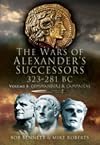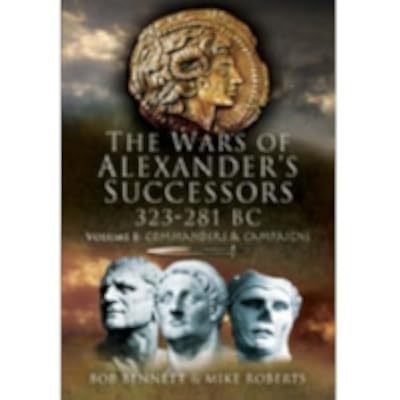
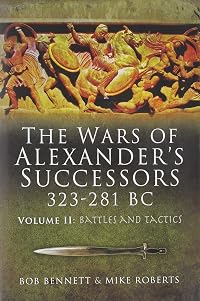
The Wars of Alexander's Successors 323 - 281 BC: Commanders and Campaigns v. 1
by Bob Bennett, Mike Roberts
The Wars of Alexander's Successors 323 - 281 BC (1)
On This Page
Description
When the dying Alexander the Great was asked to whom he bequeathed his vast empire, he supposedly replied "to the strongest". There ensued a long series of struggles between his generals and governors for control of these territories. Most of these Diadochi (Successors) were consummate professionals who had learned the art of war under Alexander or even his father, Philip. Few died a peaceful death and the last survivors of this tough breed were still leading their armies against each other show more well into their seventies. Colorful characters, epic battles, treachery and subterfuge make this a period with great appeal to anyone interested in ancient history and ancient warfare in particular. The wars shaped the map from the Balkans to India for the next couple of centuries.This first volume introduces the key personalities - characters such as Antigonos "Monopthalmus" (the One-eyed) and his son 'Demetrius 'Poliorcetes' (the Besieger), Seleucus 'Nicator' ('the Victorious') and Ptolemy "Soter" ("the Saviour") - and gives a narrative of the causes and course of these wars from the death of Alexander to the Battle of Corupedium (281 BC) when the last two original Diadochi faced each other one final time. show lessTags
Recommendations

















Member Reviews
For length, geographic scope, complexity and spectacular changes of fortune, the wars that followed the sudden death of Alexander the Great were among the most remarkable in Western history. Over forty years of fighting passed before the conqueror's vast Empire settled into the three great kingdoms that dominated the Middle East until the rise of Parthia on one side and Rome on the other. Sadly, however, historians can recover only the outline of this epic from the patchy survivals. Had fate been kind, we would be able to read the first hand account of Hieronymus of Cardia, the memoirs of Ptolemy I Soter of Egypt and Pyrrhus of Epirus, and the distillation of their works and others by the acute later historian Arrian. Of those four show more sources, the first is extant in an imperfect condensation, the last in a few hundred word summary, and the middle two not at all. To read every bit of evidence pertaining to the military activities of the period is the work of a leisurely day. It's therefore understandable that, while hundreds of books have been written about Alexander, his successors receive limited attention in the academy and almost none in popular writing.
Bob Bennett and Mike Roberts deserve a great deal of credit for trying to fill this gap by producing a coherent narrative for the general reader. True, they are not classical scholars, as one learns from a puzzling thank you to one author's former Latin teacher for "translat[ing] the appropriate fragments from Polynaeus [sic] which was the one key source we could not find in translation". We'll assume that the gentleman was conversant in Greek as well as Latin, for Polyaenus wrote in the former language. What I don't understand is how the authors, who seem otherwise to have been quite diligent in tracking down obscure materials, overlooked Shepherd's old but serviceable version, which was reprinted as recently as 1974.
Falling firmly into the genre of popular history, the book fits the fragments of evidence together into a plausible story, with little indication of how much is solidly grounded in the sources, how much is disputed and how much is sheer speculation. The reader should not believe that we really know what the principal actors thought or felt at any particular moment. Nonetheless, while the authors guess at the whys and wherefores, they seem generally reliable about what actually occurred. I can't criticize them for trying to fill in the interstices; without that effort, the book would be of interest only to specialists (no, not even to them, for they can read Diodorus Siculus, Plutarch, Polyaenus et al. for themselves).
Taking into account what the authors wished to accomplish, their work covers the ground thoroughly and is as clear as any account of such a tangled skein of events can be.There are a few weaknesses: Only a single map, showing the entire Hellenistic world in almost no detail, is provided; there is little discussion of how the wars were fought (perhaps a subject reserved for the promised companion volume); on occasion, people and incidents are introduced without enough explanation for readers who don't know about them already (the casual references to the Harpalus affair being a good example).
These relatively minor cavils do not overshadow the book's considerable merits. It is the most readable and useful account now available for the military history of the Diadochoi. If it is superseded any time soon, I shall be very surprised. show less
Bob Bennett and Mike Roberts deserve a great deal of credit for trying to fill this gap by producing a coherent narrative for the general reader. True, they are not classical scholars, as one learns from a puzzling thank you to one author's former Latin teacher for "translat[ing] the appropriate fragments from Polynaeus [sic] which was the one key source we could not find in translation". We'll assume that the gentleman was conversant in Greek as well as Latin, for Polyaenus wrote in the former language. What I don't understand is how the authors, who seem otherwise to have been quite diligent in tracking down obscure materials, overlooked Shepherd's old but serviceable version, which was reprinted as recently as 1974.
Falling firmly into the genre of popular history, the book fits the fragments of evidence together into a plausible story, with little indication of how much is solidly grounded in the sources, how much is disputed and how much is sheer speculation. The reader should not believe that we really know what the principal actors thought or felt at any particular moment. Nonetheless, while the authors guess at the whys and wherefores, they seem generally reliable about what actually occurred. I can't criticize them for trying to fill in the interstices; without that effort, the book would be of interest only to specialists (no, not even to them, for they can read Diodorus Siculus, Plutarch, Polyaenus et al. for themselves).
Taking into account what the authors wished to accomplish, their work covers the ground thoroughly and is as clear as any account of such a tangled skein of events can be.There are a few weaknesses: Only a single map, showing the entire Hellenistic world in almost no detail, is provided; there is little discussion of how the wars were fought (perhaps a subject reserved for the promised companion volume); on occasion, people and incidents are introduced without enough explanation for readers who don't know about them already (the casual references to the Harpalus affair being a good example).
These relatively minor cavils do not overshadow the book's considerable merits. It is the most readable and useful account now available for the military history of the Diadochoi. If it is superseded any time soon, I shall be very surprised. show less
Very useful book that fills a significant gap in the market - an accessible history of the Successors. It has its faults though. There is only one map in the whole book; the book could have benefited from one map per chapter. Maybe the authors saved the graphics budget for the second book in the series - battles. The other problem is that the history of this period is filled with long Greek and Macedonian names. Confusion is added because the players also have nicknames - in Greek and English - and are sometimes referred to by their homeland too - 'the Carian'. This book needed a cast of characters.
But I am very glad I have the book.
But I am very glad I have the book.
Ratings
Members
- Recently Added By
Author Information
3 Works 95 Members
7 Works 160 Members
Series

Classifications
- Genres
- History, Nonfiction, General Nonfiction, Biography & Memoir
- DDC/MDS
- 938.108 — History & geography History of ancient world (to ca. 499) Greece to 323 Macedonia
- LCC
- DF235.4 .B47 — History of Europe, Asia, Africa and Oceania Greece History of Greece History By period Hellenistic period, 323-146.B.C.
- BISAC
Statistics
- Members
- 51
- Popularity
- 592,174
- Reviews
- 2
- Rating
- (3.90)
- Languages
- English
- Media
- Paper, Ebook
- ISBNs
- 4
- ASINs
- 3