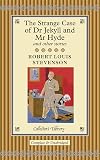
Dr. Jekyll and Mr. Hyde and Other Stories [Collector's Library]
by Robert Louis Stevenson
On This Page
Description
.0000000000The Strange Case of Dr Jekyll and Mr Hyde is a masterpiece of Victorian literature and one of the most potent and enduring of modern myths. Why has Dr Jekyll begun to associate with the ugly and violent Mr Hyde? When Jekyll's friend Utterson tries to solve this mystery he uncovers a horrific story of murder and suffering which leads eventually to the terrible revelation of Mr Hyde's true identity. Also in this volume are three other memorable stories: The Body Snatchers, Markheim show more and Olalla.With an Afterword by Peter Harness. show lessTags
Recommendations












Member Reviews
As I'm going to see the play Jekyll & Hyde this weekend, I felt compelled to reread the book. The first thing I was struck by was the size of the novel. I remembered it being short, but I didn't realize just how short it is. The edition I'm reading has less than a hundred pages for Jekyll & Hyde and then takes another hundred pages to present 3 of Stevenson's short stories and a brief editorial note.
Despite its short size, the writing is dense in portions. Steeped in heavy Victorian style, Stevenson's writing is thick with vivid descriptions often with fifty-cent (or more) words to stir the literary mind. The writing is also very clearly a "Gothic" novel in genre. It came during the Victorian revival of the Gothic at the end of the 19th show more century rather than during the heyday of the late 18th century. Core gothic writing often involved aggrandized locations in creepy disrepair such as crumbling castles or manors. There was often the idea of the supernatural either in terms of ghosts and spirits or the taboo of the occult, witchcraft and even the presence of the devil himself.
Stevenson is using a lot of the themes from the Gothic tradition while also keeping things at a high enough level to allow the "terror" to exist primarily within the reader both while reading and, perhaps worse still, after reading as the reader explore his or her own mind.
In our modern day, it's hard to approach Jekyll & Hyde without some knowledge of the tale. As such, a large sense of the suspense and mystery is likely lost on modern day readers. I'll try not to put any explicit spoilers here in case a truly fresh reader is out there, but let's just say that the ending wasn't a terrific surprise to me. And yet, the novel was fulfilling in terms of what it set out to accomplish.
The pacing of the novel was slow and sometimes tedious. Rather than following closely alongside Dr. Jekyll and/or Mr. Hyde, the reader is aligned with Jekyll's lawyer, Mr. Utterson. Utterson is dismayed at some of the choices and behaviors of his friend, the good doctor, and so he plays "Mr. Seek" to try and uncover the mystery surrounding "Mr. Hyde."
The revelations as they come are well presented and have some shock value even with all the cultural weight already surrounding the book. One element I had forgotten which was especially striking when compared with versions of Jekyll/Hyde I've seen recently...is that Mr. Hyde is actually smaller than Dr. Jekyll.
That concept is a small nuance that points this book out as a creation not only for enjoyment of a suspenseful and creepy story...but also as a platform for exploring the duality of human nature and our propensity to feel guilty for the evil within us while at the same time being intrigued by it. My interpretation of Hyde's small size was different from that in the book in that I viewed him as a sort of cowering and ashamed person. While potentially accurate, in hindsight it's not entirely true since he is portrayed as pure evil and hence he wouldn't likely be shrunken and cowered since his own bravado and pride cause him to be built up by the evil within him. Jekyll's explanation for his size (due to repressed evil) seems more likely, but still left something to be desired.
An interesting note I thought of and that was further explored in the editor's note, is that while Hyde is portrayed as wholly evil, Jekyll is not in fact 'wholly good.' Jekyll has the propensity for evil within him. In fact, it's that desire to do evil that causes him to undergo the experiments in the first place. So this isn't entirely a 'good versus evil' debate, but rather more of a debate that 'everyone contains evil within, it's just a matter of whether we let it out or not.'
A thought provoking read with fun themes and excellent Victorian writing. If you're looking for a great horror novel or an intense thriller, you'll likely be unsatisfied. But if you look to this book for what it is and what it was in its time, you'll likely enjoy it.
****
4 stars show less
Despite its short size, the writing is dense in portions. Steeped in heavy Victorian style, Stevenson's writing is thick with vivid descriptions often with fifty-cent (or more) words to stir the literary mind. The writing is also very clearly a "Gothic" novel in genre. It came during the Victorian revival of the Gothic at the end of the 19th show more century rather than during the heyday of the late 18th century. Core gothic writing often involved aggrandized locations in creepy disrepair such as crumbling castles or manors. There was often the idea of the supernatural either in terms of ghosts and spirits or the taboo of the occult, witchcraft and even the presence of the devil himself.
Stevenson is using a lot of the themes from the Gothic tradition while also keeping things at a high enough level to allow the "terror" to exist primarily within the reader both while reading and, perhaps worse still, after reading as the reader explore his or her own mind.
In our modern day, it's hard to approach Jekyll & Hyde without some knowledge of the tale. As such, a large sense of the suspense and mystery is likely lost on modern day readers. I'll try not to put any explicit spoilers here in case a truly fresh reader is out there, but let's just say that the ending wasn't a terrific surprise to me. And yet, the novel was fulfilling in terms of what it set out to accomplish.
The pacing of the novel was slow and sometimes tedious. Rather than following closely alongside Dr. Jekyll and/or Mr. Hyde, the reader is aligned with Jekyll's lawyer, Mr. Utterson. Utterson is dismayed at some of the choices and behaviors of his friend, the good doctor, and so he plays "Mr. Seek" to try and uncover the mystery surrounding "Mr. Hyde."
The revelations as they come are well presented and have some shock value even with all the cultural weight already surrounding the book. One element I had forgotten which was especially striking when compared with versions of Jekyll/Hyde I've seen recently...is that Mr. Hyde is actually smaller than Dr. Jekyll.
That concept is a small nuance that points this book out as a creation not only for enjoyment of a suspenseful and creepy story...but also as a platform for exploring the duality of human nature and our propensity to feel guilty for the evil within us while at the same time being intrigued by it. My interpretation of Hyde's small size was different from that in the book in that I viewed him as a sort of cowering and ashamed person. While potentially accurate, in hindsight it's not entirely true since he is portrayed as pure evil and hence he wouldn't likely be shrunken and cowered since his own bravado and pride cause him to be built up by the evil within him. Jekyll's explanation for his size (due to repressed evil) seems more likely, but still left something to be desired.
An interesting note I thought of and that was further explored in the editor's note, is that while Hyde is portrayed as wholly evil, Jekyll is not in fact 'wholly good.' Jekyll has the propensity for evil within him. In fact, it's that desire to do evil that causes him to undergo the experiments in the first place. So this isn't entirely a 'good versus evil' debate, but rather more of a debate that 'everyone contains evil within, it's just a matter of whether we let it out or not.'
A thought provoking read with fun themes and excellent Victorian writing. If you're looking for a great horror novel or an intense thriller, you'll likely be unsatisfied. But if you look to this book for what it is and what it was in its time, you'll likely enjoy it.
****
4 stars show less
Yet another modern classic I’ve just now read. But somewhere here on Goodreads is the sentence: “It’s never too late to read the classics.
Jul 25, 2025 (Edited)English (UK)
Ratings
Members
- Recently Added By
Author Information

2,801+ Works 139,356 Members
Novelist, poet, and essayist Robert Louis Stevenson was born in Edinburgh, Scotland. A sickly child, Stevenson was an invalid for part of his childhood and remained in ill health throughout his life. He began studying engineering at Edinburgh University but soon switched to law. His true inclination, however, was for writing. For several years show more after completing his studies, Stevenson traveled on the Continent, gathering ideas for his writing. His Inland Voyage (1878) and Travels with a Donkey (1878) describe some of his experiences there. A variety of essays and short stories followed, most of which were published in magazines. It was with the publication of Treasure Island in 1883, however, that Stevenson achieved wide recognition and fame. This was followed by his most successful adventure story, Kidnapped, which appeared in 1886. With stories such as Treasure Island and Kidnapped, Stevenson revived Daniel Defoe's novel of romantic adventure, adding to it psychological analysis. While these stories and others, such as David Balfour and The Master of Ballantrae (1889), are stories of adventure, they are at the same time fine studies of character. The Master of Ballantrae, in particular, is a study of evil character, and this study is taken even further in The Strange Case of Dr. Jekyll and Mr. Hyde (1886). In 1887 Stevenson and his wife, Fanny, went to the United States, first to the health spas of Saranac Lake, New York, and then on to the West Coast. From there they set out for the South Seas in 1889. Except for one trip to Sidney, Australia, Stevenson spent the remainder of his life on the island of Samoa with his devoted wife and stepson. While there he wrote The Wrecker (1892), Island Nights Entertainments (1893), and Catriona (1893), a sequel to Kidnapped. He also worked on St. Ives and The Weir of Hermiston, which many consider to be his masterpiece. He died suddenly of apoplexy, leaving both of these works unfinished. Both were published posthumously; St. Ives was completed by Sir Arthur Quiller-Couch, and The Weir of Hermiston was published unfinished. Stevenson was buried on Samoa, an island he had come to love very much. Although Stevenson's novels are perhaps more accomplished, his short stories are also vivid and memorable. All show his power of invention, his command of the macabre and the eerie, and the psychological depth of his characterization. (Bowker Author Biography) show less
Common Knowledge
- Canonical title
- Dr. Jekyll and Mr. Hyde and Other Stories [Collector's Library]
Classifications
Statistics
- Members
- 133
- Popularity
- 245,550
- Reviews
- 2
- Rating
- (4.03)
- Languages
- English
- Media
- Paper, Audiobook
- ISBNs
- 3
- ASINs
- 2