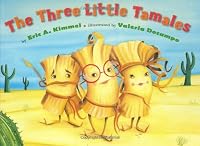
The Three Little Tamales
by Eric A. Kimmel
On This Page
Description
In this variation of "The Three Little Pigs" set in the Southwest, three little tamales escape from a restaurant before they can be eaten, and set up homes in the prairie, cornfield, and desert.Tags
Recommendations















Member Reviews
American author Eric A. Kimmel and Argentine illustrator Valeria Docampo join forces in this retelling of the traditional English tale of The Three Little Pigs, transplanted to Texas and given a Latino flavor. Three little tamales run away from the taqueria where they were made, and build houses - one of sagebrush, one of cornstalks, and one of cactus. When Señor Lobo, AKA the Big Bad Wolf, comes along, the first two tamales find their homes destroyed, and they flee to the third's. Here the wolf is thwarted, both in his attempt to blow down the house, and his effort to climb down the chimney...
The Three Little Tamales is the second title I have read from Kimmel and Docampo, following upon their Medio Pollito: A Spanish Tale, which show more relates a story from Spain. Like that other book, this paired an engaging story with brightly-colored, attention-grabbing illustrations. The story itself is somewhat watered down - the first two tamales escape, rather than being eaten by the wolf, as the pigs were in the original tale, and the wolf himself escapes the cooking pot in the end - making it more palatable, perhaps, for younger children. For my own part, I always have mixed feelings about transplanted fairy and folk-tales, which I think are somewhat different from fractured fairy-tales. In the latter, there is some central aspect of the story that is changed - it is told from the villain's perspective, in some cases - but in the former, the change is largely a cultural or geographic one, and the story remains essentially the same. That is the case here, as the English tale is simply given a Latino skin. There's nothing really wrong with this - such transplants are probably how the diverse variants of specific tale types developed, worldwide - but in a published form it feels disappointing. Folklore is such a diverse and fascinating subject, and there are so many wonderful stories that haven't yet been given a picture-book treatment. I'd far rather read an actual Chicano folktale from Texas, then a Latino version of a European one.
Leaving that aside, this was an engaging little book, and I think young children will enjoy it. Recommended to picture-book audiences that appreciate folk and fairy-tales. show less
The Three Little Tamales is the second title I have read from Kimmel and Docampo, following upon their Medio Pollito: A Spanish Tale, which show more relates a story from Spain. Like that other book, this paired an engaging story with brightly-colored, attention-grabbing illustrations. The story itself is somewhat watered down - the first two tamales escape, rather than being eaten by the wolf, as the pigs were in the original tale, and the wolf himself escapes the cooking pot in the end - making it more palatable, perhaps, for younger children. For my own part, I always have mixed feelings about transplanted fairy and folk-tales, which I think are somewhat different from fractured fairy-tales. In the latter, there is some central aspect of the story that is changed - it is told from the villain's perspective, in some cases - but in the former, the change is largely a cultural or geographic one, and the story remains essentially the same. That is the case here, as the English tale is simply given a Latino skin. There's nothing really wrong with this - such transplants are probably how the diverse variants of specific tale types developed, worldwide - but in a published form it feels disappointing. Folklore is such a diverse and fascinating subject, and there are so many wonderful stories that haven't yet been given a picture-book treatment. I'd far rather read an actual Chicano folktale from Texas, then a Latino version of a European one.
Leaving that aside, this was an engaging little book, and I think young children will enjoy it. Recommended to picture-book audiences that appreciate folk and fairy-tales. show less
This is a spin on the classic Three Little Pigs. Three little tamales run away from their shop and find new houses in the desert. Senor Lobo (the big bad wolf) comes along and blows down the first and second tamales' houses, they then run to the third. The third tamale has an idea and they try to cook Senor Lobo and then he runs away! This is a cute spin off and would be great in a fairy-tale or multicultural unit.
Written, the note says, because fans of The Runaway Tamale requested a sequel.
Yet again, Kimmel has partnered with just the right artist for the story. And yet again, the story is gracefully told (try reading it aloud even if you don't have littles) and fully satisfying. And this time the focus is on humor, which succeeds perfectly imo.
I hope Kimmel knows how beloved his works are by us.
Yet again, Kimmel has partnered with just the right artist for the story. And yet again, the story is gracefully told (try reading it aloud even if you don't have littles) and fully satisfying. And this time the focus is on humor, which succeeds perfectly imo.
I hope Kimmel knows how beloved his works are by us.
If you like The Three Little Pigs, there is a good chance you will enjoy the Three Little Tamales. Set in southwest Texas along the Mexican border, Eric Kimmel incorporates Spanish language. This would be a great start to a study on Mexico.
This is a fun story with a twist on "The Three Little Pigs". It can be more relatable for children that are of Hispanic decent. It also has Spanish words that can help children feel more comfortable reading for ELLs.
This is a charming Hispanic spin on The Three Little Pigs. Three tamales take on the role of the pigs and just like the classic, they get rid of the big bad wolf by attempting to boil him in a pot. Spanish language and Hispanic style is included. I really enjoyed reading this story and would like to read it along with the Americanized version. I would also try to find this story told through other cultures. Showing my class that there is more than one version of a fairytale or folk story will aid students in opening their minds to new ideas and broadening their horizons.
Basically the three little pigs retold with a "Mexican flavor" in the words of Eric Kimmel. I am not really sure why he chose tortillas to represent the pigs but it works. The three tamales choose different places to live and it just so happens that the last tamale chose a cactus which is protected by thorns and cannot be blown down by the wolf. There is no good explanation of why the tamales chose the houses they did, so it seems a bit random and I am not sure what the message is. My daughter liked it though and reread it herself the next day (she is five). It is fairly long for a picture book and probably good for most 5-7 year olds. This book could be used to introduce Mexican culture to young children.
Members
- Recently Added By
Author Information

142+ Works 16,850 Members
Eric Kimmel was born in Brooklyn, NY in 1946. He received a bachelor's degree in English Literature from Lafayette College. He also has a Ph.D. in Education from the University of Illinois. He was an elementary school teacher and college professor before becoming a full-time writer. He has published over fifty titles, many of which have won state show more and national awards. His titles "Hershel and the Hanukkah Goblins" won the Caldecott Honor Medal, "The Chanukkah Guest" and "Gershon's Monster" won the Sydney Taylor Picture Book Award and "Anansi and the Talking Melon" won the Utah Children's Choice Award. Kimmel travels nationally and internationally visiting schools and talking about his books and telling stories. (Bowker Author Biography) show less
All Editions
Awards and Honors
Awards
Notable Lists
Classifications
- Genre
- Children's Books
- DDC/MDS
- 398.20942 — Society, Government, and Culture Customs, etiquette & folklore Folklore & Folktales Folk literature History, geographic treatment, biography European folktales Folklore of England
- LCC
- PZ7 .K5648 .T — Language and Literature Fiction and juvenile belles lettres Fiction and juvenile belles lettres Juvenile belles lettres
- BISAC
Statistics
- Members
- 282
- Popularity
- 113,887
- Reviews
- 18
- Rating
- (3.88)
- Languages
- English
- Media
- Paper, Ebook
- ISBNs
- 4
- ASINs
- 1