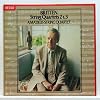
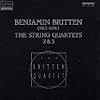
String Quartets Nos. 2 & 3 [sound recording]
by Benjamin Britten
On This Page
Tags
Members
- Recently Added By
Author Information

760+ Works 2,810 Members
Considered the most significant British composer since seventeenth-century composer Henry Purcell, Benjamin Britten excelled in composing series of songs, operas, and other types of vocal music. Pursuing a youthful interest in the piano, Britten studied at the Royal College of Music in London. His work drew the favorable attention of critics with show more the premiere of his Fantasy Quartet for Oboe and Strings in 1934. A conscientious objector in World War II; Britten composed War Requiem (1962) as a tribute to the victims of war everywhere. The composition, which incorporates parts for soloists, choruses, and orchestra, is based on the Latin text of the Mass for the Dead and verses by Wilfred Owen, a young English soldier killed in World War I. Following its first performance at Coventry Cathedral in Coventry, England, it received worldwide acclaim. After World War II, Britten devoted himself principally to composing operas. His first operatic work was Paul Bunyan (1941), a choral operetta about a lumberjack who likes to sing ballads. Britten's two most successful operas are Peter Grimes (1945) and The Turn of the Screw (1954). Other operas by Britten include Rape of Lucretia (1946), A Midsummer Night's Dream (1960), and Death in Venice (1973). Using a remarkable sensitivity to text, Britten evolved vocal melodic lines followed by orchestral interludes that punctuate and enhance the dramatic flow of his operas. Britten died in 1976. (Bowker Author Biography) show less
Common Knowledge
- Canonical title
- String Quartets Nos. 2 & 3 [sound recording]
Classifications
- Genre
- Music
Statistics
- Members
- 5
- Popularity
- 3,425,174
- Languages
- English
- ASINs
- 2