On This Page
Description
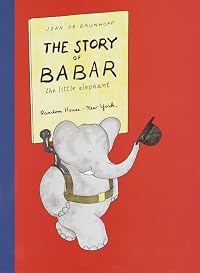
An orphaned baby elephant goes to live in the city with an old lady who gives him everything he wants, but eventually returns to the forest where he is crowned king of the elephants.Tags
Recommendations










Member Reviews
Odd little childrens book. A minor quibble, elephants live in a matriarchy, so not only is this not educational its actively uneducational :P .
I'm sure there must be some other versions of this book but the one i read had hand-written text!, and in cursive! Even i had issues deciphering a word here or there but i can only imagine the horror on a child's face if they were handed this :lol. And their growing horror if they actually managed to figure out what it says ;) .
There are several dark moments in this which are not well dealt with to say the least. Also Babar is elected King rather than inheriting it, which seems a nice change... until you find out why he in particular is elected. Part of me wants to think it's a biting satire on show more elections but i suspect not :lol.
The art's still nice though :) . show less
I'm sure there must be some other versions of this book but the one i read had hand-written text!, and in cursive! Even i had issues deciphering a word here or there but i can only imagine the horror on a child's face if they were handed this :lol. And their growing horror if they actually managed to figure out what it says ;) .
There are several dark moments in this which are not well dealt with to say the least. Also Babar is elected King rather than inheriting it, which seems a nice change... until you find out why he in particular is elected. Part of me wants to think it's a biting satire on show more elections but i suspect not :lol.
The art's still nice though :) . show less
Originally published in 1931 as Histoire de Babar, le petite éléphant, this classic children's picture-book, the first of a number of titles to chronicle the adventures of its eponymous elephantine hero, has sparked quite a bit of debate in the field of children's literature. Condemned by some as a colonialist fantasy - most notably, see Herbert R. Kohl's Should We Burn Babar?: Essays on Children's Literature and the Power of Stories - and defended by others as a comic parody of that fantasy - see Adam Gopnik's essay, Freeing the Elephants: What Babar Brought, published in The New Yorker magazine - it seems to excite quite a bit of commentary from adult readers. Whether child readers perceive these themes, or are harmed by them, is show more another question altogether.
Although not one of my great favorites as a girl, I do vaguely recall reading the Babar books when young, and while I can't remember any of the specifics regarding my reaction to them - clearly, as my friends and family can attest, they didn't turn me into an apologist for colonialism - I liked them well enough. Rereading this as an adult, I was struck by how very un-sweet this supposedly sweet tale is, and I'm not thinking of the colonialist themes alone. From Babar's mother being shot in front of his eyes, to the former elephant king dropping dead (in a shriveled green heap!) after eating a poisoned mushroom, there's plenty here that might be considered traumatic. Oddly enough, I don't remember any of that from my childhood reading either, which suggests that my younger self was focused more on the adventure as a whole, rather than on specific incidents. Or perhaps that I was just less bothered by the traumatic than I am currently?
In any case, in answer to the question of whether we should we burn Babar - no, obviously not. Nor should we ban him, or try to dissuade others from reading him. The book is certainly a little dated, and it reflects the colonial reality of its day, but I'm undecided as to whether it praises and/or defends that reality, rather than just referencing it, the way so many stories reference the zeitgeist of their time, and am uncomfortable with the notion of condemning it, when the reasons for doing so are not clear to me. I suppose if I felt more strongly about the story itself - unlike the artwork, which I find charming, I am largely indifferent to the narrative - I would find it easier to decide. show less
Although not one of my great favorites as a girl, I do vaguely recall reading the Babar books when young, and while I can't remember any of the specifics regarding my reaction to them - clearly, as my friends and family can attest, they didn't turn me into an apologist for colonialism - I liked them well enough. Rereading this as an adult, I was struck by how very un-sweet this supposedly sweet tale is, and I'm not thinking of the colonialist themes alone. From Babar's mother being shot in front of his eyes, to the former elephant king dropping dead (in a shriveled green heap!) after eating a poisoned mushroom, there's plenty here that might be considered traumatic. Oddly enough, I don't remember any of that from my childhood reading either, which suggests that my younger self was focused more on the adventure as a whole, rather than on specific incidents. Or perhaps that I was just less bothered by the traumatic than I am currently?
In any case, in answer to the question of whether we should we burn Babar - no, obviously not. Nor should we ban him, or try to dissuade others from reading him. The book is certainly a little dated, and it reflects the colonial reality of its day, but I'm undecided as to whether it praises and/or defends that reality, rather than just referencing it, the way so many stories reference the zeitgeist of their time, and am uncomfortable with the notion of condemning it, when the reasons for doing so are not clear to me. I suppose if I felt more strongly about the story itself - unlike the artwork, which I find charming, I am largely indifferent to the narrative - I would find it easier to decide. show less
THE STORY OF BABAR, written in 1933, is a classic children’s book. It is about a small elephant named Babar who runs away to the city because he gets scared when his mother is killed by a hunter. When he goes to the city, a very rich Old Lady takes him in. She buys him new clothes and lets him live at her house. In fact, “she gives him whatever she wants.” (De Brunhoff, 21) Babar takes lessons from a professor and socializes with the Old Lady and her friends. Two years go by and Babar is missing the jungle just as he sees his cousins, Arthur and Celeste running towards him in the city! Babar buys them new clothes and food from the city, but eventually their mothers come looking for Arthur and Celeste to take them back to the show more jungle. Babar goes back with them, taking them in his car. On the day they arrive, the King of the elephants has eaten a bad mushroom and died, and since Babar is now educated because he went to the city, the elephants decide to make him the new king. Babar also announces that he and Celeste are going to be married! The book ends with the two cousins being wed and heading off to their honeymoon. This is a classic book that is well known to many readers, but there are underlying messages in the story that aren’t commonly seen by young children. The ideas of colonialism are presented when Babar leaves the jungle, buys clothes, starts walking upright, gets an education, and starts acting more civilized. This is essentially what had happened in history when slaves were taken from Africa. The book also poses another problem: incest. Babar and Celeste are cousins and they marry. Although THE STORY OF BABAR shows these issues, many young children wouldn’t understand or notice them. That being said, I still don’t think I would ever use this book in an elementary classroom, as it has no educational value or message, other than it is good to be rich, civilized, and educated. show less
28 months - read this to O three times so far. I was a bit surprised by the two death scenes in the story but we still rather enjoyed it. I always like to read older classics with O because they don't beat around the bush with what we consider sensitive topics that are now taboo to write about in kids books. I think my daughter was 22 months the first time she mentioned death and actually understood the meaning.
I read this a long time ago as a kid, and personally I don't think it has aged that well. It's not a bad book, mind you, but thinking back, and looking at this book through a 21st-century perspective, it can be questionable. I'm not saying to not give this book to kids, but definitely talk with them about it. The one illustration I remember most after all these years is a dead elephant, so that should tell you how dark this can be for a kids' book.
When a hunter kills his mother, the little elephant Babar is so frightened that he runs away and ends up in a big city. He buys himself some nice clothes and accepts a nice Old Lady’s invitation to live at her house. Time passes, and then Babar has an unexpected meeting with his elephant cousins, who have run away. When their mothers come to fetch them, Babar decides to return to the forest with them, where he will become the king of the elephants.
The story and the lovely illustrations have enchanted generations of children. It doesn’t appeal so much to this adult. There doesn’t seem to be much substance to the story, although I might feel differently about it if I had fond childhood memories of reading it. Also, I don’t like show more stories where animals die. show less
The story and the lovely illustrations have enchanted generations of children. It doesn’t appeal so much to this adult. There doesn’t seem to be much substance to the story, although I might feel differently about it if I had fond childhood memories of reading it. Also, I don’t like show more stories where animals die. show less
This books made me feel physically ill. This book symbolized to me every empirical society that enslaves another with their value system and how those enslaved put on the chains willingly. It is a great book to use as a historical connections. The one that immediately came to me was the Brahmaṇ and how many of them sold their souls to their colonizers for personals gains.
Members
- Recently Added By
Lists

Favorite Childhood Books
1,651 works; 519 members
1001 Children's Books You Must Read Before You Grow Up
774 works; 101 members

Favorite Animal Fiction
359 works; 156 members

Mensa for Kids Excellence in Reading Award Program (Grades K-3)
64 works; 6 members

Sonlight Books
1,487 works; 25 members

Brightly Beaming Curriculum Books
281 works; 8 members
Ambleside Books
459 works; 18 members

Bennett's 30 Great Books Every Preschooler Should Meet
30 works; 3 members

CCE 1000 Good Books List
1,033 works; 12 members

Romalda Spalding's Writing Road To Reading
213 works; 3 members

Elephants in Books
55 works; 5 members

Favorite Books in Translation
320 works; 133 members

Favorite Picture Books
479 works; 160 members

Recommended Reading List
219 works; 1 member

Early Picture Books
467 works; 9 members

Mustich's 1000 Books to Read Before You Die: A Life Changing List
1,001 works; 19 members

Before Austen Comes Aesop
318 works; 9 members

al.vick-series
381 works; 2 members

1930s
262 works; 5 members

In or About the 1930s
198 works; 27 members

Runaways -- children's/young adult fiction
98 works; 4 members

Books Read in 2015
3,299 works; 129 members

Works Referenced in The League of Extraordinary Gentlemen
122 works; 6 members

Favorite Kids Books (chapter, middle grade)
170 works; 4 members

The Telegraph's 110 Best Books: The Perfect Library
101 works; 18 members
Talk Discussions
Past Discussions
The Story of Babar: Limited Edition in Folio Society Devotees (August 2024)
Author Information

182+ Works 8,604 Members
Jean de Brunhoff 1899 - 1937 Jean de Brunhoff (born December 9, 1899) was a French writer and illustrator known for creating the Babar books, the first of which appeared in 1931. He was the fourth and youngest child of Maurice de Brunhoff, a publisher. After the first book Histoire de Babar (The Story of Babar), six more titles followed before show more Jean de Brunhoff died of tuberculosis at the age of 37. He was buried in Père Lachaise Cemetery in Paris. Many people credit Jean's wife, Cécile de Brunhoff, as the real creator of Babar. After Jean's death, his brother Michel de Brunhoff, who was the editor of French Vogue, oversaw the publication in book form of his two last books, Babar and His Children and Babar and Father Christmas. The Babar series continues to be an international bestseller. Babar the elephant is an iconic character who has also been paid tribute by many museums worldwide. (Bowker Author Biography) show less
Some Editions
Awards and Honors
Notable Lists
Series

Work Relationships
Is contained in
Has the adaptation
Has as a study
Common Knowledge
- Canonical title
- The Story of Babar: The Little Elephant
- Original title
- L'histoire de Babar: le petit éléphant
- Alternate titles
- The Story of Babar the Little Elephant
- Original publication date
- 1931 ; 1933 (US) (US); 1934-09-27 (UK) (UK)
- People/Characters
- Babar
- Important places
- Celestville; Paris, France; France
- Related movies
- Babar (1989 | IMDb)
- First words
- In the great forest a little elephant is born.
- Last words
- (Click to show. Warning: May contain spoilers.)And now King Babar and Queen Celeste, both eager for further adventures, set out on their honeymoon in a gorgeous yellow balloon.
- Original language
- French
Classifications
Statistics
- Members
- 3,559
- Popularity
- 4,622
- Reviews
- 46
- Rating
- (3.82)
- Languages
- 9 — Dutch, English, Finnish, French, German, Italian, Russian, Spanish, Swedish
- Media
- Paper, Audiobook, Ebook
- ISBNs
- 75
- ASINs
- 27