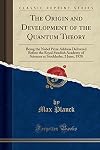
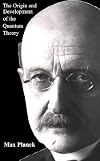
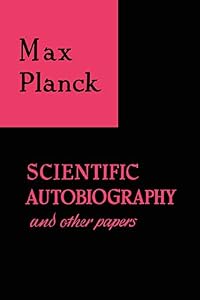
The Origin and Development of the Quantum Theory: with "A Scientific Autobiography"
by Max Planck
33 Members (3.50)
On This Page
Description
Every breath you've ever taken has vibrated with the importance of this work. In The Origin and Development of the Quantum Theory, we address the behaviour of atoms and subatomic particles and peer into the scaffolding and instruction manuals of the Gods. Nobel Prize winning physicist Max Planck, despite a reputedly steady and conservative disposition, revolutionised his field and his work on black body radiation and his particular conclusions on Quanta remain on the cutting edge of show more theoretical physics. Atoms and subatomic particles emit thermal radiation but the extent to which this is from the violet portion of the spectrum varies, in this lecture, the reader can find out why. After a life in which he had already been fighting to see an upswing in the fortunes of his beleaguered nation, he gave this lecture to an assembly of his most distinguished colleagues in 1920 in Stockholm. In these pages you can find his inspiring words about the glory of a lofty goal being undimmed by initial failures. In a moment of fantastic success, this speech illustrates the truth of his theory, rising from the ashes of the First World War with a discovery which changed the way physicists think. The lecture theatre was full of the finest minds of the age, waiting with baited breath on the edge of their seats to hear a genius hold forth on what made the Universe run. As the great man himself said 'Whatever the answer to this question, there can be no doubt that science will some day master the dilemma'. About the Publisher Forgotten Books publishes hundreds of thousands of rare and classic books. Find more at www.forgottenbooks.com This book is a reproduction of an important historical work. Forgotten Books uses state-of-the-art technology to digitally reconstruct the work, preserving the original format whilst repairing imperfections present in the aged copy. In rare cases, an imperfection in the original, such as a blemish or missing page, may be replicated in our edition. We do, however, repair the vast majority of imperfections successfully; any imperfections that remain are intentionally left to preserve the state of such historical works. show lessTags
Recommendations



















Member Reviews
Members
- Recently Added By
Lists

How to Read a Book's Recommended Reading List
309 works; 10 members

The Well-Educated Mind, Susan Wise Bauer, 2016
179 works; 3 members
Author Information

80 Works 593 Members
Max Planck, a German physicist, received his Ph.D. in physics from the University of Munich (1879) and taught at the University of Berlin from 1891 to 1928. By studying black-body radiation, he discovered that energy is not continuous, but is emitted or absorbed in fundamental, individual units called quanta. Quantum theory originated from his show more 1900 paper, representing a radical break with classical physics that even Planck could not wholly accept. For his work in quantum theory, Planck was awarded the 1918 Nobel Prize in physics. Other physicists were able to apply the quantum concept by following up on his revolutionary idea. Albert Einstein's 1905 paper, explaining the photoelectric effect, and Niels Bohr's 1913 model of the hydrogen atom were two applications of Planck's theory. Along with Einstein, Planck ranks as one of the two founders of modern physics. He was the acknowledged leader of German science in the 1930s, as president of the Kaiser Wilhelm Institute. However, he resigned this post in 1937 to protest the Nazi treatment of Jewish scientists. He remained in Germany throughout World War II. After the war the Institute was renamed the Max Planck Institute, and he again served as its president until his death. Planck's personal life contained many tragedies: death of a wife, two sons (one was killed in World War I, the other was executed in 1944 for participation in an unsuccessful conspiracy to assassinate Hitler), and two daughters (in childbirth). (Bowker Author Biography) show less
Some Editions
Classifications
- Genres
- Science & Nature, Nonfiction, General Nonfiction, History, Biography & Memoir
- DDC/MDS
- 954.035092 — History & geography History of Asia India 1785–1947 British rule 1858–1947 Control by Crown History, geographic treatment, biography Biography
- LCC
- QC174 .P8 — Science Physics Physics Atomic physics. Constitution and properties of matter
- BISAC
Statistics
- Members
- 33
- Popularity
- 855,945
- Rating
- (3.50)
- Languages
- English
- Media
- Paper, Ebook
- ISBNs
- 7
- ASINs
- 7