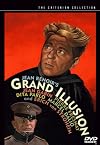
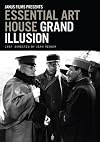
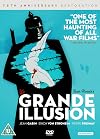
The Grand Illusion [1937 film]
by Jean Renoir (Director, Screenwriter), Charles Spaak (Screenwriter)
On This Page
Description
In this classic tale of adventure, duty and honor conflict in a German prisoner-of-war camp when an aristocratic French officer becomes friends with the commandant while cooperating with his comrades in a daring escape.Tags
Recommendations




Member Reviews
French POWs in WWI attempt escape.
A nice enough movie. It's a little slow in places but mostly entertaining. I expect it was a lot more powerful and significant when seen in the context 1930s Europe than it is in 2010s America (although the storytelling is strong enough on a literal level to hold up to time).
Concept: A
Story: A
Characters: B
Dialog: B
Pacing: C
Cinematography: C
Special effects/design: B
Acting: A
Music: B
Enjoyment: C plus
GPA: 3.0/4
A nice enough movie. It's a little slow in places but mostly entertaining. I expect it was a lot more powerful and significant when seen in the context 1930s Europe than it is in 2010s America (although the storytelling is strong enough on a literal level to hold up to time).
Concept: A
Story: A
Characters: B
Dialog: B
Pacing: C
Cinematography: C
Special effects/design: B
Acting: A
Music: B
Enjoyment: C plus
GPA: 3.0/4
A group of French soldiers, including the patrician Captain de Boeldieu and the working-class Lieutenant Maréchal, grapple with their own class differences after being captured and held in a World War I German prison camp. When the men are transferred to a high-security fortress, they must concoct a plan to escape beneath the watchful eye of aristocratic German officer von Rauffenstein, who has formed an unexpected bond with de Boeldieu.
(source: TMDb)
(source: TMDb)
Franklin Roosevelt said of it: "Everyone who believes in democracy should see this film". Mussolini banned it in Italy, and Hitler's Ministry of Propaganda banned it in Nazi Germany. The film vanished during WWII, and was thought to have been destroyed. Then it was recovered in 1946, but in an altered state. Only in 1959 the original negative could be confirmed. The Nazis hated the film because of its pacifist, anti-war, theme. The setting for the film is Germany in 1914, during WWI. Unlike other war movies, "La Grande Illusion" shows no actual combat, and the number of deaths is minimal. The film's tone is surprisingly lighthearted. Renoir conveys a sense of community among the French prisoners, despite their differences in social show more class. We see them several times sitting around a table eating, and chatting amiably. The cordiality between prisoners and their jailers is also surprising. It's not exactly a hug fest, but the predominant feeling among the men is respect for fellow officers, even if those officers are your enemy. None of the French or German officers want war; it's just their "duty", when called on. The specific ¨Grand Illusion¨ is not explained in the script, but naturally the title means that expecting a positive and prospective outcome from wars is nothing more than a mere grand illusion. show less
Jan 31, 2025Portuguese (Brazil)
Ratings
Members
- Recently Added By
Published Reviews
ThingScore 100
The war, ironically, has outmoded the military. These officers are commanding men who, in their terms, are not even soldiers; the fighting itself has become a series of base humiliations. They have lost sympathy with the world; they have lost even their self-respect. All they have left is their sense of the rules of the fool’s game — and they play by them. Von Rauffenstein’s grief at show more his slaughter of de Boeldieu is so moving and painful because von Rauffenstein knows the stupidity and waste of it. When he cuts the sprig of geranium, the only flower in the fortress, it is for the death of nobility — and his own manhood. (Von Stroheim had used the geranium in the fortress scene of Queen Kelly — but the flower wasn’t cut off, the whole picture was.)...
La Grande Illusion is a triumph of clarity and lucidity; every detail fits simply, easily, and intelligibly. There is no unnecessary camera virtuosity: the compositions seem to emerge from the material. It’s as if beauty just happens (is it necessary to state that this unobtrusive artistry is perhaps the most difficult to achieve?). The characters, the dialogue, the fortress, the farm, the landscape, all fuse into the story and the theme. The result is the greatest achievement in narrative film. It’s a little embarrassing to state this so baldly, but La Grande Illusion, like Renoir’s earlier, but very different, Partie de Campagne, is just about a perfect work (in fact, I can’t find a flaw in it). show less
La Grande Illusion is a triumph of clarity and lucidity; every detail fits simply, easily, and intelligibly. There is no unnecessary camera virtuosity: the compositions seem to emerge from the material. It’s as if beauty just happens (is it necessary to state that this unobtrusive artistry is perhaps the most difficult to achieve?). The characters, the dialogue, the fortress, the farm, the landscape, all fuse into the story and the theme. The result is the greatest achievement in narrative film. It’s a little embarrassing to state this so baldly, but La Grande Illusion, like Renoir’s earlier, but very different, Partie de Campagne, is just about a perfect work (in fact, I can’t find a flaw in it). show less
added by SnootyBaronet
Lists

Movies wishlist
134 works; 2 members
Author Information

All Editions
Awards and Honors
Notable Lists
Series
Belongs to Publisher Series
Work Relationships
Common Knowledge
- Canonical title
- The Grand Illusion [1937 film]
- Original title
- La grande illusion
- Original publication date
- 1937-06-09
- Quotations
- For me it's simple. A golf course is for golf. A tennis court is for tennis. A prison camp is for escaping.
- Disambiguation notice
- Film
Classifications
Statistics
- Members
- 160
- Popularity
- 205,469
- Reviews
- 6
- Rating
- (4.24)
- Languages
- 5 — English, French, German, Korean, Spanish
- ISBNs
- 16
- UPCs
- 4
- ASINs
- 20