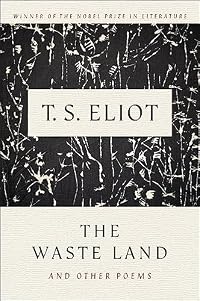
The Waste Land and Other Poems
by T. S. Eliot
On This Page
Description
Loosely based on the Arthurian legend of the Holy Grail and the Fisher King, "The Waste Land", which first appeared in 1922, is a landmark work of Modernist poetry. Containing hundreds of allusions and quotations from other works, The Waste Land is marked by a disjointed structure which moves between voices and imagery without a clear delineation for the reader, a hallmark of Modernist literature. Arguably Eliot's most famous work, the theme of the poem, as the title would suggest, is show more ultimately a dire one, of disillusionment, despair, and death. Also included in this collection is "The Love Song of J. Alfred Prufrock" a work which preceded The Waste Land having been first published in 1910. Regarded as the beginning of Eliot's influential period, "Prufrock" was considered idiosyncratic at first but with time has been recognized as an important shift in poetry from the Romantic era to the Modernist one. "The Wasteland and Other Poems", which includes an additional twenty-three poems, collects some of the most pivotal works of the Modernist literary movement, which would establish Eliot as one of the most important poets of the 20th century. show lessTags
Recommendations







Member Recommendations

Member Reviews
The Waste Land — T. S. Eliot ⭐⭐⭐⭐⭐
I read The Waste Land last year and somehow forgot to log it on Goodreads, which feels mildly illegal given the amount of effort involved. This is not a poem you “just read.” I followed a YouTube lecture series—about four hours total—and honestly, that felt like the correct unit of measurement.
Did I understand everything? Absolutely not. But I’d say I got a solid 80%, which is more than enough to appreciate the sheer craft and audacity of the poem. The fragmentation, the shifting voices, the constant cultural and literary references—it’s disorienting in a way that feels intentional rather than annoying.
My copy is absolutely covered in annotations, to the point where the poem show more itself looks like it’s been through World War I. Which somehow feels appropriate, since this is a work haunted by the aftermath of war, loss, and cultural exhaustion, with every line carrying the sense of something broken and searching for meaning.
At its core, The Waste Land wrestles with the spiritual decay of modern society (yes, yes—very cheerful), but what makes it unforgettable is how Eliot does it: collage-like, multilingual, myth-heavy, and strangely musical. It’s less a poem you decode once and more an experience you survive and then keep thinking about for weeks afterward.
Difficult, demanding, and completely worth the effort. A uniquely modern reading experience—confusing in the best possible way. show less
I read The Waste Land last year and somehow forgot to log it on Goodreads, which feels mildly illegal given the amount of effort involved. This is not a poem you “just read.” I followed a YouTube lecture series—about four hours total—and honestly, that felt like the correct unit of measurement.
Did I understand everything? Absolutely not. But I’d say I got a solid 80%, which is more than enough to appreciate the sheer craft and audacity of the poem. The fragmentation, the shifting voices, the constant cultural and literary references—it’s disorienting in a way that feels intentional rather than annoying.
My copy is absolutely covered in annotations, to the point where the poem show more itself looks like it’s been through World War I. Which somehow feels appropriate, since this is a work haunted by the aftermath of war, loss, and cultural exhaustion, with every line carrying the sense of something broken and searching for meaning.
At its core, The Waste Land wrestles with the spiritual decay of modern society (yes, yes—very cheerful), but what makes it unforgettable is how Eliot does it: collage-like, multilingual, myth-heavy, and strangely musical. It’s less a poem you decode once and more an experience you survive and then keep thinking about for weeks afterward.
Difficult, demanding, and completely worth the effort. A uniquely modern reading experience—confusing in the best possible way. show less
This is a short collection of poems of ten poems by TS Eliot, including his longer works "The Wasteland", "The Love song of J. Alfred Prufrock", and "Ash Wednesday", as well as some shorter works.
Some of these (such as Prufrock and Landscapes) are transparent enough on the first read through. However "The Wasteland" requires a lot more work – the allusions, the references, the symbolism is all more dense and consistently obscure than that found in pretty much all poetry written before this. This is not to say however that we can't understand its general meaning quite well without having read it a dozen times, read a commentary on it, and listened to a couple of lectures (though you will probably want to), as its tone and imagery show more convey enough of its meaning without us getting every reference and allusion. And this is what makes it work as poetry – that it communicates exactly what it is trying to communicate without the reader completely and consciously understanding all of its content straight away – because it works on more than one level.
So what is the Wasteland about? It's about post-war London – about how horrible it is, like Dante's hell. It's about a fractured Europe which is compared to the body of Osiris chopped up and scattered around. It's about decay, the grubbiness and shabiness of things, and the parched wasteland of society waiting for renewal following World War I. The symbolism is variously religious, mythological, literary, operatic, contemporary, and exotic.
Aside from the depressing content of the Wasteland, its deliberate obscurity means that it lacks much of the immediate aesthetic appeal that entices many people to much poetry. However this is what Modernism is about – creating something new that doesn't always rely on the aesthetic appeal of orderly verse, attractive imagery, fine sentiment, and clarity – in the same way that modernism in painting broke the traditional rules of visual aesthetics. Eliot didn't invent modernism in poetry, but he does exemplify it. He uses different voices, mixes up symbolism and references from different cultures, with different meters, styles, themes and tones. This gives the poetry a cultural richness and a lot to get out of it, but this requires more of the reader, and for this reason Eliot won't appeal to many readers. show less
Some of these (such as Prufrock and Landscapes) are transparent enough on the first read through. However "The Wasteland" requires a lot more work – the allusions, the references, the symbolism is all more dense and consistently obscure than that found in pretty much all poetry written before this. This is not to say however that we can't understand its general meaning quite well without having read it a dozen times, read a commentary on it, and listened to a couple of lectures (though you will probably want to), as its tone and imagery show more convey enough of its meaning without us getting every reference and allusion. And this is what makes it work as poetry – that it communicates exactly what it is trying to communicate without the reader completely and consciously understanding all of its content straight away – because it works on more than one level.
So what is the Wasteland about? It's about post-war London – about how horrible it is, like Dante's hell. It's about a fractured Europe which is compared to the body of Osiris chopped up and scattered around. It's about decay, the grubbiness and shabiness of things, and the parched wasteland of society waiting for renewal following World War I. The symbolism is variously religious, mythological, literary, operatic, contemporary, and exotic.
Aside from the depressing content of the Wasteland, its deliberate obscurity means that it lacks much of the immediate aesthetic appeal that entices many people to much poetry. However this is what Modernism is about – creating something new that doesn't always rely on the aesthetic appeal of orderly verse, attractive imagery, fine sentiment, and clarity – in the same way that modernism in painting broke the traditional rules of visual aesthetics. Eliot didn't invent modernism in poetry, but he does exemplify it. He uses different voices, mixes up symbolism and references from different cultures, with different meters, styles, themes and tones. This gives the poetry a cultural richness and a lot to get out of it, but this requires more of the reader, and for this reason Eliot won't appeal to many readers. show less
The Waste Land refers to _____.
Published in 1921, just 2 years after the unreconciled death of his deeply Unitarian father, an emotional breakdown of both TS and his wife Vivian, and ending a writer's block that had silenced him for years, this poem is an assemblage of vignettes from Eliot's life in London. The poem is intense in the sense of psychologial nuance and ironic elegance. He fuses fairly diverse images into a skilfully rhythmic whole. While similar to such academic set pieces as Milton’s "Lycidas," The Waste Land is also like jazz -- syncopated, sometimes running parallel arpeggios of ideas, and in its post-War context, essentially iconoclastic. Eliot seems to indulge a horror of life, while immersing in it, so you come show more away with a sharp clearly cut sense of disillusionment. The "symbolist" influence of Arthur Symons, and even the daring of the Italian futurist Tamaso Marinetti, are projected. It intrudes.
My own response is that this is a kind of reaction to his bad marriage; making "art" out of those mad and mad-making conversations. I recall that Virginia Wolf, not unkindly, described TS as a poet who lived to scratch, and Vivian was his itch. show less
Published in 1921, just 2 years after the unreconciled death of his deeply Unitarian father, an emotional breakdown of both TS and his wife Vivian, and ending a writer's block that had silenced him for years, this poem is an assemblage of vignettes from Eliot's life in London. The poem is intense in the sense of psychologial nuance and ironic elegance. He fuses fairly diverse images into a skilfully rhythmic whole. While similar to such academic set pieces as Milton’s "Lycidas," The Waste Land is also like jazz -- syncopated, sometimes running parallel arpeggios of ideas, and in its post-War context, essentially iconoclastic. Eliot seems to indulge a horror of life, while immersing in it, so you come show more away with a sharp clearly cut sense of disillusionment. The "symbolist" influence of Arthur Symons, and even the daring of the Italian futurist Tamaso Marinetti, are projected. It intrudes.
My own response is that this is a kind of reaction to his bad marriage; making "art" out of those mad and mad-making conversations. I recall that Virginia Wolf, not unkindly, described TS as a poet who lived to scratch, and Vivian was his itch. show less
My understanding is that The Waste Land (1922) is a landmark in poetry and a very influential collection. Eliot assembled it in a Swiss sanitarium while recuperating from a nervous breakdown; among other things his marriage was deeply unhappy and beset by his wife’s many sicknesses.
Eliot writes like a jazz musician plays, coming at the reader from many lyrical angles and from a wealth of cultural, philosophical, and religious references. Unfortunately, I’m not a huge jazz fan, and I had the same thing feeling reading this as I do listening to jazz. I desperately wanted to like it, but was unable to fully appreciate it. There are some flashes of brilliance and this is undoubtedly writing that will elicit a wide variety of responses.
show more
From “The Love Song of J. Alfred Prufrock”, my favorite from the collection:
…
Do I dare
Disturb the universe?
In a minute there is time
For decisions and revisions which a minute will reverse.
For I have known them all already, known them all: -
Have known the evenings, mornings, afternoons,
I have measured out my life with coffee spoons;
I know the voices dying with a dying fall
Beneath the music from a farther room.
…
Should I, after tea and cakes and ices,
Have the strength to force the moment to its crisis?
But though I have wept and fasted, wept and prayed,
Though I have seen my head [grown slightly bald] brought in upon a platter,
I am no prophet – and here’s no great matter;
I have seen the moment of my greatness flicker,
And I have seen the eternal Footman hold my coat, and snicker,
And in short, I was afraid.
…
It is impossible to say just what I mean!
But as if a magic lantern threw the nerves in patterns on a screen:
Would it have been worth while
If one, settling a pillow or throwing off a shawl,
And turning toward the window, should say:
“That is not it at all,
That is not what I meant, at all.”
…
I grow old … I grow old …
I shall wear the bottoms of my trousers rolled.
…
From Preludes:
…
I am moved by fancies that are curled
Around these images, and cling:
The notion of some infinitely gentle
Infinitely suffering thing.
…
From The Waste Land (III. The Fire Sermon)
…
The time is now propitious, as he guesses,
The meal is ended, she is bored and tired,
Endeavours to engage her in caresses
Which still are unreproved, if undesired.
Flushed and decided, he assaults at once;
Exploring hands encounter no defence;
His vanity requires no response,
And makes a welcome of indifference.
…
From The Hollow Men:
…
This is the way the world ends
This is the way the world ends
This is the way the world ends
Not with a bang but with a whimper. show less
Eliot writes like a jazz musician plays, coming at the reader from many lyrical angles and from a wealth of cultural, philosophical, and religious references. Unfortunately, I’m not a huge jazz fan, and I had the same thing feeling reading this as I do listening to jazz. I desperately wanted to like it, but was unable to fully appreciate it. There are some flashes of brilliance and this is undoubtedly writing that will elicit a wide variety of responses.
show more
From “The Love Song of J. Alfred Prufrock”, my favorite from the collection:
…
Do I dare
Disturb the universe?
In a minute there is time
For decisions and revisions which a minute will reverse.
For I have known them all already, known them all: -
Have known the evenings, mornings, afternoons,
I have measured out my life with coffee spoons;
I know the voices dying with a dying fall
Beneath the music from a farther room.
…
Should I, after tea and cakes and ices,
Have the strength to force the moment to its crisis?
But though I have wept and fasted, wept and prayed,
Though I have seen my head [grown slightly bald] brought in upon a platter,
I am no prophet – and here’s no great matter;
I have seen the moment of my greatness flicker,
And I have seen the eternal Footman hold my coat, and snicker,
And in short, I was afraid.
…
It is impossible to say just what I mean!
But as if a magic lantern threw the nerves in patterns on a screen:
Would it have been worth while
If one, settling a pillow or throwing off a shawl,
And turning toward the window, should say:
“That is not it at all,
That is not what I meant, at all.”
…
I grow old … I grow old …
I shall wear the bottoms of my trousers rolled.
…
From Preludes:
…
I am moved by fancies that are curled
Around these images, and cling:
The notion of some infinitely gentle
Infinitely suffering thing.
…
From The Waste Land (III. The Fire Sermon)
…
The time is now propitious, as he guesses,
The meal is ended, she is bored and tired,
Endeavours to engage her in caresses
Which still are unreproved, if undesired.
Flushed and decided, he assaults at once;
Exploring hands encounter no defence;
His vanity requires no response,
And makes a welcome of indifference.
…
From The Hollow Men:
…
This is the way the world ends
This is the way the world ends
This is the way the world ends
Not with a bang but with a whimper. show less
Apparently, 100 years ago Eliot's stuff was rocking people's socks off. Alas, I am a 21st century simpleton, and cannot read German, Latin, or French. I imagine that a passionate teacher in a college class could guide me through The Waste Land, could purge my ignorance of Eliot's references, so that they would leap from the page. But here, in the harsh light of reality, I'll toss this volume into the topmost recesses of my library and forget about it.
my mind is to puny to properly comprehend all that is going on in these poems, yet it was fun to try. i will definitely read these again, and it will probably take me years before i actually begin to unpack anything within these masterful works of art. in the mean time, i give you perhaps the only quote i understood from these poems:
"Thinking of the key, each confirms a prison"
i can only hope to one day be given the brain space to properly understand a fraction of these poems.
"Thinking of the key, each confirms a prison"
i can only hope to one day be given the brain space to properly understand a fraction of these poems.
I don't really know what to say about this except "read it." How do I review The Waste Land without writing a lengthy academic paper (which, btw, I have done)? It's a gorgeous poem, full of imagery and symbolism. Read it, then read it again.
Members
- Recently Added By
Lists

Classics you know you should have read but probably haven't
421 works; 407 members

Poetry Collections
79 works; 6 members

20th Century Literature
1,161 works; 55 members

The Telegraph's 110 Best Books: The Perfect Library
101 works; 17 members

Books Read in 2013
1,629 works; 51 members

Poetry Corner
187 works; 15 members

Literary Works Read in College
316 works; 15 members

Existentialism
90 works; 11 members

American Lit for Eng 11 Research Project
368 works; 6 members

Five star books
1,755 works; 108 members

Books I want to read
25 works; 3 members

Modernism
140 works; 8 members
Nobel Price Winners
222 works; 20 members

Best Late Night Poetry
11 works; 2 members

Blackwell's Five Foot Bookshelf
72 works; 4 members

Books talked about in Pamela Dean's Tam Lin
74 works; 1 member
Author Information

T. S. Eliot is considered by many to be a literary genius and one of the most influential men of letters during the half-century after World War I. He was born on September 26, 1888, in St. Louis, Missouri. Eliot attended Harvard University, with time abroad pursuing graduate studies at the Sorbonne, Marburg, and Oxford. The outbreak of World War show more I prevented his return to the United States, and, persuaded by Ezra Pound to remain in England, he decided to settle there permanently. He published his influential early criticism, much of it written as occasional pieces for literary periodicals. He developed such doctrines as the "dissociation of sensibility" and the "objective correlative" and elaborated his views on wit and on the relation of tradition to the individual talent. Eliot by this time had left his early, derivative verse far behind and had begun to publish avant-garde poetry (including "The Love Song of J. Alfred Prufrock" (1915), which exploited fresh rhythms, abrupt juxtapositions, contemporary subject matter, and witty allusion. This period of creativity also resulted in another collection of verse (including "Gerontian") and culminated in The Waste Land, a masterpiece published in 1922 and produced partly during a period of psychological breakdown while married to his wife, Vivienne Haigh-Wood Eliot. In 1922, Eliot became a director of the Faber & Faber publishing house, and in 1927 he became a British citizen and joined the Church of England. Thereafter, his career underwent a change. With the publication of Ash Wednesday in 1930, his poetry became more overtly Christian. As editor of the influential literary magazine The Criterion, he turned his hand to social as well as literary criticism, with an increasingly conservative orientation. His religious poetry culminated in Four Quartets, published individually from 1936 onward and collectively in 1943. This work is often considered to be his greatest poetic achievement. Eliot also wrote poetry in a much lighter vein, such as Old Possum's Book of Practical Cats (1939), a collection that was used during the early 1980s as the basis for the musical, Cats. In addition to his contributions in poetry and criticism, Eliot is the pivotal verse dramatist of this century. He followed the lead of William Butler Yeats in attempting to revive metrical language in the theater. But, unlike Yeats, Eliot wanted a dramatic verse that would be self-effacing, capable of expressing the most prosaic passages in a play, and an insistent, undetected presence capable of elevating itself at a moment's notice. His progression from the pageant The Rock (1934) and Murder in the Cathedral (1935), written for the Canterbury Festival, through The Family Reunion (1939) and The Cocktail Party (1949), a West End hit, was thus a matter of neutralizing obvious poetic effects and bringing prose passages into the flow of verse. Recent critics have seen Eliot as a divided figure, covertly attracted to the very elements (romanticism, personality, heresy) he overtly condemned. His early attacks on romantic poets, for example, often reveal him as a romantic against the grain. The same divisions carry over into his verse, where violence struggles against restraint, emotion against order, and imagination against ironic detachment. This Eliot is more human and more attractive to contemporary taste. During his lifetime, Eliot received many honors and awards, including the Nobel Prize for literature in 1948. (Bowker Author Biography) show less
Some Editions
Awards and Honors
Notable Lists
Series
Belongs to Publisher Series
Work Relationships
Contains
Common Knowledge
- Original title
- The Lifted Veil
- Original publication date
- 1922
- People/Characters
- Madame Sosostris
- First words
- Let us go then, you and I, / When the evening is spread out against the sky / Like a patient etherised upon a table; / Let us go, through certain half-deserted streets, / The muttering retreats / Of restless nights in one-nig... (show all)ht cheap hotels / And sawdust restaurants with oyster-shells; / Streets that follow like a tedious argument / Of insidious intent / To lead you to an overwhelming question... / Oh, do not ask, 'What is is?' / Let us go and make our visit.
- Last words
- (Click to show. Warning: May contain spoilers.)O Light Invisible, we give Thee thanks for Thy great / glory!
- Original language
- English
- Disambiguation notice
- This work (Harcourt) contains the following selected poems:
- The Love Song of J. Alfred Prufrock
- Preludes
- Gerontion
- Sweeney Among the Nightingales
- The Waste Land
- Ash-Wednesday
- Journey of the... (show all) Magi
- Marina
- Landscapes (I. New Hampshire; II Virginia; III Usk)
- Two Choruses from 'The Rock'
Please keep it separate from works with different selections and contents.
Classifications
Statistics
- Members
- 5,061
- Popularity
- 2,728
- Reviews
- 37
- Rating
- (4.15)
- Languages
- 8 — Chinese, Danish, English, French, German, Greek, Norwegian (Bokmål), Spanish
- Media
- Paper, Audiobook, Ebook
- ISBNs
- 44
- UPCs
- 2
- ASINs
- 50