On This Page
Description
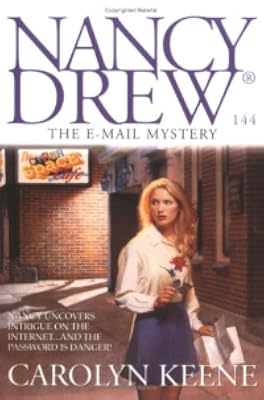
Someone is using email to sabotage Nancy's father's law firm--and Nancy's searching cyberspace to put an end to this web of greed, deception, and betrayal.Tags
Recommendations

































Member Reviews
A quick read, but a painfully dull mystery. Published in 1998, the rise of the Internet and the start of e-mailing figure very heavy in this book. I was surprised that Bess is brought in by Nancy to help tackle the case as an "Internet expert" considering Bess was always more interested in chasing boys, eating food, and going shopping. This change in her hobbies definitely felt like an outlier compared to other ND books.
Longtime Nancy Drew fans looking to see how Ms. Drew fares with modern technology will be disappointed to read how stiff and dated her adventures come across in The E-Mail Mystery. Although the book is barely fifteen, the slow and careful attempts to explain the Internet seemed to have aged at three times the pace. Granted, some credit is due to author Carolyn Keene, who published this story when mass home use of internet was still relatively new and certainly thought that she would be introducing many of these topics to her readers. She takes time to cover considerable ground regarding internet safety, reminding the readers several times to protect phone numbers, addresses, passwords, etc from strangers. Unfortunately, time has flown show more since Nancy uncovered The E-Mail Mystery’s culprit, and today’s audience is far too savvy and impatient to wait for Nancy to discover what is clear to them within the first 30 pages of the story.
Much of The E-Mail Mystery takes place in Nancy’s father’s law office, where she is helping him with filing while she investigates a slew of her father’s clients that had hurriedly decided to settle their cases. Sadly, even if the technological aspects of the story were up to date, the rhythm would still feel bland and the intrigue would largely remain missing. The premise reaches remarkable heights of silliness when the story’s villain makes a cliched proclamation akin to, “...But you’ll never catch me!” before, sorry to say, getting caught. show less
Much of The E-Mail Mystery takes place in Nancy’s father’s law office, where she is helping him with filing while she investigates a slew of her father’s clients that had hurriedly decided to settle their cases. Sadly, even if the technological aspects of the story were up to date, the rhythm would still feel bland and the intrigue would largely remain missing. The premise reaches remarkable heights of silliness when the story’s villain makes a cliched proclamation akin to, “...But you’ll never catch me!” before, sorry to say, getting caught. show less
Ratings
Members
- Recently Added By
Lists

The Stratemeyer Syndicate
605 works; 1 member
Author Information

933+ Works 203,429 Members
Carolyn Keene was the pseudonym that Mildred Wirt Benson and Walter Karig used to write Nancy Drew books. The idea of Nancy Drew came from Edward Stratemeyer in 1929. He also had other series, that included the Hardy Boys, but he died in 1930 before the Nancy Drew series became famous. His daughters, Harriet and Edna, inherited his company and show more maintained Nancy Drew having Mildred Wirt Benson, the original Carolyn Keene, as the principal ghostwriter. During the Depression, they asked Benson to take a pay cut and she refused, which is when Karig wrote the books. Karig's Nancy Drew books were Nancy's Mysterious Letter, The Sign of the Twisted Candles, and Password to Larkspur Lane. He was fired from writing more books because of his refusal to honor the request that he keep his work as Carolyn Keene a secret. He allowed the Library of Congress to learn of his authorship and his name appeared on their catalog cards. Afterwards, they rehired Benson and she wrote until her last Nancy Drew book (#30) was written in 1953, Clue of the Velvet Mask. Harriet and Edna Stratemeyer also contributed to the Nancy Drew series. Edna wrote plot outlines for several of the early books and Harriet, who claimed to be the sole author, had actually outlined and edited nearly all the volumes written by Benson. The Stratemeyer Syndicate had begun to make its writers sign contracts that prohibited them from claiming any credit for their works, but Benson never denied her writing books for the series. After Harriet's death in 1982, Simon and Schuster became the owners of the Stratemeyer Syndicate properties and in 1994, publicly recognized Benson for her work at a Nancy Drew conference at her alma mater, the University of Iowa. Now, Nancy Drew has several ghostwriters and artists that have contributed to her more recent incarnations. (Bowker Author Biography) show less
Series

Common Knowledge
- Canonical title
- The E-Mail Mystery
- Original title
- The e-mail mystery
- People/Characters
- Nancy Drew
Classifications
Statistics
- Members
- 197
- Popularity
- 166,922
- Reviews
- 2
- Rating
- (3.33)
- Languages
- English, Swedish
- Media
- Paper, Ebook
- ISBNs
- 12
- UPCs
- 2
- ASINs
- 2