
On This Page
Description
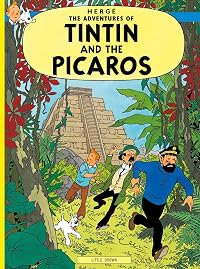
Tintin, Captain Haddock, and Professor Calculus help the deposed General Alcazar and his guerrilla band of Picaros defeat the tyrannical General Tapioca.Tags
Recommendations












Member Reviews
The final Tintin story (not counting the incomplete Alph-Art) goes out on something of a anti-climax. It's not a bad story in the Tintin canon (though not one of the best, either), but somehow I wanted something more from it. That said, I suppose the lack of a crescendo means that Tintin still lives in the mind, unchanging and ready for new adventures that I'll never see. Hmmm - that thought is actually quite comforting.
The most striking and thought provoking panel in the book (I think this might be a spoiler if you haven't read it yet!) is the penultimate one. Following Alcazar's bloodless coup, Hergé leaves us with the image of Tintin's plane whisking him back to European comfort, whilst below two armed, military police officers show more swagger past a shanty town. Over the rubbish heap bordering the slums, two emaciated faces stare hopelessly out, next to a sign reading "Viva Alcazar". Has Tintin's involvement in South American revolutionary politics really made any difference to the people of San Theodoros? It appears not.
I've enjoyed reading the Tintin books, though I'm not entirely sure why the adoration of the stories has arisen. Maybe I came to them too late in life and would have found them more compelling as a child. Now that I've completed them in order, I can go back and dip in where I will and see how they stand up to re-reading. show less
The most striking and thought provoking panel in the book (I think this might be a spoiler if you haven't read it yet!) is the penultimate one. Following Alcazar's bloodless coup, Hergé leaves us with the image of Tintin's plane whisking him back to European comfort, whilst below two armed, military police officers show more swagger past a shanty town. Over the rubbish heap bordering the slums, two emaciated faces stare hopelessly out, next to a sign reading "Viva Alcazar". Has Tintin's involvement in South American revolutionary politics really made any difference to the people of San Theodoros? It appears not.
I've enjoyed reading the Tintin books, though I'm not entirely sure why the adoration of the stories has arisen. Maybe I came to them too late in life and would have found them more compelling as a child. Now that I've completed them in order, I can go back and dip in where I will and see how they stand up to re-reading. show less
My review from Tintin Books:
"As Napoleon said, 'Think of it, soldiers. Forty centuries look down upon you.'"
-- Captain Haddock to Calculus
I hadn't read "Tintin and the Picaros" since I was a kid, so it's arguably the completed album I know least. Returning to it, I found much to love. After the creative misstep that was Flight 714, Herge was very much back on track.
Of all the albums in the "Tintin" ouevre, "Picaros" is less clearly aimed at children. (Even the formula-defying The Castafiore Emerald features a great deal of slapstick and mistaken identities.) There is a mature, autumnal feel from the first two frames, as Tintin arrives at Marlinspike in different clothes on his motorbike, amidst the barren, tilled fields, dark skies, show more dead trees and the constant presence of ravens. And there are SO many words! The early pages, during which Haddock and Tintin ponder their connection to the coup in San Theodoros, and whether to travel there to clear their names, is filled with frame after frame of news bulletin and lengthy debate. It's wonderful to see the two personalities going head to head, and for each to make a decision that truly reflects them. (While Tintin's ultimate desire to join his friends is in character, it feels a bit abrupt, it must be said.)
The sequence where Haddock and Calculus travel to San Theodoros must be the longest without Tintin in the canon, and allows them to shine. Here, Calculus is decidedly more subdued, and Haddock seems to have lost his taste for alcohol. (Incidentally, it's nice that many characters - including Nestor - drink, which evens out Tintin's own teetotalism.) Herge is clearly enjoying himself: the crowd scenes are still lively, and he decorates the jungle landscape much more than other recent works (it wouldn't be "Tintin" without a few encounters with the native wildlife), although - oddly - a lot of time is again spent in confined quarters. (Perhaps still echoing his growing interest in comedies of manners?).
There are many small things to enjoy - the comedy of Tintin and Calculus failing to eat the spicy food of the Arumbayas (themselves making a pleasant return after being the focus of The Broken Ear, and General Alcazar has never been more lively than he is here.
It's in the final third of the work that Herge steps things up a level. At first, he makes a point of how alcoholism has destroyed some native tribes, and continues to redress his characters - with Tintin comically forcing the stoic Alcazar to refrain from killing anyone if he wishes for help with his coup. And then we meet Alcazar's wife Peggy: a brash redhead in curlers (who, naturally, only Calculus finds attractive - shades of La Castafiore). Suddenly, the general is washing dishes in his wife's pink apron, and finding himself henpecked morning and night. Over the last 15 pages, Herge begins to deconstruct his own world. "Picaros" is a very personal story, with Tintin forced to step into the local politics to save his own friends. The alcohol mystery is only solved right near the end (when, in a neat bow, it becomes integral to the climax), and Herge delights with some of the later frames - the fire-lit silhouette of the Picaros' last party; the Viva Tapioca party (with wanted posters of the Thom(p)sons in the edge of the frame!).
There's something neat and perfect in the plotting too. Although not much happens (it takes a full third just to get Tintin to San Theodoros, and another third of chases), the climax genuinely feels climactic. There's a haunting sense in the last few pages, as the Thom(p)sons face death with a moving stoicism, while Alcazar cannot get through to the executioner: it's a scene that has played out in countless movies, only here, the soldier first deliberately dials the wrong number, and then gets a voice saying "The number you have dialled does not exist"!!. The delightful climax, in which Tintin travels in an inflatable parade balloon to save his friends, is breathtaking. And the penultimate page ends with an hysterical frame: Castafiore preparing to sing, and everyone she knows looking terrified. We don't even need to hear her sing anymore (and don't here, except on television): the set-up is now as perfect as the joke itself.
I feel like I've said a lot and yet not much. Well, in short, this is never going to be the most remembered "Tintin" album. So much relies on previous events, and - as biographer Michael Farr would argue - the involvement of Herge's studio assistants means that the frames sometimes lose just a little something. (Dialogue scenes, particularly, seem a little less artistically dense than they once were). But truthfully there's very little to criticise: all the supporting cast play roles here, but none overtake the picture. Tintin has developed considerably as a character, with his bike, his yoga and his peace symbol. The politics are clever, the guest cast amusing, and the logic taut.
Of course, it wouldn't be a review without commenting on how things end. Jolyon Wagg has shown up amidst a tour bus headed for the festivities, and Herge has a lot of fun showing these clueless tourists interacting with genuine people, but treating them as if they are some kind of cultural exhibit (perhaps reflecting a little on how readers of "Tintin" could portray themselves as post-racial, while accepting stereotypes and half-truths without question?). On the final page, though, things reach their most terrifying. As Tintin and friends jet off back to the safety of Belgium, they've re-instated Alcazar as General of San Theodoros. In reality, he's already being henpecked by Peggy while - in the album's penultimate frame - Alcazar's grim-faced soldiers patrol a garbage-strewn slum. A happy ending indeed. show less
"As Napoleon said, 'Think of it, soldiers. Forty centuries look down upon you.'"
-- Captain Haddock to Calculus
I hadn't read "Tintin and the Picaros" since I was a kid, so it's arguably the completed album I know least. Returning to it, I found much to love. After the creative misstep that was Flight 714, Herge was very much back on track.
Of all the albums in the "Tintin" ouevre, "Picaros" is less clearly aimed at children. (Even the formula-defying The Castafiore Emerald features a great deal of slapstick and mistaken identities.) There is a mature, autumnal feel from the first two frames, as Tintin arrives at Marlinspike in different clothes on his motorbike, amidst the barren, tilled fields, dark skies, show more dead trees and the constant presence of ravens. And there are SO many words! The early pages, during which Haddock and Tintin ponder their connection to the coup in San Theodoros, and whether to travel there to clear their names, is filled with frame after frame of news bulletin and lengthy debate. It's wonderful to see the two personalities going head to head, and for each to make a decision that truly reflects them. (While Tintin's ultimate desire to join his friends is in character, it feels a bit abrupt, it must be said.)
The sequence where Haddock and Calculus travel to San Theodoros must be the longest without Tintin in the canon, and allows them to shine. Here, Calculus is decidedly more subdued, and Haddock seems to have lost his taste for alcohol. (Incidentally, it's nice that many characters - including Nestor - drink, which evens out Tintin's own teetotalism.) Herge is clearly enjoying himself: the crowd scenes are still lively, and he decorates the jungle landscape much more than other recent works (it wouldn't be "Tintin" without a few encounters with the native wildlife), although - oddly - a lot of time is again spent in confined quarters. (Perhaps still echoing his growing interest in comedies of manners?).
There are many small things to enjoy - the comedy of Tintin and Calculus failing to eat the spicy food of the Arumbayas (themselves making a pleasant return after being the focus of The Broken Ear, and General Alcazar has never been more lively than he is here.
It's in the final third of the work that Herge steps things up a level. At first, he makes a point of how alcoholism has destroyed some native tribes, and continues to redress his characters - with Tintin comically forcing the stoic Alcazar to refrain from killing anyone if he wishes for help with his coup. And then we meet Alcazar's wife Peggy: a brash redhead in curlers (who, naturally, only Calculus finds attractive - shades of La Castafiore). Suddenly, the general is washing dishes in his wife's pink apron, and finding himself henpecked morning and night. Over the last 15 pages, Herge begins to deconstruct his own world. "Picaros" is a very personal story, with Tintin forced to step into the local politics to save his own friends. The alcohol mystery is only solved right near the end (when, in a neat bow, it becomes integral to the climax), and Herge delights with some of the later frames - the fire-lit silhouette of the Picaros' last party; the Viva Tapioca party (with wanted posters of the Thom(p)sons in the edge of the frame!).
There's something neat and perfect in the plotting too. Although not much happens (it takes a full third just to get Tintin to San Theodoros, and another third of chases), the climax genuinely feels climactic. There's a haunting sense in the last few pages, as the Thom(p)sons face death with a moving stoicism, while Alcazar cannot get through to the executioner: it's a scene that has played out in countless movies, only here, the soldier first deliberately dials the wrong number, and then gets a voice saying "The number you have dialled does not exist"!!. The delightful climax, in which Tintin travels in an inflatable parade balloon to save his friends, is breathtaking. And the penultimate page ends with an hysterical frame: Castafiore preparing to sing, and everyone she knows looking terrified. We don't even need to hear her sing anymore (and don't here, except on television): the set-up is now as perfect as the joke itself.
I feel like I've said a lot and yet not much. Well, in short, this is never going to be the most remembered "Tintin" album. So much relies on previous events, and - as biographer Michael Farr would argue - the involvement of Herge's studio assistants means that the frames sometimes lose just a little something. (Dialogue scenes, particularly, seem a little less artistically dense than they once were). But truthfully there's very little to criticise: all the supporting cast play roles here, but none overtake the picture. Tintin has developed considerably as a character, with his bike, his yoga and his peace symbol. The politics are clever, the guest cast amusing, and the logic taut.
Of course, it wouldn't be a review without commenting on how things end. Jolyon Wagg has shown up amidst a tour bus headed for the festivities, and Herge has a lot of fun showing these clueless tourists interacting with genuine people, but treating them as if they are some kind of cultural exhibit (perhaps reflecting a little on how readers of "Tintin" could portray themselves as post-racial, while accepting stereotypes and half-truths without question?). On the final page, though, things reach their most terrifying. As Tintin and friends jet off back to the safety of Belgium, they've re-instated Alcazar as General of San Theodoros. In reality, he's already being henpecked by Peggy while - in the album's penultimate frame - Alcazar's grim-faced soldiers patrol a garbage-strewn slum. A happy ending indeed. show less
The Tintin series returns to the Banana Republic politics of San Theodoros and meanders to a somewhat pointless end in Tintin and the Picaros. Having made a practice of recycling material from earlier books, Hergé continues this by recycling the location of the adventure, as well as numerous allies, villains, and supporting characters in a story that more or less goes nowhere. As a Tintin story goes, this volume is not particularly bad, but as a finale for a long running hero, it is simply anticlimactic.
From The Red Sea Sharks on, the Tintin series had been living on reused characters. After bringing back the bulk of the characters developed in the early books in the series in The Red Sea Sharks, Hergé then brought back Chang show more Chong-Chen in Tintin in Tibet, Bianca Castafiore and her entourage in The Castafiore Emerald, and Allan and Rastapopoulos in Flight 714. Hergé even began recycling characters of more recent vintage, with Jolyon Wagg making several appearances over the last handful of books in the series, and Skut, first introduced in The Red Sea Sharks, making another appearance in Flight 714. Although the early part of the series had some missteps, it had been on a steady upward trend in quality through the two-part series of Destination Moon and Explorers on the Moon and the tense espionage drama of The Calculus Affair, but after that it seems that the series simply ran out of steam as Hergé ran out of ideas and had to resort to pulling old plots, characters, and gags out of mothballs and reusing them. Sadly, Tintin and the Picaros continues this trend, and is a fairly bland story with a cast of characters pulled from earlier, better books going through the motions in an uninspiring plot.
The book opens up with a pile of exposition as the characters bring the reader up to speed on recent developments: Bianca Castafiore, accompanied by her maid Irma, accompanist Wagner, and the detectives Thompson and Thomson, is touring South America and is due to perform in San Theodoros, currently ruled by the authoritarian General Tapioca who overthrew Tintin's old friend General Alcazar with the help of the Bordourian dictator Kûrvi-Tasch. At the same time, we learn that Captain Haddock seems to have acquired a distaste for whiskey. After setting up the background, the story proceeds quickly as when they get up the next morning Captain Haddock, Tintin, and Professor Calculus learn that Bianca and everyone traveling with her had been arrested by General Tapioca for plotting against his government. Soon, the plot thickens as Tapioca accuses Captain Haddock and Tintin of masterminding the alleged conspiracy from Marlinspike Hall, an accusation that is hotly denied by Haddock when reporters show up on his doorstep. Of course, Professor Calculus amusingly seems to confirm that he is part of a plot to overthrow General Tapioca, but this is the result of his mishearing everything that is said to him. The back and forth between Haddock and Tapioca is fought out in the newspapers in a series of sensational headlines until finally an incensed Captain takes up the General's offer to come to Tapiocopolis for discussions. This whole sequence is kind of silly, as it seems a little ridiculous that a sitting head of state would pick a public fight with a minor celebrity in a distant country for no apparent reason out of the blue. However, without this public fracas, none of the rest of the book would have a story, and this is less artificial a setup for the plot than the wild coincidences of some of the other stories. Another fairly glaring oddity in this portion of the book is the fact that despite the dust-up between Tapioca and the trio of heroes being front page news, Tintin never seems to even consider doing any actual reporting on the matter. This shouldn't really be a surprise because the series hasn't even made a nod in the direction of Tintin's supposed job for several books, but when reporters play such a prominent role in a story the boy hero's lack of attention to his ostensible occupation is all the more apparent.
Haddock and Calculus head off to San Theodoros, with Tintin steadfastly maintaining that Tapioca's invitation is an obvious trap and refusing to do (which seems decidedly out of character for the usually rash Tintin, who in previous books would frequently rush headlong into obvious danger). When their plane is flying into Tapiocopolis, we get some quick scenes of the city, first the prosperous downtown, and then the wretched slums patrolled by soldiers. After Haddock is met at the airport by General Tapioca's aide-de-camp Colonel Alvarez we learn some interesting details: first that Calculus is a man of strong principles, second that Alvarez is unable to recognize Tintin by sight, and finally, San Theodoros is imminently hosting the celebration of Carnaval. Soon, Haddock and Calculus are whisked away to their quarters and soon learn that although it is quite comfortable and everyone they encounter pretends they are guests, it is a prison cell nonetheless. We also encounter Colonel Sponsz, Tintin's old nemesis from The Calculus Affair, who is quite frustrated by Tintin's refusal to take the bait and travel to San Theodoros. It seems that the entirety of the conflict between Tapioca and Haddock was engineered by Sponsz in order to exact petty revenge upon the trio. As usual for Tintin villains, Sponsz is willing to go to great lengths in order to accomplish trivial goals. Fortunately for Sponsz, Tintin inexplicably changes his mind and shows up a day after Haddock and Calculus, putting his head into the lion's mouth.
All seems well when Pablo, the man whose life Tintin saved in The Broken Ear, shows up with news that General Alcazar has a secret plan to break Tintin, Haddock, and Calculus out of their gilded cage. After a brief action sequence in which our heroes wind up in a truck driven by the General-in-exile, and are off to meet up with the "Picaros", the name given to the rebels who support Alcazar's return to power. Of course, since this is a Tintin book, there is no avoiding recycling characters, so in addition to the return of Pablo and General Alcazar from The Broken Ear, we also have to run across the English explorer Ridgewell and the Arumbaya tribe from that same book. Ridgewell soon reveals that the Arumbayas have taken up heavy drinking as a result of airdrops of whiskey that the government has been raining down upon the jungle in an attempt to incapacitate Alcazar's Picaros. And we soon learn that Calculus is up to something, as he drops some pills into the Arumbaya cooking pots. Before too long, Tintin, Haddock, Calculus, and Alcazar are guests at dinner with the Arumbayas, and after eating some exceedingly spicy food, the affliction that has rendered alcohol undrinkable for Captain Haddock seems to have spread to everyone else as well. This surprises everyone except Calculus, giving the reader some inkling of what the Professor is up to. Interestingly, for this sequence, Haddock has been knocked on the head and has temporarily lost his mind.
And Calculus' current project becomes critically important to the plot as it turns out that the members of the tiny band of Picaros have become similarly addicted to alcohol, and as a result, their campaign against General Tapioca's regime has ground to a halt. Despite the fact that his followers number only about thirty men, Alcazar asserts that he could overthrow Tapioca during the upcoming festivities of Carnaval After learning that Calculus has come up with a formula that, once ingested, makes alcohol extremely unpleasant tasting, Tintin goes to Alcazar and offers to help cure his men of their love of liquor, but only if Alcazar agrees to make his coup d'etat entirely bloodless. After some protests, Alcazar agrees, and Tintin goes to put his plan into action. In an interesting twist, he is obstructed by Captain Haddock, who makes a fairly strong case for the primacy personal autonomy, although Tintin sweeps those concerns aside, which is unsurprising given Tintin's previous actions to manipulate his friends in earlier books whenever he thought it was useful to do so. And this makes clear that although Tintin is supposed to be a hero, and is for the most part a hero, he is a fairly duplicitous and underhanded one.
The scenes in the Picaros camp that develop Alcazar's character into more than a caricature of a deposed tinpot dictator, although only barely. it turns out that Alcazar is a henpecked husband, with a domineering wife named Peggy who complains about living in the jungle with Alcazar's guerrilla army, which leads to a scene of Alcazar in a pink apron washing dishes. It is also at this point that Alcazar begins promising to reward people by making them members of "the order of San Fernando", with various varieties of honorary titles being bandied about - a subtle commentary by Hergé on the value of honors received from petty regimes, and in a larger sense on the value of these sorts of petty regimes at all. The sort of free hand with which Alcazar hands out memberships in the order of San Fernando is a marked contrast to the honor bestowed upon Tintin at the end of King Ottokar's Sceptre when he becomes the first non-Syldavian ever to be made a Knight of the Order of the Golden Pelican. In a not particularly subtle manner, Hergé seems to be commenting on the worth of Latin American countries in a way that contrasts them quite unfavorably with more traditional Balkan monarchies.
After a show trial in which Castafiore, Thompson, and Thomson are all convicted of conspiring against Tapioca, the two detectives are condemned to death while the Milanese Nightingale is sentenced to life imprisonment. At this point, because once isn't enough, Jolyon Wagg makes his second appearance in the book, arriving with a group set to perform at the Carnaval celebration, which causes Tintin to hatch a plan for Alcazar to seize power. Before too long, Alcazar is handing out dubiously valuable honors and the Picaros along with Tintin and Haddock are off to Tapiocopolis in a borrowed bus disguised in silly jester costumes as Jolyon's troupe the "Jolly Follies". Once again, Hergé throws in some commentary on the politics of San Theodoros by including a letter from Alcazar to Peggy that reveals that the General is at best semi-literate. Because Tintin is on his side, Alcazar's plan goes off like clockwork, although he and his men do look ridiculous storming the palace in multicolored tights, green hoods, red hats with puffy yellow, blue, and pink feathers, and goofy-looking masks. Once again, it seems that Hergé is making a statement about the politics of the region by making the ostensible "good guys" look ridiculous. It is also somewhat ironic, although predictable for a Tintin adventure, that had Sponsz and Tapioca not attempted to execute a scheme of petty revenge against Tintin and Haddock, Alcazar would have never been able to depose the Tapioca regime and seize power. As usual, the villains' clumsy plotting proves to be their own undoing, and if they had just left Tintin alone, their plans would have gone off with a hitch.
Once Alcazar takes control, he informs Tapioca that he will not be executed, which incenses the now deposed dictator. It seems that the brutality of politics is not only expected, but if it is not implemented those who are to be subjected to it feel slighted, as if they weren't worthy of reprisal. However, Tintin has to halt an execution, and Thompson and Thomson are to face the firing squad. Worked in among the action and comedy involved in getting Tintin and a squad of soldiers across the city in the middle of Carnaval is what seems to be a very interesting revelation about the two detectives. Throughout the series Thompson and Thomson have been inseparable, dressing alike, completing each other's sentences, and bearing an uncanny resemblance to one another. They quite clearly establish that they are not related, partially due to the different spelling of their names, but also because the two detectives say so on more than one occasion. But it is in their final scene in the final book of the series that we get a little light shed on their actual relationship when asked to come up with some last words, Thomson says "Kiss me, Thompson, will that do?". Did Hergé intend to imply with this that Thompson and Thomson were lovers? It is a very thin thread, but given the fairly rampant speculation that has surrounded the relationships between Tintin, Haddock, and Calculus based upon nothing but their close friendship and shared living quarters, it seems possible that he was responding to this by giving a very small hint that maybe, just maybe, the speculation should have centered on the detectives.
In the end, all of the action of the book adds up to nothing at all. In the final scene in the book, we get a shot of the plane that Tintin and his friends are on to leave San Theodoros flying over a slum that looks remarkably like the slum that Haddock and Calculus flew over when arriving in Tapiocopolis near the beginning of the book: the only difference is that the billboard now says "Viva Alcazar" rather than "Viva Tapioca" and the uniforms of the patrolling soldiers are different. In short, despite Tintin's influence in forcing a bloodless coup, nothing of importance has changed. In some ways, this seems to be a metaphor for the entire Tintin series: Tintin is, for the most part, an agent of the status quo. While he does solve some crimes, as in The Black Island or The Crab with the Golden Claws, for the most part he acts merely to restore the world to the state in which it was when the story began, as in The Broken Ear or King Ottokar's Sceptre. I think it is no accident that the best stories in the series are ones in which Tintin does actually accomplish something, such as the two part stories of The Secret of the Unicorn and Red Rackham's Treasure (in which Captain Haddock acquires Marlinspike Hall), or Destination Moon and Explorers on the Moon (in which the characters all go to the moon and back), but all too often the results of the stories are forgotten as soon as the characters move on to the next book - except for the villains who are always remembering that Tintin foiled their schemes and plotting revenge.
But as the series draws to a close, it becomes apparent that for all of Tintin's efforts the world is essentially returned to the status quo ante, a point made crystal clear by this book in which despite all his actions, nothing really changes. Sure, Tintin saves Bianca, Irma, Wagner, Thompson, and Thomson from execution or imprisonment, but they were only threatened as a means of extracting petty revenge upon Tintin to begin with. And San Theodoros is essentially the same as when he arrived, just with a change of names at the top. And as a result, the reader is left feeling entirely unsatisfied with the end result of the story in this book, unsatisfied with this story as an ending to the series, and in some ways, unsatisfied with the series as a whole.
This review has also been posted to my blog Dreaming About Other Worlds. show less
From The Red Sea Sharks on, the Tintin series had been living on reused characters. After bringing back the bulk of the characters developed in the early books in the series in The Red Sea Sharks, Hergé then brought back Chang show more Chong-Chen in Tintin in Tibet, Bianca Castafiore and her entourage in The Castafiore Emerald, and Allan and Rastapopoulos in Flight 714. Hergé even began recycling characters of more recent vintage, with Jolyon Wagg making several appearances over the last handful of books in the series, and Skut, first introduced in The Red Sea Sharks, making another appearance in Flight 714. Although the early part of the series had some missteps, it had been on a steady upward trend in quality through the two-part series of Destination Moon and Explorers on the Moon and the tense espionage drama of The Calculus Affair, but after that it seems that the series simply ran out of steam as Hergé ran out of ideas and had to resort to pulling old plots, characters, and gags out of mothballs and reusing them. Sadly, Tintin and the Picaros continues this trend, and is a fairly bland story with a cast of characters pulled from earlier, better books going through the motions in an uninspiring plot.
The book opens up with a pile of exposition as the characters bring the reader up to speed on recent developments: Bianca Castafiore, accompanied by her maid Irma, accompanist Wagner, and the detectives Thompson and Thomson, is touring South America and is due to perform in San Theodoros, currently ruled by the authoritarian General Tapioca who overthrew Tintin's old friend General Alcazar with the help of the Bordourian dictator Kûrvi-Tasch. At the same time, we learn that Captain Haddock seems to have acquired a distaste for whiskey. After setting up the background, the story proceeds quickly as when they get up the next morning Captain Haddock, Tintin, and Professor Calculus learn that Bianca and everyone traveling with her had been arrested by General Tapioca for plotting against his government. Soon, the plot thickens as Tapioca accuses Captain Haddock and Tintin of masterminding the alleged conspiracy from Marlinspike Hall, an accusation that is hotly denied by Haddock when reporters show up on his doorstep. Of course, Professor Calculus amusingly seems to confirm that he is part of a plot to overthrow General Tapioca, but this is the result of his mishearing everything that is said to him. The back and forth between Haddock and Tapioca is fought out in the newspapers in a series of sensational headlines until finally an incensed Captain takes up the General's offer to come to Tapiocopolis for discussions. This whole sequence is kind of silly, as it seems a little ridiculous that a sitting head of state would pick a public fight with a minor celebrity in a distant country for no apparent reason out of the blue. However, without this public fracas, none of the rest of the book would have a story, and this is less artificial a setup for the plot than the wild coincidences of some of the other stories. Another fairly glaring oddity in this portion of the book is the fact that despite the dust-up between Tapioca and the trio of heroes being front page news, Tintin never seems to even consider doing any actual reporting on the matter. This shouldn't really be a surprise because the series hasn't even made a nod in the direction of Tintin's supposed job for several books, but when reporters play such a prominent role in a story the boy hero's lack of attention to his ostensible occupation is all the more apparent.
Haddock and Calculus head off to San Theodoros, with Tintin steadfastly maintaining that Tapioca's invitation is an obvious trap and refusing to do (which seems decidedly out of character for the usually rash Tintin, who in previous books would frequently rush headlong into obvious danger). When their plane is flying into Tapiocopolis, we get some quick scenes of the city, first the prosperous downtown, and then the wretched slums patrolled by soldiers. After Haddock is met at the airport by General Tapioca's aide-de-camp Colonel Alvarez we learn some interesting details: first that Calculus is a man of strong principles, second that Alvarez is unable to recognize Tintin by sight, and finally, San Theodoros is imminently hosting the celebration of Carnaval. Soon, Haddock and Calculus are whisked away to their quarters and soon learn that although it is quite comfortable and everyone they encounter pretends they are guests, it is a prison cell nonetheless. We also encounter Colonel Sponsz, Tintin's old nemesis from The Calculus Affair, who is quite frustrated by Tintin's refusal to take the bait and travel to San Theodoros. It seems that the entirety of the conflict between Tapioca and Haddock was engineered by Sponsz in order to exact petty revenge upon the trio. As usual for Tintin villains, Sponsz is willing to go to great lengths in order to accomplish trivial goals. Fortunately for Sponsz, Tintin inexplicably changes his mind and shows up a day after Haddock and Calculus, putting his head into the lion's mouth.
All seems well when Pablo, the man whose life Tintin saved in The Broken Ear, shows up with news that General Alcazar has a secret plan to break Tintin, Haddock, and Calculus out of their gilded cage. After a brief action sequence in which our heroes wind up in a truck driven by the General-in-exile, and are off to meet up with the "Picaros", the name given to the rebels who support Alcazar's return to power. Of course, since this is a Tintin book, there is no avoiding recycling characters, so in addition to the return of Pablo and General Alcazar from The Broken Ear, we also have to run across the English explorer Ridgewell and the Arumbaya tribe from that same book. Ridgewell soon reveals that the Arumbayas have taken up heavy drinking as a result of airdrops of whiskey that the government has been raining down upon the jungle in an attempt to incapacitate Alcazar's Picaros. And we soon learn that Calculus is up to something, as he drops some pills into the Arumbaya cooking pots. Before too long, Tintin, Haddock, Calculus, and Alcazar are guests at dinner with the Arumbayas, and after eating some exceedingly spicy food, the affliction that has rendered alcohol undrinkable for Captain Haddock seems to have spread to everyone else as well. This surprises everyone except Calculus, giving the reader some inkling of what the Professor is up to. Interestingly, for this sequence, Haddock has been knocked on the head and has temporarily lost his mind.
And Calculus' current project becomes critically important to the plot as it turns out that the members of the tiny band of Picaros have become similarly addicted to alcohol, and as a result, their campaign against General Tapioca's regime has ground to a halt. Despite the fact that his followers number only about thirty men, Alcazar asserts that he could overthrow Tapioca during the upcoming festivities of Carnaval After learning that Calculus has come up with a formula that, once ingested, makes alcohol extremely unpleasant tasting, Tintin goes to Alcazar and offers to help cure his men of their love of liquor, but only if Alcazar agrees to make his coup d'etat entirely bloodless. After some protests, Alcazar agrees, and Tintin goes to put his plan into action. In an interesting twist, he is obstructed by Captain Haddock, who makes a fairly strong case for the primacy personal autonomy, although Tintin sweeps those concerns aside, which is unsurprising given Tintin's previous actions to manipulate his friends in earlier books whenever he thought it was useful to do so. And this makes clear that although Tintin is supposed to be a hero, and is for the most part a hero, he is a fairly duplicitous and underhanded one.
The scenes in the Picaros camp that develop Alcazar's character into more than a caricature of a deposed tinpot dictator, although only barely. it turns out that Alcazar is a henpecked husband, with a domineering wife named Peggy who complains about living in the jungle with Alcazar's guerrilla army, which leads to a scene of Alcazar in a pink apron washing dishes. It is also at this point that Alcazar begins promising to reward people by making them members of "the order of San Fernando", with various varieties of honorary titles being bandied about - a subtle commentary by Hergé on the value of honors received from petty regimes, and in a larger sense on the value of these sorts of petty regimes at all. The sort of free hand with which Alcazar hands out memberships in the order of San Fernando is a marked contrast to the honor bestowed upon Tintin at the end of King Ottokar's Sceptre when he becomes the first non-Syldavian ever to be made a Knight of the Order of the Golden Pelican. In a not particularly subtle manner, Hergé seems to be commenting on the worth of Latin American countries in a way that contrasts them quite unfavorably with more traditional Balkan monarchies.
After a show trial in which Castafiore, Thompson, and Thomson are all convicted of conspiring against Tapioca, the two detectives are condemned to death while the Milanese Nightingale is sentenced to life imprisonment. At this point, because once isn't enough, Jolyon Wagg makes his second appearance in the book, arriving with a group set to perform at the Carnaval celebration, which causes Tintin to hatch a plan for Alcazar to seize power. Before too long, Alcazar is handing out dubiously valuable honors and the Picaros along with Tintin and Haddock are off to Tapiocopolis in a borrowed bus disguised in silly jester costumes as Jolyon's troupe the "Jolly Follies". Once again, Hergé throws in some commentary on the politics of San Theodoros by including a letter from Alcazar to Peggy that reveals that the General is at best semi-literate. Because Tintin is on his side, Alcazar's plan goes off like clockwork, although he and his men do look ridiculous storming the palace in multicolored tights, green hoods, red hats with puffy yellow, blue, and pink feathers, and goofy-looking masks. Once again, it seems that Hergé is making a statement about the politics of the region by making the ostensible "good guys" look ridiculous. It is also somewhat ironic, although predictable for a Tintin adventure, that had Sponsz and Tapioca not attempted to execute a scheme of petty revenge against Tintin and Haddock, Alcazar would have never been able to depose the Tapioca regime and seize power. As usual, the villains' clumsy plotting proves to be their own undoing, and if they had just left Tintin alone, their plans would have gone off with a hitch.
Once Alcazar takes control, he informs Tapioca that he will not be executed, which incenses the now deposed dictator. It seems that the brutality of politics is not only expected, but if it is not implemented those who are to be subjected to it feel slighted, as if they weren't worthy of reprisal. However, Tintin has to halt an execution, and Thompson and Thomson are to face the firing squad. Worked in among the action and comedy involved in getting Tintin and a squad of soldiers across the city in the middle of Carnaval is what seems to be a very interesting revelation about the two detectives. Throughout the series Thompson and Thomson have been inseparable, dressing alike, completing each other's sentences, and bearing an uncanny resemblance to one another. They quite clearly establish that they are not related, partially due to the different spelling of their names, but also because the two detectives say so on more than one occasion. But it is in their final scene in the final book of the series that we get a little light shed on their actual relationship when asked to come up with some last words, Thomson says "Kiss me, Thompson, will that do?". Did Hergé intend to imply with this that Thompson and Thomson were lovers? It is a very thin thread, but given the fairly rampant speculation that has surrounded the relationships between Tintin, Haddock, and Calculus based upon nothing but their close friendship and shared living quarters, it seems possible that he was responding to this by giving a very small hint that maybe, just maybe, the speculation should have centered on the detectives.
In the end, all of the action of the book adds up to nothing at all. In the final scene in the book, we get a shot of the plane that Tintin and his friends are on to leave San Theodoros flying over a slum that looks remarkably like the slum that Haddock and Calculus flew over when arriving in Tapiocopolis near the beginning of the book: the only difference is that the billboard now says "Viva Alcazar" rather than "Viva Tapioca" and the uniforms of the patrolling soldiers are different. In short, despite Tintin's influence in forcing a bloodless coup, nothing of importance has changed. In some ways, this seems to be a metaphor for the entire Tintin series: Tintin is, for the most part, an agent of the status quo. While he does solve some crimes, as in The Black Island or The Crab with the Golden Claws, for the most part he acts merely to restore the world to the state in which it was when the story began, as in The Broken Ear or King Ottokar's Sceptre. I think it is no accident that the best stories in the series are ones in which Tintin does actually accomplish something, such as the two part stories of The Secret of the Unicorn and Red Rackham's Treasure (in which Captain Haddock acquires Marlinspike Hall), or Destination Moon and Explorers on the Moon (in which the characters all go to the moon and back), but all too often the results of the stories are forgotten as soon as the characters move on to the next book - except for the villains who are always remembering that Tintin foiled their schemes and plotting revenge.
But as the series draws to a close, it becomes apparent that for all of Tintin's efforts the world is essentially returned to the status quo ante, a point made crystal clear by this book in which despite all his actions, nothing really changes. Sure, Tintin saves Bianca, Irma, Wagner, Thompson, and Thomson from execution or imprisonment, but they were only threatened as a means of extracting petty revenge upon Tintin to begin with. And San Theodoros is essentially the same as when he arrived, just with a change of names at the top. And as a result, the reader is left feeling entirely unsatisfied with the end result of the story in this book, unsatisfied with this story as an ending to the series, and in some ways, unsatisfied with the series as a whole.
This review has also been posted to my blog Dreaming About Other Worlds. show less
Feels a bit thin and polished compared to the mid-series classics, but still enjoyable. The final image is a kicker.
As the baby of the family I torn this one into pieces, as a result, when I grew up and learned to read by my own the remaining pieces left me wonder about the ending of the story. Now I got to read it after 25 years and I have to say it's the best of the series. It shows the circle of revolution in the militarist countries in a smart fun way and make you smile when it keeps reminding you how it can really be.
I remember reading a load of these in my first year of secondary school and being rather embarrassed when my tutor group found out I was reading them! They were good though!
THE SADVENTURES OF TINTIN
Members
- Recently Added By
Lists

Books Read in 2014
2,343 works; 86 members
Author Information

'Hergé' was born Georges Remi on 22 May, 1907 in Etterbeek, a suburb of Brussels, in Belgium. After leaving school, he worked for the daily newspaper, Le XXe Siècle (The 20th Century). He was responsibe the for the section of the newspaper designed for children. Tintin, the main character in his works, was introduced on January 10, 1929 in a show more story entitled 'Tintin in the Land of the Soviets.' Each story ran as a comic strip in the newspaper and then was published as a book. Some of these books were adapted for the small screen including The Crab With The Golden Claws, Star of Mystery, Red Rakham's Treasure, Black Island, Objective Moon and The Calculus Affair. French TV produced longer versions of twenty of the books in 1992, which have been broadcast in over fifty countries. On 3 March, 1983, he died in Brussels. At the time of his death, he was working on Tintin and the Alpha-Art, which was published in an unfinished form. (Bowker Author Biography) show less
All Editions
Some Editions
Awards and Honors
Notable Lists
Series

Work Relationships
Is contained in
Has the adaptation
Common Knowledge
- Canonical title
- Tintin and the Picaros
- Original title
- Tintin et les Picaros
- Alternate titles*
- Tintin : Tintin et les Picaros
- Original publication date
- 1976
- People/Characters
- Tintin; Snowy; Captain Haddock; Professor Calculus; Bianca Castafiore; Thomson and Thompson (show all 29); Colonel Sponsz; General Alcázar; General Tapioca; The Picaros; Irma the Maid; Igor Wagner; Jolyon Wagg; Christopher Willoughby-Drupe; Marco Rizotto; Nestor; Manolo; General Kurvi-Tasch; Pablo; Monkeys; The Arumbayas; Doctor Ridgewell; Avakuki; Wildlife; Electric Eels; Peggy; The Jolly Follies; Sunny Jim; Pedro
- Important places
- Tapiocapolis, San Theodoros; Hotuatabotl
- First words
- Ah! vous voilà rentré!
Ah! There you are... - Last words*
- (Click to show. Warning: May contain spoilers.)Et moi aussi, mais alors, avec un peu de moutarde...
- Original language*
- Français (Belgique) (Belgique)
*Some information comes from Common Knowledge in other languages. Click "Edit" for more information.
Classifications
- Genre
- Graphic Novels & Comics
- DDC/MDS
- 741.59493 — Arts & recreation Drawing & decorative arts Drawing Comic books, graphic novels, fotonovelas, cartoons, caricatures, comic strips History, geographic treatment, biography European Other European Belgium & Luxembourg
- LCC
- PN6790 .B44 .T5813 — Language and Literature Literature (General) Literature (General) Collections of general literature Comic books, strips, etc.
- BISAC
Statistics
- Members
- 1,874
- Popularity
- 11,447
- Reviews
- 16
- Rating
- (3.92)
- Languages
- 24 — Basque, Bengali, Catalan, Chinese, Czech, Danish, Dutch, English, Finnish, French, German, Greek, Hindi, Italian, Korean, Norwegian (Bokmål), Norwegian, Polish, Portuguese, Serbian, Spanish, Swedish, Turkish, Welsh
- Media
- Paper, Ebook
- ISBNs
- 70
- ASINs
- 8