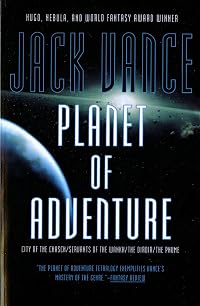
Planet of Adventure
by Jack Vance
Tschai, Planet of Adventure (Collections and Selections — omnibus 1-4)
On This Page
Description
Stranded on the distant planet Tschai, young Adam Reith is the sole survivor of a space mission who discovers the world is inhabited - not only by warring alien cultures, but by human slaves as well, taken early in Earth's history. Reith must find a way off the planet to warn Earth of Tschai's deadly existence. Against a backdrop of baroque cities and haunted wastelands, sumptuous palaces and riotous inns, Reith will encounter deadly wastrels and murderous aliens, dastardly villains and show more conniving scoundrels - and always the random beauty in need of rescue. show lessTags
Recommendations







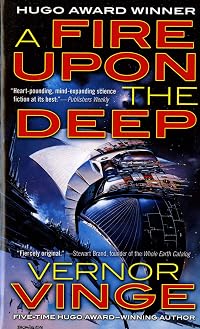
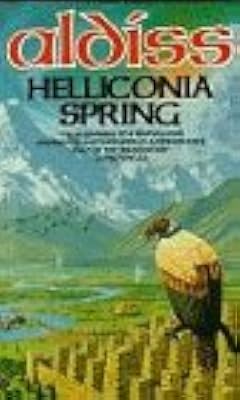
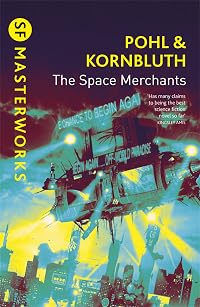
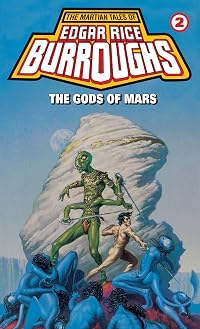
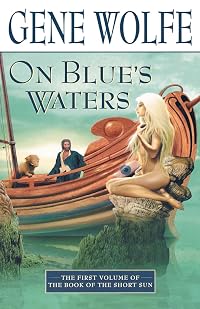


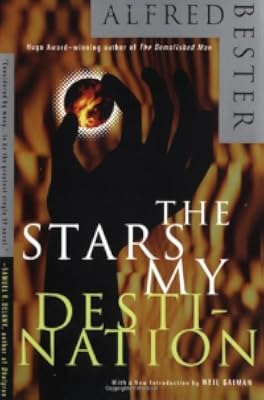
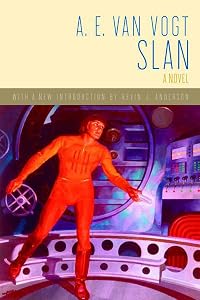
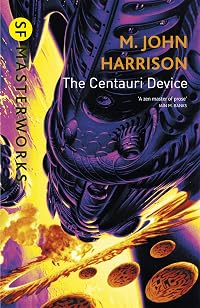







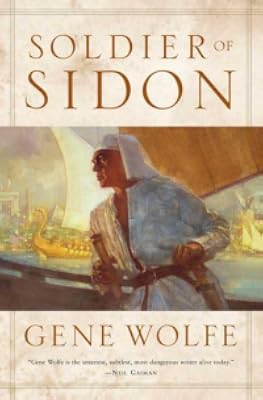
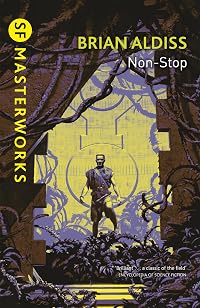


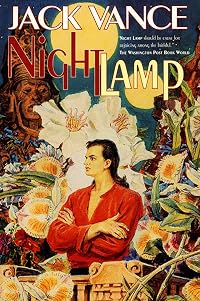

Member Recommendations

Member Reviews
A Haunting Novel: It's hard for me to describe Planet of Adventure. The book is in many ways amateurish and below the standards I'm used to from Jack Vance; the editing was poor (there were numerous errors), the names were often cheesy (the "Dirdir" figure prominently), and the plot seemed almost formulaic. His main character, Adam Reith, is the same taciturn hero we saw in Night Lamp, The Demon Princes, or any of his other novels, who for some reason can never be defeated in single combat. These shortcomings nearly moved me to put it down for good after about 40 pages.But despite this, in many ways the mixture of science fiction and fantasy in Planet of Adventure lets Vance shine brighter than in any other book of his which I have show more read. Planet of Adventure is peppered with ingenious situations and highly entertaining side plots. I found his alien cultures incredibly well conceived - the Emblem men, who pass their personalities intergenerationally via emblems they wear, the Khor, who each own "two souls which come and go with dawn and sunset," and the enigmatic Pnume, who lurk beneath the surface of Tschai.
Although Vance always finds some way to mark his supporting characters as unique, if only through their physical description, Vance's characters in Planet of Adventure are even more memorable than usual because they all have a great deal of emotional depth which is further enhanced through Vance's minimalist style. In most of his other books Vance uses sentimental understatement and sparse emotional language to project a sense of melancholy wistfulness onto the reader, but never does it come across more powerfully than in Planet of Adventure.
In short, while not perfect, Planet of Adventure is phenomenally imaginative, poignantly dramatic, and altogether a haunting novel. show less
My own favourites are the Cadwal Chronicles and the Alastor trilogy and, as a stand alone: “Night Lamp”. The majority of his short-stories are also great. The long running thread on the multi-volume philosophical treatise "Life" by Baron Bodissey, as well as Bodissey himself, which pop up in many of Vance's novels as either footnotes or character discussion is brilliant and amusing. Only Terry Pratchett comes close in his use of footnotes to both expand on and intensify a joke/idea.
Jack Vance is without doubt one of the greatest fantasists of his generation. He gets sidelined, I think, because he's not as directly political of the proto-New Wavers (Pohl, Dick, etc.) and not as commercially inclined as, say, Frank Herbert. He also show more wrote a lot of pot boilers in the fifties and first half of the sixties, before raising his game immensely between 1965 and 1985 (when he was in his late fifties to eighties!). In The Lyonesse Trilogy”, wherein you will see the roots of a lot of the last decade's "gritty" fantasy and New Weird. In fact, pretty much everything by Vance is worth reading.
His SF is of the distinctly non-hard variety, harkening back more to Flash Gordon era space opera with a darker view of the human state, and of course that brilliant, vivid Vancean imagination. Try Big Planet to give you a taste, then move on to the “Demon Princes” and “Planet of Adventure” ("City of the Chasch", "Servants of the Wankh", "The Dirdir" and "The Pnume") - they're five and four book series respectively, but only amount to the length of one of today's bloated epics.
Much modern fantasy suffers from a need to be perceived as ark, and combined with a desire to out-epic the competition it's led to something of a sameness in the huge-number-of-mutilated-dead count, tougher-than-the-last-tough-guy hyperinflation, and characters flawed by their amorality or brutality (Gwynne, Lawrence, Weeks, Ryan, etc.).
“Planet of Adventure” is still a 4 stars read for me after all these years.
SF = Speculative Fiction. show less
Jack Vance is without doubt one of the greatest fantasists of his generation. He gets sidelined, I think, because he's not as directly political of the proto-New Wavers (Pohl, Dick, etc.) and not as commercially inclined as, say, Frank Herbert. He also show more wrote a lot of pot boilers in the fifties and first half of the sixties, before raising his game immensely between 1965 and 1985 (when he was in his late fifties to eighties!). In The Lyonesse Trilogy”, wherein you will see the roots of a lot of the last decade's "gritty" fantasy and New Weird. In fact, pretty much everything by Vance is worth reading.
His SF is of the distinctly non-hard variety, harkening back more to Flash Gordon era space opera with a darker view of the human state, and of course that brilliant, vivid Vancean imagination. Try Big Planet to give you a taste, then move on to the “Demon Princes” and “Planet of Adventure” ("City of the Chasch", "Servants of the Wankh", "The Dirdir" and "The Pnume") - they're five and four book series respectively, but only amount to the length of one of today's bloated epics.
Much modern fantasy suffers from a need to be perceived as ark, and combined with a desire to out-epic the competition it's led to something of a sameness in the huge-number-of-mutilated-dead count, tougher-than-the-last-tough-guy hyperinflation, and characters flawed by their amorality or brutality (Gwynne, Lawrence, Weeks, Ryan, etc.).
“Planet of Adventure” is still a 4 stars read for me after all these years.
SF = Speculative Fiction. show less
Looking down my list of the most popular science fiction books of 1970. I came across The Pnume by Jack Vance which is number 4 in the Planet of Adventure series. As this was the final book of the quartet I thought I might as well start at the beginning with City of The Chasch.
In book number 1 Adam Reith and his co-pilot are descending down to an unknown planet in their out of control space pod. They have been shot down and decide to eject at the last minute to save themselves. Reith survives badly injured and is held captive by a primitive clan of humans (the emblem men), the co-pilot is not so lucky and is quickly despatched by the emblem men. He has seen a group of alien creatures the Blue Chasch) carry away his space pod. His show more immediate task is to escape from the emblem men and then track down the aliens that have his space pod, which is his only means of escaping from the planet.
The series is called The Planet of Adventure and this is a good description of the science fiction element of this book. It is a pure and simple adventure story with non stop action and a seemingly indestructible hero in Adam Reith. There are four alien species on the planet, the Chasch, the Dirdir, the Wankh and the Pnume and they all seem to have enslaved a human species and so there are Chaschmen, Didirmen, Wankhmen, and Pnumkin. In book 1 Reith almost single handedly overthrows the Blue Chasch enabling the human species to attempt to rule themselves in accordance with Reith's civilised blue print.
In the first book Vance quickly and deftly puts the reader in the picture so that s/he can enjoy the adventure story. The civilisation of the reptilian Blue Chasch and their characteristics are depicted well enough to interest the reader, in fact one almost wishes that Vance had delved deeper with his world building, perhaps this will feature in the subsequent books. The alien races are seen, from a human point of view looking at them from the outside, through the eyes of the subordinate human beings on the planet. Violence is endemic, torture is common place and sexism is what you would expect from a late 60's pulp fiction writer, but let this not stop the reader from enjoying a well told story - 3 stars.
Jack Vance - Planet of Adventure - Book 2 Servants of the Wankh
I can imagine how many young (and perhaps not so young) readers have giggled over the title of book 2 in Jack Vance's Planet of Adventure series.
In this one Adam Reith, and his two companions Tranz (an emblem man) and Anacho (a dirdir man) come to the conclusion that the only way that Adam can get back to earth is to steal a spaceship of some kind. Both Tranz and Anacho do not believe that humans originated from planet Earth and this forms part of the ongoing mystery of the series. How did this planet (Tschai) come to be inhabited by humans many of whom seem to have been enslaved by the four alien species. The Wankh who are supported by the Wankhmen have a few spaceships and the trio with some help from the Lokhars another human tribe attempt to steal one of them. There is also the problem of the human slave girl Ylin Ylang; the flower of Cath who has attached herself to Adam after her rescue and wants him to take her back to Cath where her rich father will reward him generously.
Book 2 picks up the story directly from book 1. It does spend a little more time in explaining motives and there are brief conversations about why people behave the way they do. It certainly enhances the mystery of the planet Tschai and the alien and human species who live there. There is an uneasy truce between alien species and their human counterparts and they think nothing of killing each other. Much of the scientific equipment related to transport; for example air ships seem to be in a poor state of repair. Everything on this planet has its price and characters spend much time haggling and bargaining. The story is told in a linear fashion all from the point of view of Adam Reith who must match his wits and his guns and sword arm with his many enemies. This second book in the series has a little bit more about it than the first one, but still a 3 star read.
Jack Vance - Planet of Adventure Book 3 The Dirdir
In this book Adam Reith tangles with the third alien race on the planet of Tschai - the Dirdir. They are perhaps the most technologically developed race on the planet and perhaps the most vicious. They are by nature hunters and their favourite prey is humans. Adam and his two companions Tranz and Anacho must find sequins in the wildest part of the planet in an area that is like finding gold in a gold rush. The town of Suragasch is a place where:
'hatred hung in the air like stench'
In the sequin fields there are not only problems of finding the gems, but also of avoiding the Dirdir hunting parties. This section of the quartet is perhaps the most exciting, where the adventure story really takes over in an alien landscape where no quarter is given. Adam Reith must fight his way out of the glass cage; the elite hunting space of the Dirdirs to rescue his friend Anacho. The book ends with Adam Reith pitting his wits against the arch entrepreneur Woudiver in the warehouse at the edge of the Dirdir town of Sivishe, which borders the Dirdirs space port. Adam must haggle with Woudiver who has the connections which will allow Adam to build a spaceship. Adam knows that Woudiver will sell him out to the Dirdirs, but it is even worse; he is sold out to the Pnume 3.5 stars.
Jack Vance - Planet of Adventure Book 4 The Pnume
This final book in the series carries on directly from book 3 where Adam Reith finds himself lowered in a black sack down to the tunnels and caves of the Pnume; the fourth and most mysterious of the alien races. Certainly this is the most atmospheric book of the series where Adam must negotiate an underground alien city. He finds and captures a Pnumekin girl who only has a serial number for a name which Adam shortens to Zap 210. A substantial part of this book is a sort of bildungsroman where Zap 210 develops into a woman and falls in love with Adam Reith. This is handled reasonably well, if a bit predictably. If the reader has kept with the story to find out the mysteries of the humans who have become the sub race to the four alien races on the planet then he will be largely disappointed; the Pnumes hall of Foreverness hints at a possible solution, but it is only a hint. The story continues to be full of incident, but is becoming a little tired at this point and this was my least favourite of the four books, but the quality of the writing is maintained so that it compares favourably with most of the pulp fiction writing of that era (The Pnume was published in 1970)
This series is a good example of an adventure story written to fascinate and perhaps intrigue the younger reader of science fiction. It is a step up from Edgar RIce Burroughs 'Mars' series in that the world building is more thoughtful and the human relationship aspects are handled in a more adult fashion. Dedicating each book to one of the four alien races that the hero Adam Reith must tackle and overcome gives the story telling some depth. In the first book of the series Reith manages to ferment a revolution of some kind amongst humans who are subject to the alien race the Blue Chaisch and in the second book the Wankh and the Blue Chaisch are at war, however interactions of humans and the alien races are not part of books 3 and 4 as Vance largely avoids solving the mysteries of the Planet of Adventure.
Adam Reith is the seemingly indestructible hero of the four books with amazing powers of recovery and a solution to every problem. He is of course a male chauvinist with only a hint of a more tender and thoughtful side. Stubborn with a powerful sense of his own worth is a requirement of hero's in these adventure stories as the reader follows his tracks through an alien world where he must overcome all obstacles to find a spaceship to transport himself back to earth.
An alien world where humans are the sub species is interesting, especially as they have either accepted the situation or become completely enslaved. They have reverted to type in the way that they have organised themselves with every man out for himself. One of the most fascinating parts of this book is their addiction to money and power, which is not always the way with the aliens on the planet. In the human societies everything has its price and Adam Reith must not only be a supreme athlete and problem solver, but must also be a wily negotiator as he haggles for everything. I have never read an adventure series where obtaining money is of such importance. I am tempted to think that Jack vance has featured this aspect of the story not only for realism, but also to highlight an essential feature of human society. It is however easy to read too much into a pulp fiction series. All in all this is an entertaining series of books with a good story which I would rate as 3 stars. show less
In book number 1 Adam Reith and his co-pilot are descending down to an unknown planet in their out of control space pod. They have been shot down and decide to eject at the last minute to save themselves. Reith survives badly injured and is held captive by a primitive clan of humans (the emblem men), the co-pilot is not so lucky and is quickly despatched by the emblem men. He has seen a group of alien creatures the Blue Chasch) carry away his space pod. His show more immediate task is to escape from the emblem men and then track down the aliens that have his space pod, which is his only means of escaping from the planet.
The series is called The Planet of Adventure and this is a good description of the science fiction element of this book. It is a pure and simple adventure story with non stop action and a seemingly indestructible hero in Adam Reith. There are four alien species on the planet, the Chasch, the Dirdir, the Wankh and the Pnume and they all seem to have enslaved a human species and so there are Chaschmen, Didirmen, Wankhmen, and Pnumkin. In book 1 Reith almost single handedly overthrows the Blue Chasch enabling the human species to attempt to rule themselves in accordance with Reith's civilised blue print.
In the first book Vance quickly and deftly puts the reader in the picture so that s/he can enjoy the adventure story. The civilisation of the reptilian Blue Chasch and their characteristics are depicted well enough to interest the reader, in fact one almost wishes that Vance had delved deeper with his world building, perhaps this will feature in the subsequent books. The alien races are seen, from a human point of view looking at them from the outside, through the eyes of the subordinate human beings on the planet. Violence is endemic, torture is common place and sexism is what you would expect from a late 60's pulp fiction writer, but let this not stop the reader from enjoying a well told story - 3 stars.
Jack Vance - Planet of Adventure - Book 2 Servants of the Wankh
I can imagine how many young (and perhaps not so young) readers have giggled over the title of book 2 in Jack Vance's Planet of Adventure series.
In this one Adam Reith, and his two companions Tranz (an emblem man) and Anacho (a dirdir man) come to the conclusion that the only way that Adam can get back to earth is to steal a spaceship of some kind. Both Tranz and Anacho do not believe that humans originated from planet Earth and this forms part of the ongoing mystery of the series. How did this planet (Tschai) come to be inhabited by humans many of whom seem to have been enslaved by the four alien species. The Wankh who are supported by the Wankhmen have a few spaceships and the trio with some help from the Lokhars another human tribe attempt to steal one of them. There is also the problem of the human slave girl Ylin Ylang; the flower of Cath who has attached herself to Adam after her rescue and wants him to take her back to Cath where her rich father will reward him generously.
Book 2 picks up the story directly from book 1. It does spend a little more time in explaining motives and there are brief conversations about why people behave the way they do. It certainly enhances the mystery of the planet Tschai and the alien and human species who live there. There is an uneasy truce between alien species and their human counterparts and they think nothing of killing each other. Much of the scientific equipment related to transport; for example air ships seem to be in a poor state of repair. Everything on this planet has its price and characters spend much time haggling and bargaining. The story is told in a linear fashion all from the point of view of Adam Reith who must match his wits and his guns and sword arm with his many enemies. This second book in the series has a little bit more about it than the first one, but still a 3 star read.
Jack Vance - Planet of Adventure Book 3 The Dirdir
In this book Adam Reith tangles with the third alien race on the planet of Tschai - the Dirdir. They are perhaps the most technologically developed race on the planet and perhaps the most vicious. They are by nature hunters and their favourite prey is humans. Adam and his two companions Tranz and Anacho must find sequins in the wildest part of the planet in an area that is like finding gold in a gold rush. The town of Suragasch is a place where:
'hatred hung in the air like stench'
In the sequin fields there are not only problems of finding the gems, but also of avoiding the Dirdir hunting parties. This section of the quartet is perhaps the most exciting, where the adventure story really takes over in an alien landscape where no quarter is given. Adam Reith must fight his way out of the glass cage; the elite hunting space of the Dirdirs to rescue his friend Anacho. The book ends with Adam Reith pitting his wits against the arch entrepreneur Woudiver in the warehouse at the edge of the Dirdir town of Sivishe, which borders the Dirdirs space port. Adam must haggle with Woudiver who has the connections which will allow Adam to build a spaceship. Adam knows that Woudiver will sell him out to the Dirdirs, but it is even worse; he is sold out to the Pnume 3.5 stars.
Jack Vance - Planet of Adventure Book 4 The Pnume
This final book in the series carries on directly from book 3 where Adam Reith finds himself lowered in a black sack down to the tunnels and caves of the Pnume; the fourth and most mysterious of the alien races. Certainly this is the most atmospheric book of the series where Adam must negotiate an underground alien city. He finds and captures a Pnumekin girl who only has a serial number for a name which Adam shortens to Zap 210. A substantial part of this book is a sort of bildungsroman where Zap 210 develops into a woman and falls in love with Adam Reith. This is handled reasonably well, if a bit predictably. If the reader has kept with the story to find out the mysteries of the humans who have become the sub race to the four alien races on the planet then he will be largely disappointed; the Pnumes hall of Foreverness hints at a possible solution, but it is only a hint. The story continues to be full of incident, but is becoming a little tired at this point and this was my least favourite of the four books, but the quality of the writing is maintained so that it compares favourably with most of the pulp fiction writing of that era (The Pnume was published in 1970)
This series is a good example of an adventure story written to fascinate and perhaps intrigue the younger reader of science fiction. It is a step up from Edgar RIce Burroughs 'Mars' series in that the world building is more thoughtful and the human relationship aspects are handled in a more adult fashion. Dedicating each book to one of the four alien races that the hero Adam Reith must tackle and overcome gives the story telling some depth. In the first book of the series Reith manages to ferment a revolution of some kind amongst humans who are subject to the alien race the Blue Chaisch and in the second book the Wankh and the Blue Chaisch are at war, however interactions of humans and the alien races are not part of books 3 and 4 as Vance largely avoids solving the mysteries of the Planet of Adventure.
Adam Reith is the seemingly indestructible hero of the four books with amazing powers of recovery and a solution to every problem. He is of course a male chauvinist with only a hint of a more tender and thoughtful side. Stubborn with a powerful sense of his own worth is a requirement of hero's in these adventure stories as the reader follows his tracks through an alien world where he must overcome all obstacles to find a spaceship to transport himself back to earth.
An alien world where humans are the sub species is interesting, especially as they have either accepted the situation or become completely enslaved. They have reverted to type in the way that they have organised themselves with every man out for himself. One of the most fascinating parts of this book is their addiction to money and power, which is not always the way with the aliens on the planet. In the human societies everything has its price and Adam Reith must not only be a supreme athlete and problem solver, but must also be a wily negotiator as he haggles for everything. I have never read an adventure series where obtaining money is of such importance. I am tempted to think that Jack vance has featured this aspect of the story not only for realism, but also to highlight an essential feature of human society. It is however easy to read too much into a pulp fiction series. All in all this is an entertaining series of books with a good story which I would rate as 3 stars. show less
I purchased this, and several other science fiction novels following review of a list purporting to be “The Greatest Science Fiction Works of All Time”. There were a number of works with which I was not familiar, and being a fan of science fiction, thought it best to upgrade my library. I became somewhat concerned after reading their #1 selection, Litany of the Long Sun, and finding it not to my taste.
Luckily, I had better luck with this Jack Vance offering, which I found to be very well crafted and highly entertaining. The book is in the form of four novellas, and begins with the arrival of an earth vessel to a planet (Tschai) from which a radio beacon was received 212 light years previously. Immediately following dispatch of an show more advanced scout team, the mother ship is destroyed, the scout ship crashes and the lone survivor, Adam Reith, is captured by one of the local tribes.
The world on which Reith finds himself is inhabited by a number of different alien species and classes of humanoid figures. Each alien species has an underclass of humanoid beings who are kept in thralldom, raising the question of “When and how did this ‘human Diaspora’ occur?”. The novel tracks our Earth born hero through contact with the various inhabitants of Tschai, as he searches for those with the technology to return him to Earth.
The author does an outstanding job of creating and forming different cultures and mores among both the alien species and their human counterparts. He does so without resort to hackneyed or trite stereotypes. This work is very similar to the sociological/anthropological style of fantasy/science fiction that I’ve enjoyed from Ursula LeGuin. In that respect, it is somewhat short on “hard” science fiction and perhaps more accurately classified as fantasy.
My only quibble with the story lies in the virtual omnipotence and indestructibility of our intrepid hero. Who would guess that in addition to mixed martial arts training, astronauts of the future will be proficient in knife and sword fighting, to the extent that they will be able to best multitudes of attackers who have fought in those styles their entire lives? In instances too numerous to count, Reith overcomes insurmountable odds with barely a scratch.
In any event, I can highly recommend this work and endorse its inclusion on the aforementioned list of science fiction/fantasy greats. show less
Luckily, I had better luck with this Jack Vance offering, which I found to be very well crafted and highly entertaining. The book is in the form of four novellas, and begins with the arrival of an earth vessel to a planet (Tschai) from which a radio beacon was received 212 light years previously. Immediately following dispatch of an show more advanced scout team, the mother ship is destroyed, the scout ship crashes and the lone survivor, Adam Reith, is captured by one of the local tribes.
The world on which Reith finds himself is inhabited by a number of different alien species and classes of humanoid figures. Each alien species has an underclass of humanoid beings who are kept in thralldom, raising the question of “When and how did this ‘human Diaspora’ occur?”. The novel tracks our Earth born hero through contact with the various inhabitants of Tschai, as he searches for those with the technology to return him to Earth.
The author does an outstanding job of creating and forming different cultures and mores among both the alien species and their human counterparts. He does so without resort to hackneyed or trite stereotypes. This work is very similar to the sociological/anthropological style of fantasy/science fiction that I’ve enjoyed from Ursula LeGuin. In that respect, it is somewhat short on “hard” science fiction and perhaps more accurately classified as fantasy.
My only quibble with the story lies in the virtual omnipotence and indestructibility of our intrepid hero. Who would guess that in addition to mixed martial arts training, astronauts of the future will be proficient in knife and sword fighting, to the extent that they will be able to best multitudes of attackers who have fought in those styles their entire lives? In instances too numerous to count, Reith overcomes insurmountable odds with barely a scratch.
In any event, I can highly recommend this work and endorse its inclusion on the aforementioned list of science fiction/fantasy greats. show less
An explorer from Earth gets stranded on an planet with several alien species living on it. There are also human beings who seem to be descended from people taken from Earth thousands of years in the past.
This is very much pulp fiction, with a lot of action and direct to the point. It's a collection of four rather short novels that are often published together as one book, since they are four parts of the same story.
It reminded me a lot of Edgar Rice Burroughs' work, only more science fictional and better written. Vance's ability to describe interesting alien cultures is clearly shown. Quite a good read, with the agile and entertaining nature of its pulp roots, but also with its limitations (do not expect deep characterization).
This is very much pulp fiction, with a lot of action and direct to the point. It's a collection of four rather short novels that are often published together as one book, since they are four parts of the same story.
It reminded me a lot of Edgar Rice Burroughs' work, only more science fictional and better written. Vance's ability to describe interesting alien cultures is clearly shown. Quite a good read, with the agile and entertaining nature of its pulp roots, but also with its limitations (do not expect deep characterization).
This is classic science fiction, written by a master. The story is a series of four action/science fiction stories centered around scout Adam Reith, the only surviving member of a spaceship that has journeyed to the distant planet of Tschai to investigate a distress signal. The spaceship is destroyed and his scout ship is shot down and his partner slaughtered by the one of the five races on the planet. Adam uses his sensibility and cunning to help men oppressed by the one race and one race oppressed by men. He befriends the leader of the nomads and a human running from prosecution, and the three travel the planet together trying to help Adam get back to earth.
Not as good as Deathworld (Harry Harrison) and perhaps lacks the sharper wit of Vance's other books, but I enjoyed this omnibus nonetheless. Each of the 4 stories is fundamentally,the same - the main protaganist sets out to destroy the 4 civilisations of planet Tschai in turn. The vindictive characters and romantic settings are what raise this above the usual space adventure.
Members
- Recently Added By
Lists

Best Sellers / Popular 1968
237 works; 5 members

Les 100 principaux titres de la science-fiction (1981)
126 works; 3 members

Favorite Science Fiction
456 works; 218 members
Author Information

374+ Works 34,856 Members
John Holbrook Vance (August 28, 1916 - May 26, 2013) was an American mystery, fantasy and science fiction writer. Most of his work was published under the name Jack Vance. He also wrote 11 mystery novels as John Holbrook Vance and three as Ellery Queen, and once each used pseudonyms Alan Wade, Peter Held, John van See, and Jay Kavanse. Vance won show more the World Fantasy Award for Life Achievement in 1984. The Science Fiction Hall of Fame inducted him in 2001. Among his awards for particular works were: Hugo Awards, in 1963 for The Dragon Masters, in 1967 for The Last Castle, and in 2010 for his memoir This is Me, Jack Vance!; a Nebula Award in 1966, also for The Last Castle; the Jupiter Award in 1975; the World Fantasy Award in 1990 for Lyonesse: Madouc. He also won an Edgar (the mystery equivalent of the Nebula) for the best first mystery novel in 1961 for The Man in the Cage. He died at his home in Oakland, California, on May 26, 2013, aged 96. (Bowker Author Biography) show less
Some Editions
Awards and Honors
Series

Belongs to Publisher Series
Work Relationships
Common Knowledge
- Canonical title
- Planet of Adventure
- Alternate titles
- Tschai (Vance Integral Edition) (Vance Integral Edition)
- People/Characters
- Adam Reith
- Important places
- Tschai (fictional planet)
Classifications
Statistics
- Members
- 714
- Popularity
- 39,786
- Reviews
- 18
- Rating
- (3.89)
- Languages
- 5 — Dutch, English, French, German, Italian
- Media
- Paper, Audiobook, Ebook
- ISBNs
- 23
- ASINs
- 4