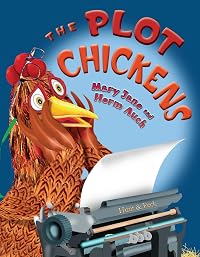
The Plot Chickens
by Mary Jane Auch
On This Page
Description
Henrietta the chicken loves to read so much that she decides to write a book herself, but first no one will publish a book written by a chicken, and then, when she publishes it herself and it gets a terrible review in "The Corn Book," Henrietta is devastated.Tags
Recommendations

Member Reviews
In my opinion, this is an incredible informational book. The story successfully teaches the writing process to children in an entertaining way. One reason I loved the book is because of its plot. Henrietta, a chicken, loves reading so she decides that she must like to write as well. Henrietta leads the readers through the writing process. She begins by planning what and who to write about, and proceeds to "hatch a plot." Additionally, the author of the book provides colorful and entertaining illustrations. As Henrietta describes the writing process, there are constant illustrations to provide humor in the story. The idea of this story is to provide students with a successful educational experience through learning the writing process.
(See Dolly's wonderful review for titles of referenced storybooks.)
Oh come on, chickens are inherently funny! Which means that even though this is a writer's manual, it' made me chuckle. And I love that it points out how professional publishers and critics do not always know what the real readers enjoy.
Oh come on, chickens are inherently funny! Which means that even though this is a writer's manual, it' made me chuckle. And I love that it points out how professional publishers and critics do not always know what the real readers enjoy.
Full of puns and poultry yolks, I mean jokes, The Plot Chickens is a tongue-in-cheek look at writing a book. With the help of an encouraging, young librarian , Henrietta the chicken writes her own book, and it's even reviewed in Corn Book Magazine, although reviewer "Noah Lyke" notes, "Henrietta lays an egg with her first book."
Informative ,
"Rule 7: Make your story come alive by using all five senses"
and funny at the same time, this book is a brightly-illustrated, hilarious look at the writing process.
Informative ,
"Rule 7: Make your story come alive by using all five senses"
and funny at the same time, this book is a brightly-illustrated, hilarious look at the writing process.
I liked this book because it is incredibly valuable in teaching the writing process to young students in a fun way. Children would have a great time following the successes and failures of this chicken as he learns to write his own successful story. This is an important topic that is taught in every school and, therefore, this book is very useful.
The language in this book is very purposeful. There is a lot of academic language involved in the writing process and this book is adept at either avoiding foreign terms (for example, the book says "write what you know" instead of "use your prior knowledge") or defining the terms right away. If new terms are introduced, the author is quick to define in it and give an example in terms of the show more chicken's story. There are also a few chicken/egg puns thrown in throughout the text that are a fun way to keep students entertained.
The illustrations could be improved. They are very hectic and harsh. The illustrator used a lot of bold colors and crammed a lot of information into each page. For a book that is all about following a structured process, I think that the illustrations should be a little more organized. The bold pictures distracted me from the text.
The point of this book was to show the audience how the steps in the writing process contribute to a finished piece of writing. show less
The language in this book is very purposeful. There is a lot of academic language involved in the writing process and this book is adept at either avoiding foreign terms (for example, the book says "write what you know" instead of "use your prior knowledge") or defining the terms right away. If new terms are introduced, the author is quick to define in it and give an example in terms of the show more chicken's story. There are also a few chicken/egg puns thrown in throughout the text that are a fun way to keep students entertained.
The illustrations could be improved. They are very hectic and harsh. The illustrator used a lot of bold colors and crammed a lot of information into each page. For a book that is all about following a structured process, I think that the illustrations should be a little more organized. The bold pictures distracted me from the text.
The point of this book was to show the audience how the steps in the writing process contribute to a finished piece of writing. show less
When I first began reading this book, I already started to like it. I loved that the main character was a chicken named Henrietta. This is something children enjoy and do a lot. It is very common for children to name stuff after what it is, for example, naming a toy frog, Froggy. The illustrations were the best I have seen so far as well. They are exciting and give the impression that the pictures are jumping out of the page. It has somewhat of a 3D feel to it. This book also has a ton of funny lines it. For example, on the third page, the author wrote, "Henrietta was in reading eggstasy," to exemplify the enjoyment Henrietta got out of reading. Also, instead of exhilarating, the author writing "eggshilarating." This book breaks down show more the key components of a story in a way that is fun and exciting to children. It is an excellent tool to use to teach a class how to write a story. The book is so fun and exciting and really makes learning enjoyable. I hope to purchase this book in the near future to save for when I have my own classroom library. show less
I liked this book. One reason I liked it was because of the language. The book is about chickens, so the author uses puns such as "Henrietta was in reading eggstasy" and "writing books must be eggshilarating". I'm sure children would find this very amusing and it would keep them entertained while they were listening to the book. Another thing I liked was that the book was not just paragraphs of text, but rather had word bubbles coming out of chickens' mouths, as well as "the rules of writing" in a different color on some of the pages. There is also text on the page coming out of a typewriter where Henrietta is writing a story. I like all of the different types of text on the page, because it definitely looks more interesting and is more show more fun to read. The main idea of this story is to teach children the rules of writing a story, such as "build suspense" or "the main character must solve his or own problem". The children can read a fun story while learning the basic fundamentals of writing a story. show less
I enjoyed reading this book because of the child-friendly guide The Plot Chickens provides for children starting to learn the writing process. Henrietta explains the writing process in a fun and creative way, from a chicken’s perspective. The author brought the text to life through Henrietta's experience of writing a story. The language used by the author was informative but not overwhelming for students first learning how to write. The author used simpler words that compensated for the actual terminology, to ensure that children would not be overwhelmed or confused when reading the story. The characters allow students to place themselves in the chickens’ shoes working their way through writing a story. The author also incorporates show more the illustrations into the story. He has word and thought bubbles by the chickens pictures and uses bright colors to capture the readers attention. By the end of the story, readers will have a great foundation to begin developing a story of their own. show less
Members
- Recently Added By
Author Information

40 Works 5,705 Members
As a child, Mary Jane Auch loved books and read constantly. Her interest in drawing began as a child and continued through high school. She went on to become an art major at Skidmore College. After graduation, Auch went for New York City, but after a year of designing prints for men's pajamas, she decided she wanted to do something more meaningful show more with her life. She enrolled in the Occupational Therapy program at Columbia University, and worked for some years in a children's hospital near Hartford, Connecticut. Eventually, Auch began illustrating for Pennywhistle Press, a national children's newspaper, which led to an interest in illustrating children's books. In the summer of 1984, Auch took a week-long children's writing conference on Cape Cod. Auch finally knew that she wanted to a writer when an instructor told her that sometimes artists find they can paint better pictures with words. She began sending manuscripts to publishers, writing four novels before she sold the first one. She then sold a second book to another publisher the same week. She continued writing books for older kids, abandoning her dream of illustrating for a while. After writing nine books, she wrote and illustrated The Easter Egg Farm, and has done both ever since. (Bowker Author Biography) show less
Awards and Honors
Awards
Classifications
Statistics
- Members
- 401
- Popularity
- 77,926
- Reviews
- 24
- Rating
- (3.95)
- Languages
- English
- Media
- Paper
- ISBNs
- 3
- ASINs
- 1