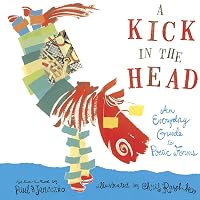
A Kick in the Head: An Everyday Guide to Poetic Forms
by Paul B. Janeczko
On This Page
Description
In this splendid and playful volume, acclaimed poetry anthologist Paul B. Janeczko and Caldecott Honor illustrator Chris Raschka present lively examples of twenty-nine poetic forms, demonstrating not only the (sometimes bendable) rules of poetry, but also the spirit that brings these forms so wonderfully to life. Featuring formal poems, some familiar and some never before published, from the likes of Eleanor Farjeon (aubade), X.J. Kennedy (elegy), Ogden Nash (couplet), Liz Rosenberg show more (pantoum), and William Shakespeare, the sonnet king himself, A Kick in the Head perfectly illustrates Robert Frost's maxim that poetry without rules is like a tennis match without a net. show lessTags
Recommendations




Member Recommendations
Member Reviews
This is one of my favorite books to help students see the different types of poetry that are out there. I used to have students create a poetry book with one of each of ten different poems. I would pass this book around for the students to get inspiration for their own poems, and it worked great!
This was the first time I ever heard this story and I really enjoyed. One reason that I enjoyed it was because of the illustrations. I liked how each picture looked like it was created with different pieces of fabric. I don't usually see illustrations done like this and I thought it was a nice touch to the book that made it very unique. Another thing that I liked about this book was the written text. I thought it was a really nice way to teach students about poems through these poems that were written. I thought the text was captivating and informative at the same time. Additionally, I found it interesting to see so many different kinds of poems in one book. Overall, I believe that the message of this story was that there are many show more different types of poems and that each is unique in its own way. show less
This poetry anthology helps children understand the various types of poems out there. Editor Janeczko compiles example poems that model 29 different poetic forms, which he describes in detail in the endnotes. Each poem also has a short explanation on the primary page, so that only those interested in learning even more about the poetic form have to turn to the back of the book. Personally, because I was interested in the more detailed explanations, I would have preferred if those were on the page with the poem instead of the short definition, but I suppose that the quicker explanation would hold children’s attention better. Janeczko includes well-known poetry forms, such as haikus, limericks, and sonnets, as well as more obscure forms show more such as clerihew, double dactyl, and pantoum. The poems range from the classics (William Shakespeare and William Blake, for example) to the modern (Janeczko includes some of his own poetry). The colorful and quirky illustrations are done in watercolor, ink, and torn paper, an unusual style that I would generally find interesting but somehow doesn’t feel quite right here (exception to this: the illustrative style works wonderful with the found poem “The Paper Trail” by Georgia Heard). Overall, however, this is a great work for introducing children to poetry in its many manifestations. show less
In my opinion this was a really great book to introduce poetry. I loved how engaging each poem was, in that it showed an example, but then also included descriptive words that aimed to inform us about each type of poetry. I also really enjoy how the poems are not too simple but are able to be understood by many ages. In addition, the poems address many different emotions and can appeal to a variety of feelings. “Tiger, tiger, burning bright in the forests of the night, what immortal hand or eye could frame thy fearful symmetry?” Finally, I loved the watercolor illustrations that showed contrast and colorful designs. The images and texts were well thought out, and the book serves as a unique experience for all readers.
Incredibly useful for students doing a unit on poetry: it includes many forms (haiku, limerick, etc.), each with an example, a definition and explanation of how to write one, and an illustration. I especially loved the limerick.
There once was a limerick called Steven
whose rhyme scheme was very uneven
it didn't make sense
it wasn't funny
and who'd call a limerick Steven anyway?
-Steven Herrick
*
Re-read, and used for teaching, February 2022
There once was a limerick called Steven
whose rhyme scheme was very uneven
it didn't make sense
it wasn't funny
and who'd call a limerick Steven anyway?
-Steven Herrick
*
Re-read, and used for teaching, February 2022
I loved this book for multiple reasons. First, I liked this book because it was humorous and light hearted. For example, one of the poems was “ First day, new school year, backpack harbors a fossil… last June’s cheese sandwich.” The child also has to be mature enough to understand the humor in this poem and really as to engage in the text to make sense of why it’s funny. Second, I loved the illustrations in the book. I think they are very appropriate for the mood of the story. For example, one of the poems was about spring rain. Next to the poem was what looked like a child-crafted picture of a bright yellow figure and a bright blue figure standing underneath a red umbrella. These colors are very bold but make the reader think show more of a bright yellow rain jacket or the bright colors of spring. Another example would be the illustrations that went along with the poem about last June’s cheese sandwich. The pictures were of fossils of fish and old sandwiches, all of blacks, browns, and unfortunate greens. Finally, I enjoyed this book because I thought it was an interesting way of organizing a book of and about poems. Not only did they have cute and creative poems on each page, but underneath the picture there was a small sentence about what type of poem was on the page and how those types of poems are constructed. For example, one of the first pages there is a colorful picture of a mule. The poem that accompanies it on the right page is “In a world of mules, there are no rules.” On the left page, underneath the mule there it says “A couplet is a two-line poem or stanza, usually rhyming.
I think the main idea of this book was to inform readers how to write different kids of poems and how to bring those poems to life. show less
I think the main idea of this book was to inform readers how to write different kids of poems and how to bring those poems to life. show less
This book, with stunning illustrations and catching colours, is a very well designed encyclopedia of poetic forms. Beginning with the shortest forms (couplet, tercet, quatrain) and moving into longer, more difficult ones such as the villanelle and the pantoum, the poems used as examples are very readable and can stand alone. I was even able to recommend this book to a young patron at the public library who was wandering but not interested in any fiction I could muster up. I asked her if she could answer the riddle given (which is fantastic) and when I showed her the answer she took the book out of my hands and read it all the way to the check-out counter.
Members
- Recently Added By
Author Information

55+ Works 5,888 Members
Paul Bryan Janeczko was born in Passaic, New Jersey on July 27, 1945. He received a bachelor's degree in English from St. Francis College in 1967 and a master's degree in English from John Carroll University in 1970. While teaching public high school, he created his own poetry anthology to use in his classes. He retired from teaching in 1990 after show more 22 years. He became a poet and anthologist best known for his poetry anthologies for children. From the 1980s through the early 2000s, he was the compiler for several anthologies including Pocket Poems: Selected for a Journey, I Feel a Little Jumpy Around You: A Book of Her Poems and His Poems Collected in Pairs, and A Kick in the Head: An Everyday Guide to Poetic Forms. He wrote several poetry collections including The Crystal Image, Requiem, Worlds Afire, and The Proper Way to Meet a Hedgehog and Other How-to Poems. His novel, Bridges to Cross, was published 1986. He died on February 19, 2019 at the age of 73. (Bowker Author Biography) show less
All Editions
Awards and Honors
Awards
Distinctions
Common Knowledge
- Canonical title
- A Kick in the Head: An Everyday Guide to Poetic Forms
Classifications
- Genres
- Poetry, Children's Books
- DDC/MDS
- 811.008 — Literature & rhetoric American literature in English American poetry Specific kinds of poetry {only by more than one author} Modified standard subdivisions Collections of literary texts
- LCC
- PS586.3 .K525 — Language and Literature American literature American literature Collections of American literature Poetry
- BISAC
Statistics
- Members
- 1,000
- Popularity
- 26,129
- Reviews
- 74
- Rating
- (4.36)
- Languages
- English
- Media
- Paper
- ISBNs
- 4