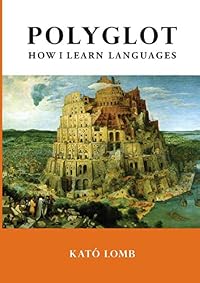
Polyglot: How I Learn Languages
by Kató Lomb
On This Page
Tags
Recommendations

























Member Reviews
Very interesting stuff. I've always been interested in languages and would like to learn several (at least!). Ms. Lomb presents a very intriguing and practical method of attacking a foreign language.
My only qualm with the book is that it seems to take her a long time to get around to actually describing her learning method. Much of the book is fraught with personal and hearsay anecdotes that, while interesting, are more fluff than substance.
That said, it's a quick read and worth scanning through if you are looking to learn a new language in an efficient manner.
My only qualm with the book is that it seems to take her a long time to get around to actually describing her learning method. Much of the book is fraught with personal and hearsay anecdotes that, while interesting, are more fluff than substance.
That said, it's a quick read and worth scanning through if you are looking to learn a new language in an efficient manner.
The author has achieved remarkable success with languages, and this book shares some of the ways that she's done that. Her approach to learning languages -- by picking up a book in that language and reading it without obsessing about checking every word you don't know in a dictionary -- is definitely intriguing. However, I hoped she would go into a little more detail about how she learned Chinese. All she mentions is taking a class and looking through a dictionary to figure out word formation. Unfortunately, I don't believe her approach really works with Chinese unless you have a fairly solid foundation already. It's just impossible to gleam the meaning of the word from context if you're not even sure what the word is. Is it just this show more one character? Or is it two or three characters, all of which look unfamiliar. Aside from the lack of focus on Chinese, the book is filled with a lot of advice and encouragement to aspiring polyglots or linguaphiles. Judging from this book, Lomb is also a rather good writer. The book is interspersed with personal anecdotes, stories, and excerpts from Hungarian writers. Definitely worth a read if you're at all interested in learning a language or several languages. I'm going to try her approach with German. show less
No great revelations here, but there are some interesting anecdotes. (Of course, some of the other reviewers' complaints that her advice is old news may be forgetting that she wrote it decades ago. Others copy her.) The linguistic tidbits are largely outdated - such as the dreadfully inaccurate notion that women talk more than men, which has long since been disproven in study after study - but it's nevertheless interesting to hear about what worked for one very successful language learner.
I didn't know until now that my personal method of learning a new language is a variant of Kató Lomb's.
I am very impressed by her description of Romanian language:
I am very impressed by her description of Romanian language:
To this day, I find Romanian very fetching. It has more of a country flavor than French and is more “manly” than Italian and more interesting than Spanish, due to its Slavic loanwords.
Lomb's ten broad tips (with thanks to a now defunct blog called LangHack):
1. Spend time tinkering with the language every day. If time is short, try at least to produce a 10-minute monologue. Morning hours are especially valuable in this respect: the early bird catches the word!
2. If your enthusiasm for studying flags too quickly, don't force the issue but don't stop altogether either. Move to some other form of studying, e.g., instead of reading, listen to the radio; instead of writing a composition, poke about in the dictionary, etc.
3. Never learn isolated units of speech; rather, learn them in context.
4. Write phrases in the margins of your text and use them as "prefabricated elements" in your conversations.
5. Even a tired brain show more finds rest and relaxation in quick, impromptu translations of billboard advertisements flashing by, of numbers over doorways, of snippets of overheard conversations, etc., just for its own amusement.
6. Memorize only that which has been corrected by a teacher. Do not keep studying sentences you have written that have not been proofread and corrected so mistakes don't take root in your mind. If you study on your own, each sentence you memorize should be kept to a size that precludes the possibility of errors.
7. Always memorize idiomatic expressions in the first person singular. For example, "I am only pulling your leg."
8. A foreign language is a castle. It is advisable to besiege it from all directions: newspapers, radio, movies that are not dubbed, technical or scientific papers, textbooks, and the visitor at your neighbor's.
9. Do not let the fear of making mistakes keep you from speaking, but do ask your conversation partner to correct you. Most importantly, don't get peeved if he or she actually obliges you - a remote possibility, anyway.
10. Be firmly convinced that you are a linguistic genius. If the facts demonstrate otherwise, heap blame on the pesky language you aim to master, your dictionaries, or this book - but not on yourself. show less
1. Spend time tinkering with the language every day. If time is short, try at least to produce a 10-minute monologue. Morning hours are especially valuable in this respect: the early bird catches the word!
2. If your enthusiasm for studying flags too quickly, don't force the issue but don't stop altogether either. Move to some other form of studying, e.g., instead of reading, listen to the radio; instead of writing a composition, poke about in the dictionary, etc.
3. Never learn isolated units of speech; rather, learn them in context.
4. Write phrases in the margins of your text and use them as "prefabricated elements" in your conversations.
5. Even a tired brain show more finds rest and relaxation in quick, impromptu translations of billboard advertisements flashing by, of numbers over doorways, of snippets of overheard conversations, etc., just for its own amusement.
6. Memorize only that which has been corrected by a teacher. Do not keep studying sentences you have written that have not been proofread and corrected so mistakes don't take root in your mind. If you study on your own, each sentence you memorize should be kept to a size that precludes the possibility of errors.
7. Always memorize idiomatic expressions in the first person singular. For example, "I am only pulling your leg."
8. A foreign language is a castle. It is advisable to besiege it from all directions: newspapers, radio, movies that are not dubbed, technical or scientific papers, textbooks, and the visitor at your neighbor's.
9. Do not let the fear of making mistakes keep you from speaking, but do ask your conversation partner to correct you. Most importantly, don't get peeved if he or she actually obliges you - a remote possibility, anyway.
10. Be firmly convinced that you are a linguistic genius. If the facts demonstrate otherwise, heap blame on the pesky language you aim to master, your dictionaries, or this book - but not on yourself. show less
Weak. Her insights could be summarised in two pages, not the 200 of the book. And many of her anecdotes felt made up.
Ratings
Members
- Recently Added By
Author Information
6+ Works 142 Members
Common Knowledge
- Original publication date
- 1970
Classifications
Statistics
- Members
- 113
- Popularity
- 286,901
- Reviews
- 6
- Rating
- (3.46)
- Languages
- English, Estonian, Hungarian, Russian
- Media
- Paper
- ISBNs
- 4
- ASINs
- 2