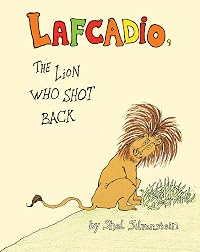
Lafcadio, The Lion Who Shot Back
by Shel Silverstein
On This Page
Description
After leaving the jungle for the circus and a life of fame and wealth, a lion who taught himself to be the best shot in the world discovers he's not really a lion anymore, and not really a man, either.Tags
Recommendations






Member Reviews
This book shares a common theme with the Sendak cautionary tale "Higglety Pigglety Pop" in which the spoiled dog Jennie leaves home in search of excitement. In Silverstein's book, a lion beset by hunters takes a gun, turns the hunter into a rug, and learns how to shoot. A circus man offers to make him rich and famous and renames him Lafcadio the Great (his previous name being "more of a lion name like, oh, maybe Grograph or Ruggrrg or Grmmff or Grrrrr.") Lafcadio follows the circus man, hoping to try something new and to score some marshmallows (he had never tasted one but loved the sound of the word marshmallow "and if they taste like they sound - mmmmmmmmmmmmm! - I just know I will love them"). So he goes off to "civilization" where show more he does all the things humans do: "And he became a social lion. ... And he became a literary lion. ... And he became a clothes lion." But he also became bored. One day the circus man decided to take him on a hunting trip to cheer him up ("because every cloud must have a silver lioning...") and they went to Africa. As he began shooting, his old friends recognized him and stopped him. Lafcadio no longer knew: was he a man or a lion? In the end, he walks off alone, unsure of his identity and what the future would bring. Wonderfully clever story, great illustrations (showing Lafcadio's gradual transformation), and lots of fun wordplay for both children and adults. (JAF) show less
A delightful story following a Lion who learns to use a gun and rids the jungle of hunters. He lives as a hero among his lion friends until a ringmaster recruits him to join the circus, with promises of marshmallows, fame and fortune. Lafcadio becomes Lafcadio the Great, and indeed becomes rich and famous, living as a human among humans until he is nearly no longer a lion. One day Lafcadio is invited to join his human friends on a hunting trip in Africa--where he is recognized by another Lion. Now Lafcadio must decide: does he want to be a lion and live among the lions, or would he rather be human and return to the city? Ultimately ***(spoiler!)*** he decides he'd rather be neither, and supposes he doesn't belong anywhere.
I absolutely show more love the closing lines of the book, where Shel SIlverstein hints at an ending and then leaves the reader hanging. You're here at the end and you're wondering what's going to become of poor Lafcadio, who doesn't belong anywhere. Silverstein teases with, "...he didn't really know where he was going, but he did know he was going somewhere, because you really have to go somewhere, don't you? And he didn't really know what was going to happen to him, but he did know that something was going to happen, because something always does, doesn't it?'
I was literally almost nodding my head in agreement as I turned the pages, but as it turns out, nothing happens to Lafcadio. He disappears, and the reader is left wondering along with the author, speculating as to his whereabouts, but the reader is left with a promise from Silverstein that, if he does get any word from Lafcadio, he will let us know.
I feel that this book best belongs incorporated into an ELA/creative writing/storytelling unit, because of the whimsical way Silverstein tells the story, much of which is not at all grammatically correct. It serves as a great example of how a good story doesn't necessarily need perfect grammar, a conclusive ending, or even a "point" except to be a good, fun read for the reader. show less
I absolutely show more love the closing lines of the book, where Shel SIlverstein hints at an ending and then leaves the reader hanging. You're here at the end and you're wondering what's going to become of poor Lafcadio, who doesn't belong anywhere. Silverstein teases with, "...he didn't really know where he was going, but he did know he was going somewhere, because you really have to go somewhere, don't you? And he didn't really know what was going to happen to him, but he did know that something was going to happen, because something always does, doesn't it?'
I was literally almost nodding my head in agreement as I turned the pages, but as it turns out, nothing happens to Lafcadio. He disappears, and the reader is left wondering along with the author, speculating as to his whereabouts, but the reader is left with a promise from Silverstein that, if he does get any word from Lafcadio, he will let us know.
I feel that this book best belongs incorporated into an ELA/creative writing/storytelling unit, because of the whimsical way Silverstein tells the story, much of which is not at all grammatically correct. It serves as a great example of how a good story doesn't necessarily need perfect grammar, a conclusive ending, or even a "point" except to be a good, fun read for the reader. show less
Lafcadio was originally published in 1963. Its content certainly wouldn't fly nowadays. Lafcadio is a lion who ate a hunter, confiscated his rifle and then how learned to shoot very accurately. He emigrated to the city and became a famous sharpshooting lion with the circus. He loved marshmellows and unleashed a mighty ROAR when he didn't get his way. Lafcadio became more man-like as he lived in the city, and he realized that he was not happy. He returned to the jungle and determined that he didn't like being a lion either. Lafcadio was torn, and the story ended with him roaming the countryside.
Readers of The Giving Tree will recognize Silverstein's trademark "open" ending - allowing the reader to interpret the story's meaning. To me, show more the moral of the story is be careful what you wish for. But others could draw other meaningful lessons. Overall, once I got over the inclusion of guns and human death in a child's book (!), I thought the story was very lyrical and fun to read. show less
Readers of The Giving Tree will recognize Silverstein's trademark "open" ending - allowing the reader to interpret the story's meaning. To me, show more the moral of the story is be careful what you wish for. But others could draw other meaningful lessons. Overall, once I got over the inclusion of guns and human death in a child's book (!), I thought the story was very lyrical and fun to read. show less
this lion has no fear in him, only curiousity. so when hunter come to kill him he doesnt run like the others, he stands his ground. he becomes famous for being the lion who shot back because he ended up being one of the best shooters in the world. he loses the lion he once was and becomes more like the men who had come to kill him and his family. too human to be a lion, and too lion to be human, he winds up alone. this could be used with a lesson about staying true to who you are and loving yourself.
This is one of the greatest read-aloud books, with plenty opportunity for sound effects (especially roars). Lots of fun to read, although the ending is rather serious.
Fantastic book for kids! So imaginative and creative. Easy read that children will find delightful!
Shel Silverstein is always brilliant! His rhymes are fun and entertaining! Some of my all time favorites!! Such a great way to entertain children and get them interested in reading!
Shel Silverstein is always brilliant! His rhymes are fun and entertaining! Some of my all time favorites!! Such a great way to entertain children and get them interested in reading!
I have loved this book since i was little. its about a lion who basically trys to be welcomed into human society as a circus lion. however hes more of a human since he wears clothes and everything. he also has an obsession with marshmellows
Members
- Recently Added By
Author Information

101+ Works 86,218 Members
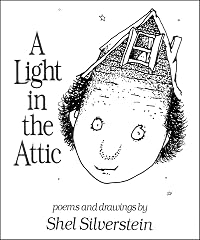
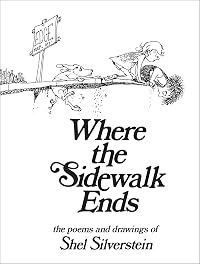
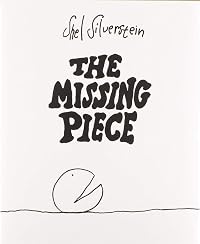
The most popular current writer of humorous verse for children, Shel Silverstein was born in Chicago, Illinois, has been married and divorced, has one daughter, and currently lives in Brooklyn, New York. His career includes composing popular songs, drawing cartoons, writing many adult articles (several for Playboy), and acting. However, he is best show more known for his self-illustrated children's poetry. His first such book was Uncle Shelby's Story of Lafcadio, the Lion Who Shot Back (1963), the humorous tale of a lion who turns the tables on hunters. It was followed by The Giving Tree (1964), a story of a parentlike tree that gives endlessly and is endlessly used by its son. Several other such picture books followed, including The Missing Piece (1976), about a circle that goes in search of a missing piece, and its sequel, The Missing Piece Meets the Big O (1981). However, two collections of poetry are probably his best-loved work: Where the Sidewalk Ends: The Poems and Drawings of Shel Silverstein (1974), and A Light in the Attic (1981). All of Silverstein's poetry for children employs the language play common to Lewis Carroll and Edward Lear. Silverstein is probably the best of the contemporary nonsense poets for children. (Bowker Author Biography) show less
Awards and Honors
Notable Lists
Work Relationships
Common Knowledge
- Original publication date
- 1963
- Dedication
- Even your old Uncle Shelby once had a teacher.
His name was Robert Cosbey.
This book is dedicated to him. - First words
- And now, children, your Uncle Shelby is going to tell you a story about a very strange lion--in fact, the strangest lion I have ever met.
1. Once there was a young lion and his name was--well, I don't really know what his name was because he lived in the jungle with a lot of other lions and if he did have a name it certainly wasn't a name like Joe or Ernie or a... (show all)nything like that. - Last words
- (Click to show. Warning: May contain spoilers.)He just loves marshmallows.
Classifications
Statistics
- Members
- 1,194
- Popularity
- 20,996
- Reviews
- 12
- Rating
- (4.16)
- Languages
- 11 — Chinese, Danish, Dutch, English, French, German, Italian, Farsi/Persian, Portuguese, Romanian, Spanish
- Media
- Paper, Audiobook, Ebook
- ISBNs
- 31
- ASINs
- 15