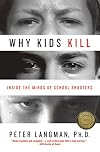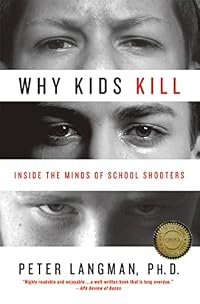
Why Kids Kill: Inside the Minds of School Shooters
by Peter Langman
On This Page
Description
Law. Psychology. Nonfiction. School shootings scare everyone, even those not immediately affected. They make national and international news. They make parents afraid to send their children off to school. But they also lead to generalizations about those who perpetrate them. Most assumptions about the perpetrators are wrong and many of the warning signs are missed until it's too late. Here, Peter Langman takes a look at 48 national and international cases of school shootings in order to show more dispel the myths, explore the motives, and expose the realities of preventing school shootings from happening in the future, including identifying at risk individuals and helping them to seek help before it's too late. show lessTags
Recommendations


















Member Reviews
Why Kids Kill provides thoughtful look into the lives and psychology of the young people responsible for some of the most horrific crimes that have played out over our television screens in the last twenty years.
Some of Langman's research findings are completely counter to what we've been lead to believe from media accounts of these events and individuals. One such exaple would be the common assumption that many children and teens who resort to school shootings have sustained a long history of bullying. Langman asserts, through his profiling of 10 school shooters including those involved with Columbine, Paducah, and Virgina Tech, that while all had encountered some teasing/bullying as a part of their history in school, that more than show more half of the shooters were bullies themselves.
Another common misrepresentation would be that the shooters were raised in negligent environments by parents with irresponsible behaviors towards guns. While a small number of shooters did experience family trauma and abuse, many others came from homes where the parent(s) tried to be involved in their child's life and provide a reasonable upbringing. Sure, some of the parents of shooters came off as "meaner" or less tolerant than others, but nothing that would be considered out of the ordinary. Of those families with guns in the home, it was because of a tradition of hunting - not due to gang involvement, drugs, or any other illegal reason.
There were occasional statements made by Langman that riled me a bit, but mainly because they were generalizations about observable behavior. One such statement was in the section about schizotypal personality traits and Dylan Klebold. Langman discussed at length how Dylan frequently "mis-used" written language in bizarre ways. While I understand that evaluating language usage would be part of a larger clinical diagnosis, my issue with this passage was that it could be misinterpreted by parents struggling to understand a creative and "different" child. Playing with language isn't necessarily a sign of schizophrenia or being a danger to others!
Despite my infrequent disagreements, Why Kids Kills is well worth the read for providing some much needed honesty about the children behind these unforgettable and tragic crimes. show less
Some of Langman's research findings are completely counter to what we've been lead to believe from media accounts of these events and individuals. One such exaple would be the common assumption that many children and teens who resort to school shootings have sustained a long history of bullying. Langman asserts, through his profiling of 10 school shooters including those involved with Columbine, Paducah, and Virgina Tech, that while all had encountered some teasing/bullying as a part of their history in school, that more than show more half of the shooters were bullies themselves.
Another common misrepresentation would be that the shooters were raised in negligent environments by parents with irresponsible behaviors towards guns. While a small number of shooters did experience family trauma and abuse, many others came from homes where the parent(s) tried to be involved in their child's life and provide a reasonable upbringing. Sure, some of the parents of shooters came off as "meaner" or less tolerant than others, but nothing that would be considered out of the ordinary. Of those families with guns in the home, it was because of a tradition of hunting - not due to gang involvement, drugs, or any other illegal reason.
There were occasional statements made by Langman that riled me a bit, but mainly because they were generalizations about observable behavior. One such statement was in the section about schizotypal personality traits and Dylan Klebold. Langman discussed at length how Dylan frequently "mis-used" written language in bizarre ways. While I understand that evaluating language usage would be part of a larger clinical diagnosis, my issue with this passage was that it could be misinterpreted by parents struggling to understand a creative and "different" child. Playing with language isn't necessarily a sign of schizophrenia or being a danger to others!
Despite my infrequent disagreements, Why Kids Kills is well worth the read for providing some much needed honesty about the children behind these unforgettable and tragic crimes. show less
Langman, while giving some insightful looks on the psychology of shooters and especially excelling in his accounts of dealing with children who had the potential to be shooters themselves, ultimately fails at trying to do more than giving a very basic insight into the ten shooters discussed in this book. It mostly comes down to Langman trying to be comprehensive while at the same time trying to give a general overview. It leaves any reader, like me, who's already pretty knowledgeable about the shooters mentioned, feeling like they've just been re-fed stuff they already know. Langman's attempts to seem more palatable to a layman audience also makes the book feel somewhat unsure of itself, as though we're reading a book from a student show more researcher instead of someone with a PhD in his field.
I would recommend Why Kids Kill for someone who knows absolutely nothing about school shooters as it does succeed in just being a good introduction, but I wouldn't recommend it for anyone who knows more than the bare minimum. show less
I would recommend Why Kids Kill for someone who knows absolutely nothing about school shooters as it does succeed in just being a good introduction, but I wouldn't recommend it for anyone who knows more than the bare minimum. show less
Ratings
Members
- Recently Added By
Lists

Books about Gun Violence
54 works; 1 member
Author Information

3+ Works 169 Members
Peter Langman is a psychologist whose work on school shooters has received international recognition. His previous book Why Kids Kill: Inside the Minds of School Shooters was named a Choice Outstanding Academic Title and was translated into German, Dutch, and Finnish. Langman's research has been cited in congressional testimony on Capitol Hill and show more thousands of news outlets. He has been interviewed by the New York Times, CBS, Fox, CNN, the BBC, and over 150 other news outlets in the United States, Canada, Europe, Asia, Australia, and the Middle East. Langman has trained thousands of professionals in education, mental health, and law enforcement on identifying potential school shooters. He maintains the largest online collection of materials relating to school shooters at schoolshooters.info. He is in private practice in Allentown, PA. show less
Common Knowledge
- Original title
- Why kids kill; Inside the minds of school shooters
Classifications
- Genres
- Nonfiction, General Nonfiction
- DDC/MDS
- 371.7 — Society, Government, and Culture Education Schools and their activities; special education School hygiene
- LCC
- LB3013.3 .L357 — Education Theory and practice of education Theory and practice of education School administration and organization School management and discipline
- BISAC
Statistics
- Members
- 151
- Popularity
- 216,176
- Reviews
- 2
- Rating
- (3.72)
- Languages
- Dutch, English, Finnish, German
- Media
- Paper, Audiobook, Ebook
- ISBNs
- 10
- ASINs
- 2