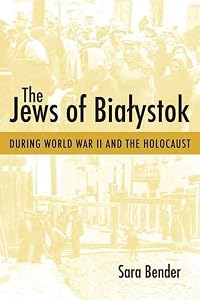
The Jews of Bialystok During World War II and the Holocaust
by Sara Bender
On This Page
Description
This history of Jewish Bialystok during World War II provides an in-depth analysis of one of the largest Jewish communities to pass from Soviet to German occupation, and it enhances our understanding of the response of Polish Jewry to the Holocaust. The Bialystok community's fate is representative of many other Jewish communities in Poland and Lithuania, but unlike other communities, Bialystok Jews left an unusually large documentary record. Exhaustive research in archival sources including show more first-person testimonies and memoirs enables Bender to create a multifaceted account of the motivations of Jewish communal leaders as well the attitudes and behavior of ordinary men and women as they grappled with an inhumane occupation and severe adversity.Bender's conclusion, in which she compares the history of the Bialystok community and ghetto to several other major communities, including Warsaw and Vilna, makes the volume an even richer contribution to the study of Polish Jewry during the Holocaust. show lessTags
Recommendations
Member Recommendations

Member Reviews
I must say that this book begins quite slowly; for me, the first 100 pages or so dragged, with a lot of numbers and such trivia about life prior to the German occupation. I wondered whether to finish it. Things picked up considerably after June 1941, however, and I'm glad I got the opportunity to learn about this undeservedly obscure ghetto and its two leaders, Mordechai Tenenbaum and Ephraim Barash.
Bialystok was an unusual Nazi ghetto in a lot of ways. It lasted longer than most of the others, and had much better living conditions: it was "organized, industrious, and even prosperous. Unlike other ghettos, it never experienced starvation or abject poverty." Barash was a uniquely popular and effective Judenrat leader. As for Tenenbaum, show more well, that guy was just a hero. The final days of the ghetto, and their doomed struggle, are the stuff of which epics are made. I also really liked the ending where the author compared Bialystok with other Nazi ghettos such as Warsaw, Vilna, etc., and discusses the differences and the reasons for their successes and failures.
This is, I think, the only book-length study of the Bialystok Ghetto, and I am very impressed by it. It's a valuable contribution to Holocaust scholarship. show less
Bialystok was an unusual Nazi ghetto in a lot of ways. It lasted longer than most of the others, and had much better living conditions: it was "organized, industrious, and even prosperous. Unlike other ghettos, it never experienced starvation or abject poverty." Barash was a uniquely popular and effective Judenrat leader. As for Tenenbaum, show more well, that guy was just a hero. The final days of the ghetto, and their doomed struggle, are the stuff of which epics are made. I also really liked the ending where the author compared Bialystok with other Nazi ghettos such as Warsaw, Vilna, etc., and discusses the differences and the reasons for their successes and failures.
This is, I think, the only book-length study of the Bialystok Ghetto, and I am very impressed by it. It's a valuable contribution to Holocaust scholarship. show less
Ratings
Members
- Recently Added By
Author Information
4+ Works 17 Members
Series
Belongs to Publisher Series
Common Knowledge
- Canonical title
- The Jews of Bialystok During World War II and the Holocaust
- Important places
- Białystok, Poland
Classifications
Statistics
- Members
- 9
- Popularity
- 2,306,043
- Reviews
- 1
- Rating
- (3.75)
- Languages
- English
- Media
- Paper
- ISBNs
- 1