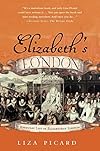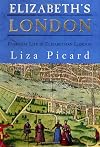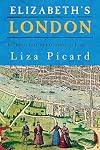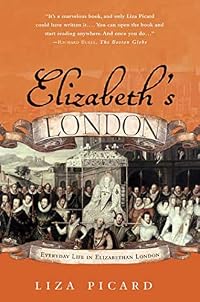
Elizabeth's London: Everyday Life in Elizabethan London
by Liza Picard
Liza Picard London Histories (1)
On This Page
Description
"This picture of the London of Queen Elizabeth (1558-1603) is the result of Liza Picard's curiosity about the practical details of daily life that almost every history book ignores." "Liza Picard's evocation of the London of four hundred years ago enables us to share the delights, as well as the horrors, of the everyday lives of sixteenth-century Britons."--BOOK JACKET.Tags
Recommendations
















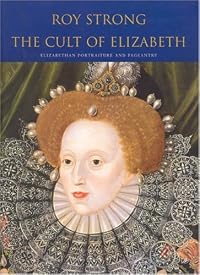
Member Recommendations
Member Reviews
This is one of a series of descriptions of London life at various pivotal times, by a retired English civil servant. It's a pleasant read; every chapter has some interesting detail about life in Elizabethan times that I didn't suspect. One enlightening item was the degree to which economic life was controlled (you can't say it was anti capitalist, because the word "capitalism" hadn't been coined yet.) Bread prices were fixed. What you could sell and where you could sell it were also controlled:
*No "root-seller" could display more than three baskets of produce.
*You could not sell bread in the street, only in the marketplace or directly to a customer's house.
*You could not eat meat on Wednesdays, Fridays or Saturdays without a show more license.
*You could not "forestall" - intercept goods before they got to market.
*You could not buy goods in one market and sell them in another.
And that's just for food; similar laws governed housebuilding, cloth making, etc.
I checked for evidence of climate, and there is some - but it's equivocal. On one hand, many plants that seem unlikely to grow in England now are attested - pomegranates and figs. On the other, the Thames froze solid enough to support horses in 1537 and 1564.
There's a handy table of costs for various things - an unskilled laborer would get 7d a day; a skilled carpenter got 1s 2d; a surgeon at St. Bartholomew's got L30 a year; Elizabeth spent about L9000 per year on her wardrobe. A loaf a bread was 1d, two dozen eggs were 8d, 10 lbs of sugar cost 12s 3d and a year at an Inn of Court was L40.
There were a lot of fractional coins, including happence, half-groats, three farthings, etc. The was also a "money of account" called a mark, equal to 2/3 of a pound; a lot of financial transactions were done in marks or fractions of a mark but there were no coins for these values. Couple that with a mix of Roman and Arabic numbers and it must have made life pretty interesting for the accountant.
There was no copper or brass money; only silver or gold (and, of course, no bank notes). That must have made for severe money shortages.
In the Victoria and Albert museum, I've seen a lot of nicely carved ivory discs dating from medieval to Tudor times and described as "tokens" without further explanation. Well, this book explains that. Every shop-keeper had a set of these and some lines or squares ruled on a handy flat surface (or perhaps a cloth with a similar pattern, for portability). The first line was for 1's, the second for 10's and so on. You put the tokens on it and used it as an abacus. Thus, when a customer wanted to buy something and there was a complicated amount of money involved, she had to take her purchase to the "counter". I had an etymological epiphany. Not to mention the "exchequer".
Lastly, the discussion of personal hygiene and medical treatment should be enough to deter anybody who's based their impressions of courtly life on romance novels. show less
*No "root-seller" could display more than three baskets of produce.
*You could not sell bread in the street, only in the marketplace or directly to a customer's house.
*You could not eat meat on Wednesdays, Fridays or Saturdays without a show more license.
*You could not "forestall" - intercept goods before they got to market.
*You could not buy goods in one market and sell them in another.
And that's just for food; similar laws governed housebuilding, cloth making, etc.
I checked for evidence of climate, and there is some - but it's equivocal. On one hand, many plants that seem unlikely to grow in England now are attested - pomegranates and figs. On the other, the Thames froze solid enough to support horses in 1537 and 1564.
There's a handy table of costs for various things - an unskilled laborer would get 7d a day; a skilled carpenter got 1s 2d; a surgeon at St. Bartholomew's got L30 a year; Elizabeth spent about L9000 per year on her wardrobe. A loaf a bread was 1d, two dozen eggs were 8d, 10 lbs of sugar cost 12s 3d and a year at an Inn of Court was L40.
There were a lot of fractional coins, including happence, half-groats, three farthings, etc. The was also a "money of account" called a mark, equal to 2/3 of a pound; a lot of financial transactions were done in marks or fractions of a mark but there were no coins for these values. Couple that with a mix of Roman and Arabic numbers and it must have made life pretty interesting for the accountant.
There was no copper or brass money; only silver or gold (and, of course, no bank notes). That must have made for severe money shortages.
In the Victoria and Albert museum, I've seen a lot of nicely carved ivory discs dating from medieval to Tudor times and described as "tokens" without further explanation. Well, this book explains that. Every shop-keeper had a set of these and some lines or squares ruled on a handy flat surface (or perhaps a cloth with a similar pattern, for portability). The first line was for 1's, the second for 10's and so on. You put the tokens on it and used it as an abacus. Thus, when a customer wanted to buy something and there was a complicated amount of money involved, she had to take her purchase to the "counter". I had an etymological epiphany. Not to mention the "exchequer".
Lastly, the discussion of personal hygiene and medical treatment should be enough to deter anybody who's based their impressions of courtly life on romance novels. show less
I found the first part on the physical lay-out of London and architecture a bit heavy going, but when I got onto the second part on people and their lives it was fascinating. Ms. Picard has a great eye for the telling anecdote or detail in the records.
http://nwhyte.livejournal.com/1194188.html
Picard has written several other books about London in different eras, but none the less makes her material here sound entirely fresh. There is a mass of detail on most aspects of London life, and I understand much better the role of institutions like the foreigners' churches and the city companies; plus I have more on my reading list for the moment when I crank my own research up a gear. Unfortunately she doesn't say much on the two subjects I most wanted to read about: the court (though this does come up in discussion of clothes) and the Irish in London - I think I spotted precisely one mention, of an Irish woman who died and whose children were therefore supported by the parish. On the other show more hand she has plenty of entertaining asides, the majority of which are buried in the endnotes (yet another book which irritatingly does not have footnotes), including numerous reminiscences of Tanganyika in the 1950s, some of which are even relevant to Elizabethan London. show less
Picard has written several other books about London in different eras, but none the less makes her material here sound entirely fresh. There is a mass of detail on most aspects of London life, and I understand much better the role of institutions like the foreigners' churches and the city companies; plus I have more on my reading list for the moment when I crank my own research up a gear. Unfortunately she doesn't say much on the two subjects I most wanted to read about: the court (though this does come up in discussion of clothes) and the Irish in London - I think I spotted precisely one mention, of an Irish woman who died and whose children were therefore supported by the parish. On the other show more hand she has plenty of entertaining asides, the majority of which are buried in the endnotes (yet another book which irritatingly does not have footnotes), including numerous reminiscences of Tanganyika in the 1950s, some of which are even relevant to Elizabethan London. show less
Useful survey of the daily life of Londoners in Elizabeth 1's reign. Has a wide range of subjects, although they are treated a little unevenly due to the author's reliance on specific primary sources. Written from a contemporary viewpoint, but avoids anachronistic opinions. Worth reading, as are the same author's books on London in other periods. Her books are also notable as an example of someone taking up serious authorship later in life.
A well-researched and highly entertaining overview of life in Tudor London. It's not an academic history, but it is a pleasure to read.
A great read, full of interesting gems about social life in Elizabethan London, covering all levels of society where relevant details are known or can reasonably be inferred.
Members
- Recently Added By
Lists

Best Books on London (non-fiction)
43 works; 11 members
Author Information

6 Works 2,873 Members
Liza Picard was born in 1927. She read law at London School of Economics and was called to the Bar by Gray's Inn, but did not practice. She worked in London for many years in the office of the Solicitor of Inland Revenue until she retired in 1987. She now lives in Oxford.
Series

Common Knowledge
- Original publication date
- 2003
- People/Characters
- Elizabeth I, Queen of England
- Important places
- London, England, UK
- Epigraph
- To the Reader
Diverse writers of histories write diversely ... For though it be written homely, yet it is not (as I trust) written untruly. And in histories the chief thing that is to be desired is truth. Wherefore, i... (show all)f thou find that in it, I beseech thee, wink at small faults, or at the least, let the consideration of my well meaning drown them.
John Stow - First words
- You only have to open Samuel Pepy's Diary and you are back in the London of Charles II.
- Last words
- (Click to show. Warning: May contain spoilers.)So on the whole the future looks good.
Classifications
Statistics
- Members
- 658
- Popularity
- 43,304
- Reviews
- 7
- Rating
- (3.95)
- Languages
- English
- Media
- Paper, Audiobook, Ebook
- ISBNs
- 7
- ASINs
- 7