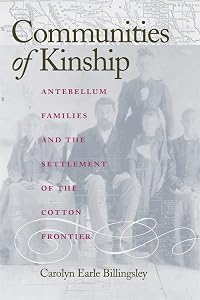
Communities of Kinship: Antebellum Families and the Settlement of the Cotton Frontier
by Carolyn Earle Billingsley
On This Page
Description
Trained as both a genealogist and a historian, Carolyn Earle Billingsley shows how the analytic category of kinship can add new dimensions to our understanding of the American South. In Communities of Kinship, she studies a southern family - that of Thomas Keesee Sr. - to show how the biological, legal, and fictive kinship ties between him and some seven thousand of his descendants and relatives helped to shape the growth of the interior South. Keesee, who was born in Pittsylvania County, show more Virginia, left there with his family when he was still a boy and subsequently lived in South Carolina, Tennessee, Alabama, and Arkansas. Drawing on Keesee family history, Billingsley reminds us that, contrary to the accepted notion of rugged individuals heeding the proverbial call of the open spaces, kindred groups accounted for most of the migration to the South's interior and boundary lands. In addition, she discusses how, for antebellum southerners, the religious affiliation of one's parents was the most powerful predictor of one's own spiritual leanings, with marriage being the strongest motivation to change them. Billingsley also looks at the connections between kinship and economic and political power, offering examples of how Keesee family members facilitated and consolidated their influence and wealth through kin ties. Piecing together a wide assortment of public and private records that pertain to the Keesee family and shed light on naming practices, residential propinquity, migration patterns, economic and political dealings, and religious interactions, Billingsley offers a model of innovation and subtle analysis for historians. This important new study makes a persuasive case that kinship, particularly in the study of the antebellum South, should be considered a discrete category of analysis complementary to, and potentially as powerful as, race, class, and gender. show lessTags
Recommendations

























Member Reviews
Trained as both a genealogist and a historian, Carolyn Earle Billingsley shows how the analytic category of kinship can add new dimensions to our understanding of the American South. In "Communities of Kinship, she studies a southern family--that of Thomas Keesee Sr.--to show how the biological, legal, and fictive kinship ties between him and some seven thousand of his descendants and relatives helped to shape the growth of the interior South. Keesee, who was born in Pittsylvania County, Virginia, left there with his family when he was still a boy and subsequently lived in South Carolina, Tennessee, Alabama, and Arkansas. Drawing on Keesee family history, Billingsley reminds us that, contrary to the accepted notion of rugged individuals show more heeding the proverbial call of the open spaces, kindred groups accounted for most of the migration to the South's interior and boundary lands. In addition, she discusses how, for antebellum southerners, the religious affiliation of one's parents was the most powerful predictor of one's own spiritual leanings, with marriage being the strongest motivation to change them. Billingsley also looks at the connections between kinship and economic and political power, offering examples of how Keesee family members facilitated and consolidated their influence and wealth through kin ties. Piecing together a wide assortment of public and private records that pertain to the Keesee family and shed light on naming practices, residential propinquity, migration patterns, economic and political dealings, and religious interactions, Billingsley offers a model of innovation and subtle analysis for historians. This important new study makes a persuasive case that kinship,particularly in the study of the antebellum South, should be considered a discrete category of analysis complementary to, and potentially as powerful as, race, class, and gender. show less
Ratings
Members
- Recently Added By
Author Information
18 Works 201 Members
Awards and Honors
Awards
Classifications
- Genres
- Nonfiction, History, General Nonfiction
- DDC/MDS
- 306.83 — Society, government, & culture Social sciences, sociology & anthropology Social Behavior - Dating, Marriage, Divorce Marriage, partnerships, unions; family Types of kinship systems
- LCC
- GN560 .U6 .B55 — Geography, Anthropology and Recreation Anthropology Anthropology Ethnology. Social and cultural anthropology Ethnic groups and races By region or country
- BISAC
Statistics
- Members
- 116
- Popularity
- 275,193
- Reviews
- 1
- Rating
- (5.00)
- Languages
- English
- Media
- Paper
- ISBNs
- 3