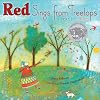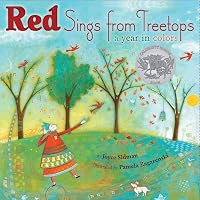
Red Sings from Treetops: A Year In Colors
by Joyce Sidman
On This Page
Description
The names of colors are woven into unrhymed poems that celebrate the seasons.Tags
Recommendations








Member Reviews
Poet Joyce Sidman and artist Pamela Zagarenski, who previously collaborated on 2007's This is Just to Say: Poems of Apology and Forgiveness, joined forces once again in this lovely picture-book, which was chosen as a Caldecott Honor Book in 2010. An exploration of the seasons, and the colors that weave through them - the new, "shy" green of spring, the "humming, shimmering, snoozing" blue of summer, the "fat and glossy" brown of fall, the "powder-soft" pink of winter - it boasts gorgeous mixed media illustrations that perfectly complement the poetic narrative.
Truthfully, I found the artwork in Red Sings from Trees far more compelling than the text, and my high four-star rating is more a result of aesthetic than literary appreciation. show more It's not that there was anything wrong with Sidman's poetry - in fact, some of the images were immensely evocative - but the finished product simply didn't speak to me. Zagarenski's illustrations, on the other hand, with their brilliantly appropriate use of color, and their many quirky details - the beautiful butterfly sail, in summer; the fabric-like interiors of the pumpkin, in fall - really drew me in! Highly recommended to anyone who appreciated beautiful picture-book art, and (because tastes vary), to young readers who appreciate poetry. show less
Truthfully, I found the artwork in Red Sings from Trees far more compelling than the text, and my high four-star rating is more a result of aesthetic than literary appreciation. show more It's not that there was anything wrong with Sidman's poetry - in fact, some of the images were immensely evocative - but the finished product simply didn't speak to me. Zagarenski's illustrations, on the other hand, with their brilliantly appropriate use of color, and their many quirky details - the beautiful butterfly sail, in summer; the fabric-like interiors of the pumpkin, in fall - really drew me in! Highly recommended to anyone who appreciated beautiful picture-book art, and (because tastes vary), to young readers who appreciate poetry. show less
This book is a poetry book about the seasons. What I love about this book is the illustrations. The depictions of each season is so creatively done, and I love it. Each poem relates colors to each season and then describes what happens in the seasons as well. I love how the illustrations brings out the artistic nature of the poetry. There is a minimal amount of text on each page, and yet every page says so much. For example “in spring white sounds like storms: snapped twigs and bouncing hail, blink of lightning and rattling boom” is all the text on one page from the book. That is what makes this book stand out to me, because the story jumps out from the pictures with guidance from the text, whereas most books are the other way show more around. Two things readers can take away from this text is that each season is unique, and poetry is a form of art. show less
With original and spot-on perceptions, Joyce Sidman's poetry brings the colors of the seasons to life in a fresh light, combining the senses of sight, sound, smell and taste. In this Caldecott Honor book, illustrator Pam Zagarenski's interpretations go beyond the concrete, allowing us to not just see color, but feel it.
Sidman, J. (2009). Red Sings from Treetops: A year in colors. New York: Houghton Mifflin Books for Children.
9780547014944
Appetizer: Within the 28 poems (approximately, I'm so bad at math I don't even trust my ability to count anymore), this picturebook shares the way the different colors behave during the four seasons (beginning with spring). The colors are repeated, their presence in nature expressed in different ways varying from season to season.
I absolutely LOVE the way the colors are personified in the poems. My favorite is a portion of the poem about green in the spring:
"Green is new
in the spring. Shy.
Green peeks from buds,
trembles in the breeze."
How beautiful is that image?! I heart it fiercely.
As one of the Caldecott honor show more books for this year, you can also expect that the illustrations are beautiful. And that is the case. There is fantastic use of colors and designs that help add to the tone and feelings of the poetry. The illustrations help to provide a sense of magic for the illustrations. For example, on the page that describes black in the fall, an inky whale is incorporated into the sky since the moon swims "through its cool sky-pool." (I know that probably sounds weird. But you can always check out the book for yourself and hopefully it will make a little more sense then)
Dinner Conversation:
"In SPRING
Red sings
from treetops:
cheer-cheer-cheer,
each note dropping
like a cherry into my ear."
"And here in secret places,
peeps Pink:
hairless,
featherless,
the color of
new
things."
"Green is queen
in summer."
"Purple pours
into summer evenings
one shadow at a time,"
To Go with the Meal:
Aside from enjoying some beautiful poetry (and some Caldecott honor earning illustrations) a teacher could use this book in a lesson about the use of colors in poetry and how they help create different meanings, images and emotions.
Rather than share the poems of this picturebook in just one sitting, a teacher could regularly present the poems throughout the school year to reflect the changes in seasons (that is of course, assuming the class is being taught in a part of the world where it actually snows in the winter).
In response to hearing or reading these poems, children could write their own poems, paying attention to incorporate colors into their writing.
Another route would be to include the poems into a science lesson on the causes of the seasons.
Tasty Rating: !!!! show less
9780547014944
Appetizer: Within the 28 poems (approximately, I'm so bad at math I don't even trust my ability to count anymore), this picturebook shares the way the different colors behave during the four seasons (beginning with spring). The colors are repeated, their presence in nature expressed in different ways varying from season to season.
I absolutely LOVE the way the colors are personified in the poems. My favorite is a portion of the poem about green in the spring:
"Green is new
in the spring. Shy.
Green peeks from buds,
trembles in the breeze."
How beautiful is that image?! I heart it fiercely.
As one of the Caldecott honor show more books for this year, you can also expect that the illustrations are beautiful. And that is the case. There is fantastic use of colors and designs that help add to the tone and feelings of the poetry. The illustrations help to provide a sense of magic for the illustrations. For example, on the page that describes black in the fall, an inky whale is incorporated into the sky since the moon swims "through its cool sky-pool." (I know that probably sounds weird. But you can always check out the book for yourself and hopefully it will make a little more sense then)
Dinner Conversation:
"In SPRING
Red sings
from treetops:
cheer-cheer-cheer,
each note dropping
like a cherry into my ear."
"And here in secret places,
peeps Pink:
hairless,
featherless,
the color of
new
things."
"Green is queen
in summer."
"Purple pours
into summer evenings
one shadow at a time,"
To Go with the Meal:
Aside from enjoying some beautiful poetry (and some Caldecott honor earning illustrations) a teacher could use this book in a lesson about the use of colors in poetry and how they help create different meanings, images and emotions.
Rather than share the poems of this picturebook in just one sitting, a teacher could regularly present the poems throughout the school year to reflect the changes in seasons (that is of course, assuming the class is being taught in a part of the world where it actually snows in the winter).
In response to hearing or reading these poems, children could write their own poems, paying attention to incorporate colors into their writing.
Another route would be to include the poems into a science lesson on the causes of the seasons.
Tasty Rating: !!!! show less
I read this book to my 3rd graders, and the students got to be artists, authors and scientists as they listened and paid attention to what the poetry made them see and feel. They observed that color can represent almost anything in the world, both tangible and intangible. We discussed the careful selection of color by artists and illustrators. The illustrations are wonderful and whimsical. Sidman takes us through the seasons and explores the five senses through poetry. This is a lovely collection of poems that children can connect to easily.
Red Sings from Treetops: A Year in Colors is a book of poetry, unrhymed free-verse on the four seasons by Joyce Sidman. This is illustrator Pamela Zagarenski's first recognition as a Caldecott Honor Book. She used mixed-media paintings on wood, and computer illustration.
Zagarenski clarifies Sidman's sometimes-vague imagery for children. For example, "Red squirms on the road after rain" are earthworms. "In spring, Yellow and Purple hold hands. They beam at each other with bright velvet faces. First flowers, first friends" are pansies. "And here, in secret places, peeps Pink: hairless, featherless, the color of new things" are baby birds. In summer, "Red darts, jags, hovers; a blur of wings, a secret throat" are hummingbirds, while "Red show more whispers along my finger with little beetle feet" are ladybugs. "In the summer night, Gray waits by the porch light, sticky webbed toes against window screens, belly pale and soft. Such a long tongue" is a frog. In fall, "Brown gleams in my hand: a tiny round house, dolloped with roof" is an acorn. "Red swells on branches bent low: Red: crisp, juicy, crunch!" are apples. "Orange ripens in full, heavy moons, thick with pulp and seed" are pumpkins. "White whispers, floats, clumps, traces its wet finger on branches and stumps" is snow.
In these ways, Zagarenski's illustrations are integral to the book, but I found her people, with their large conical clothing and their crowns (and the crowned dog), very distracting. show less
Zagarenski clarifies Sidman's sometimes-vague imagery for children. For example, "Red squirms on the road after rain" are earthworms. "In spring, Yellow and Purple hold hands. They beam at each other with bright velvet faces. First flowers, first friends" are pansies. "And here, in secret places, peeps Pink: hairless, featherless, the color of new things" are baby birds. In summer, "Red darts, jags, hovers; a blur of wings, a secret throat" are hummingbirds, while "Red show more whispers along my finger with little beetle feet" are ladybugs. "In the summer night, Gray waits by the porch light, sticky webbed toes against window screens, belly pale and soft. Such a long tongue" is a frog. In fall, "Brown gleams in my hand: a tiny round house, dolloped with roof" is an acorn. "Red swells on branches bent low: Red: crisp, juicy, crunch!" are apples. "Orange ripens in full, heavy moons, thick with pulp and seed" are pumpkins. "White whispers, floats, clumps, traces its wet finger on branches and stumps" is snow.
In these ways, Zagarenski's illustrations are integral to the book, but I found her people, with their large conical clothing and their crowns (and the crowned dog), very distracting. show less
This is a beautiful, imaginative, lyrical book of poems about the colors found in nature throughout the year as the seasons change. I read this book many times and with each reading I gained further appreciation for what the author achieves through these poems. The illustrations are marvelous too--the colors are rich and they have a playful, magical quality to them. The book starts with spring. The poems about delve into all the ways in which red, green, yellow, purple, white and pink can be seen in spring. Such beautiful imagery abounds on every page, "In spring, Yellow and Purple hold hands. They beam at each other with bright velvet faces, First flowers, first friends. The author thinks of places color is found in spring that I show more completely overlooked (e.g. pink: hairless, featherless, the color of new things.) There some beautiful images she captures in words in summer, fall and winter as well. Fall crisp, juicy, crunch. show less
Members
- Recently Added By
Lists

Caldecott Honor Books
296 works; 23 members

Youth: Arts & Crafts
156 works; 1 member

Books Read in 2023
5,638 works; 147 members

Newbery Adjacent
747 works; 3 members
Author Information

23+ Works 5,643 Members
Poet and author Joyce Sidman was born in Hartford, Connecticut on June 4, 1956. She received a B.A. in German from Wesleyan University and earned her teacher's certificate in 1983. Sidman teaches poetry and is a columnist for the St. Paul Pioneer Press. She has published several children's books, including Red Sings from Treetops, and she won the show more New Women's Voices award for Like the Air. (Bowker Author Biography) show less
All Editions
Awards and Honors
Awards
Distinctions
Common Knowledge
- Canonical title
- Red Sings from Treetops: A Year In Colors
- Original publication date
- 2009
- Dedication
- For Eli, who helps me see color-and the world-in new ways. --J.S.
For Martha. --P.Z. - First words
- In spring, red sings from treetops: cheer-cheer-cheer, each note dropping like a cherry into my ear.
- Last words
- (Click to show. Warning: May contain spoilers.)Cheer-cheer-cheer, it begins to sing: and each note drops like a cherry into my ear.
Classifications
Statistics
- Members
- 799
- Popularity
- 34,888
- Reviews
- 68
- Rating
- (3.97)
- Languages
- Chinese, English, Korean
- Media
- Paper, Audiobook, Ebook
- ISBNs
- 15
- ASINs
- 5