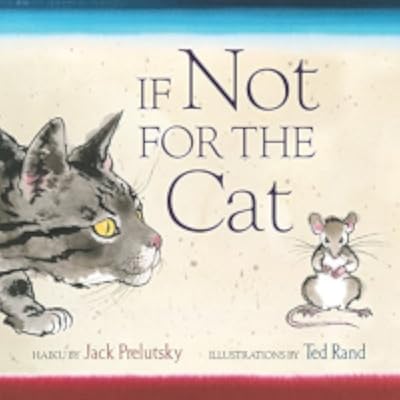
If Not for the Cat
by Jack Prelutsky
On This Page
Description
Haiku-like poems describe a variety of animals.Tags
Recommendations



Member Reviews
I checked this book out of the library for my kids several years ago and fell in love with it, deciding I needed my very own copy. Finally obtained it due to the generosity of a fellow BookCrosser!
I am a fan of Jack Prelutsky, who has entertained my children and me with wonderful "critter" poems in Tyrannosaurus Was a Beast, Scranimals, and Behold the Bold Umbrellaphant. When I read this collection of Haiku, I was charmed. Prelutsky uses wonderful, onomatopoeic language for each brief poem about animals. I think my favorite is the jellyfish:
Boneless, translucent
We undulate, undulate
Gelatinously.
Isn't that wonderful, and a great way to expose kids to big words?
Of course, my kids are practically grown now (ages 18 and 13), so my show more acquisition is really just for me :) I plan to keep it as part of my permanent collection. show less
I am a fan of Jack Prelutsky, who has entertained my children and me with wonderful "critter" poems in Tyrannosaurus Was a Beast, Scranimals, and Behold the Bold Umbrellaphant. When I read this collection of Haiku, I was charmed. Prelutsky uses wonderful, onomatopoeic language for each brief poem about animals. I think my favorite is the jellyfish:
Boneless, translucent
We undulate, undulate
Gelatinously.
Isn't that wonderful, and a great way to expose kids to big words?
Of course, my kids are practically grown now (ages 18 and 13), so my show more acquisition is really just for me :) I plan to keep it as part of my permanent collection. show less
Young readers may be familiar with Jack Prelutsky’s work, but they probably have not heard his haiku. This picture book is full of short poems about animals. The featured creatures range from a cat and mouse to a sloth, and the poems about them capture their traits.
The text is fairly witty, though some poems seem a tad less creative than others. The paintings that accompany the text are beautiful, and the details are big enough that children could see from the back of a crowded story time room. This would be a fun read-aloud because each of the animals has a unique character that can be embodied by the reader. These characterizations would also make this fun in a lesson on poetry performance or in a drama class. It could even be used show more as a mentor text where students could write a haiku while embodying a specific animal. Any age group could appreciate these terse and humorous poems. show less
The text is fairly witty, though some poems seem a tad less creative than others. The paintings that accompany the text are beautiful, and the details are big enough that children could see from the back of a crowded story time room. This would be a fun read-aloud because each of the animals has a unique character that can be embodied by the reader. These characterizations would also make this fun in a lesson on poetry performance or in a drama class. It could even be used show more as a mentor text where students could write a haiku while embodying a specific animal. Any age group could appreciate these terse and humorous poems. show less
A beautiful collection of haiku poems, each describing an animal without naming it, creating a riddle. Each page's illustration paints the picture to support the words, and a "Who is Who" index provided names the creatures.
An excerpt: "How foolish I am./Why am I drawn to the flame/Which extinguishes?"
Beautifully illustrated with watercolors and india ink brush drawings. Provides an interactive experience to engage children in poetry.
An excerpt: "How foolish I am./Why am I drawn to the flame/Which extinguishes?"
Beautifully illustrated with watercolors and india ink brush drawings. Provides an interactive experience to engage children in poetry.
A creature whispers:If not for the cat,And the scarcity of cheese,I could be content.Who is this creature?What does it like to eat?Can you solve the riddle?Seventeen haiku composed by master poet Jack Prelutsky and illustrated by renowned artist Ted Rand ask you to think about seventeen favorite residents of the animal kingdom in a new way. On these glorious and colorful pages you will meet a mouse, a skunk, a beaver, a hummingbird, ants, bald eagles, jellyfish, and many others. Who is who? The answer is right in front of you. But how can you tell? Think and wonder and look and puzzle it out!
This anthology of poetry includes a variety of haiku poems by Jack Prelutsky. The poems share a common theme of creatures including both animals and insects. An index at the back of the book details each creature's name.
This book was extremely interesting to me because I enjoy writing Haiku, but I know it is often disliked by young students because it is often quite symbolic in nature. In contrast, Prelutsky's collection is somehow insightful enough to keep adults intrigued, yet simple enough for children to enjoy. I think Prelutsky's work in this collection might inspire some young writers to try Haiku poetry.
In the classroom, I might use this book as a morning mystery reading...reading one poem aloud each day and encouraging students show more to guess the animal being represented. Then I would reveal the animal at the end of the day. I would also encourage students to find the patterns in the words and attempt to write their own animal Haikus. show less
This book was extremely interesting to me because I enjoy writing Haiku, but I know it is often disliked by young students because it is often quite symbolic in nature. In contrast, Prelutsky's collection is somehow insightful enough to keep adults intrigued, yet simple enough for children to enjoy. I think Prelutsky's work in this collection might inspire some young writers to try Haiku poetry.
In the classroom, I might use this book as a morning mystery reading...reading one poem aloud each day and encouraging students show more to guess the animal being represented. Then I would reveal the animal at the end of the day. I would also encourage students to find the patterns in the words and attempt to write their own animal Haikus. show less
"If Not For The Cat" by Jack Prelutsky is a fun collection of poems. Each poem talks about different kinds of animals and insects. No names are given in this collection just beautiful paintings of each one described in the haiku.
I loved this book and my kids shared just as much enjoyment as I did, we pointed out which animals belonged to which painting/haiku and spanned them out through a couple days.
Classroom extension ideas: After we finish reading the poems the students could write their own hailku with matching painting describing their favorite animal. Next, we could go around the class and each student can say what their animal does to help contribute to the earth.
I loved this book and my kids shared just as much enjoyment as I did, we pointed out which animals belonged to which painting/haiku and spanned them out through a couple days.
Classroom extension ideas: After we finish reading the poems the students could write their own hailku with matching painting describing their favorite animal. Next, we could go around the class and each student can say what their animal does to help contribute to the earth.
Summary:
This book of Haikus is about different animals. Because Haikus are usually very short, it was like a guessing games as each ones described an animal with only descriptive words but never gave the name of the animal.
My Personal Reaction:
I thought this was a really cool way to teach young children about Haikus. When I was in school the Haikus were kind of short and left me wondering how in the world is that poetry. I like that this kind of made poetry into a guessing game not only helping them to understand the type of poetry, but also that it helped them recognize and utilize the descriptive words in trying to guess the animal.
Classroom Extension Ideas:
1. As a class, we could each write a haiku about our favorite animal and show more play a guessing game as each student tries to figure out the other's animal.
2. We could compare this to other forms of poetry and list the differences in each. show less
This book of Haikus is about different animals. Because Haikus are usually very short, it was like a guessing games as each ones described an animal with only descriptive words but never gave the name of the animal.
My Personal Reaction:
I thought this was a really cool way to teach young children about Haikus. When I was in school the Haikus were kind of short and left me wondering how in the world is that poetry. I like that this kind of made poetry into a guessing game not only helping them to understand the type of poetry, but also that it helped them recognize and utilize the descriptive words in trying to guess the animal.
Classroom Extension Ideas:
1. As a class, we could each write a haiku about our favorite animal and show more play a guessing game as each student tries to figure out the other's animal.
2. We could compare this to other forms of poetry and list the differences in each. show less
Members
- Recently Added By
Lists

Youth: Reading, Writing, Humor, Satire
63 works; 1 member
Author Information

117+ Works 33,648 Members
Jack Prelutsky, born on September 8, 1940 in Brooklyn, New York, is primarily known as a poet for children but he is also a gifted musician, actor, photographer, sculptor and potter. Prelutsky studied at Hunter College for two years. He proposed to his future wife, Carolynn, on the day they met; she accepted the next day. While growing up in show more Brooklyn, Prelutsky studied voice at The High School of Music and Art in New York and first planned to be an opera singer. However, he decided he did not have the drive to sing opera, and he became a folk singer. Later he tried his hand at drawing. For fun, he wrote some short poems and made some drawings, which became his first publication. He has since published numerous books of illustrated poetry and also provided illustrations for books by other writers, including many in translation. Prelutsky never condescends to his young readers. He deals in verse with many imaginative creatures, but he also writes about people and problems such bullies, school, and fear of the dark. He is aware of the sound of his words and likes to perform his poetry to the accompaniment of the guitar. He visits schools and libraries to perform his work. Jack Prelutsky is the recipient of numerous awards. In 1977 The Children's Book Council honored him for Nightmares: Poems to Trouble Your Sleep. His other award-winners are The Mean Old Mean Hyena, The Headless Horseman Rides Tonight, and The New Kid on the Block. In 2006, the Poetry Foundation named Prelutsky the inaugural winner of the Children's Poet Laureate award. His book Behold the Bold Umbrellaphant and Other Poems (illustrated by Carin Berger) won the 2007 Scandiuzzi Children's Book Award of the Washington State Book Awards in the Picture Book category. (Bowker Author Biography) show less
Awards and Honors
Awards
Distinctions
Common Knowledge
- Canonical title
- If Not for the Cat
Classifications
Statistics
- Members
- 657
- Popularity
- 43,872
- Reviews
- 48
- Rating
- (4.01)
- Languages
- English
- Media
- Paper
- ISBNs
- 4