Pig-Boy: A Trickster Tale from Hawai'i
by Gerald McDermott
On This Page
Description
The mischievous, shape-shifting Pig-Boy gets in trouble with both the King and Pele, the goddess of fire, but always manages to slip away as his grandmother has told him to do.Tags
Recommendations








Member Reviews
A fun story about a little purple pig that causes mischief on the island and manages to get out of it. In the end he is back with his mother and it seems as if all the mischief is really in his dreams, although the myth to me is the possibility that dreamland and reality is a state of the unknow and possible reality. The pictures are beautiful and bring you through a feeling of bing on the island with the little purple pig.
Pig-Boy is a trickster tale from Hawai'i adapted and illustrated by the late Gerald McDermott. The illustrations are full of bright colors and have an impressionistic feel to them. As for the story, it was a little hard to warm up to Pig-Boy as much as I wanted to. Pig-Boy's human grandmother clearly loves him and is prophetic while speaking softly to him, advising him to slip away if trouble comes. Pig-Boy is based on stories of Kamapua'a, a divine trickster hero in Hawaiian myths so he has the ability to change shape if trouble comes. I especially loved when he transformed himself into 100 little pigs to avoid the king's men.
The illustrations are beautiful and the different ways Pig-Boy escapes are intriguing, but I still found the show more story lacking. It's not Gerald McDermott's best work. show less
The illustrations are beautiful and the different ways Pig-Boy escapes are intriguing, but I still found the show more story lacking. It's not Gerald McDermott's best work. show less
Pig-Boy is a hairy , dirty and hungry pig.And when trouble comes, he knows just what to do. (Of course, escaping trouble comes easily to a trickster, who can shape-shift his way out of sticky situations just in time!) With the tropical colors and cadences of the islands, master artist and storyteller Gerald McDermott brings irrepressible humor. Great for grades K-1.
Pig-Boy is a rather fat little pig that gets into a lot of trouble in this tale. He outsmarts his enemies with his quick thinking. The story begins with the grandmother of Pig-Boy rocking him and foretelling his future. She gives him the advice to just “slip away” from trouble. Then each part of the grandmother’s prophecy comes true. Pig-Boy eats and eats until his eating gets him in trouble with the King. He then slips away by shape-shifting. He runs away and sets sail to go seek refuge with the goddess Pele, but she rejects him by erupting a volcano. He then swims with the fish, but gets caught in the King’s net. He makes himself big and breaks the net, slides down the hill creating a waterfall and washes away the King and his show more men that were after him. Pig-Boy’s problem is solved by slipping away and shape-shifting when he’s about to get caught. At the end, this giant version of Pig-Boy rips a path in the mountain with his bristly back (making a waterfall) that washes away the King and his men.
Pig-Boy is presented, in this story, as being dirty, hairy, and in general, not the kind of animal others wanted around. He also eats too much and burps. The King is mad at him for stealing his chickens…but the goddess Pele doesn’t seem to like him either. She calls him “Swine” and yells at him to leave her alone. Her sort doesn’t associate with his sort, it seems. I think the grandmother knows that the fact that he is a pig will make his life hard, so she teaches him to just slip away. She knows that being “of a lower sort” will cause problems in his life and she tries to frame the life he is destined to as more of an adventure. show less
Pig-Boy is presented, in this story, as being dirty, hairy, and in general, not the kind of animal others wanted around. He also eats too much and burps. The King is mad at him for stealing his chickens…but the goddess Pele doesn’t seem to like him either. She calls him “Swine” and yells at him to leave her alone. Her sort doesn’t associate with his sort, it seems. I think the grandmother knows that the fact that he is a pig will make his life hard, so she teaches him to just slip away. She knows that being “of a lower sort” will cause problems in his life and she tries to frame the life he is destined to as more of an adventure. show less
Another great trickster tale by Gerald McDermott this tale tells the story of a pig that manages to slip away in situations in which he gets himself into trouble. From turning into a hundred little pigs, to a giant pig and into a fish he manages to escape each time he encounters trouble. I like how this book shows Hawaii and the vibrant colors of the illustrations that depict it.
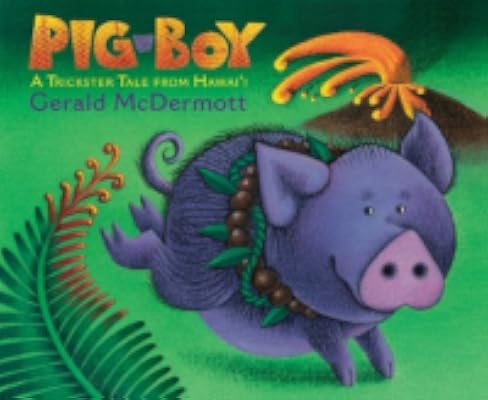
This would be a great book for preschool storytime. The tale is simple but also slightly silly about a greedy pig. The full page illustrations are bright, saturated colors that add alot of life and movement to the story. Pig Boy is also purple, which I think is fabulous.
I liked the dark green, and earthy illustrations, along with the traditional style in how the characters appeared. The Folktale though, breaks the traditional style of something good happens, then something bad happens, and keeps happening until a lesson is learned. The pigboy goes around and steals peoples food as he never gets hungry. As people try to capture Pigboy he transforms, and goes back home, only to imply he will do the same tomorrow.
Members
- Recently Added By
Author Information

35+ Works 12,501 Members
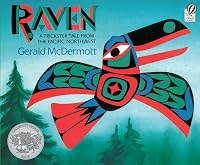
Gerald McDermott was born January 31, 1941 in Detroit, Michigan. He began studying art when he was admitted to a class at one of the nation's finest museums, the Detroit Institute of Arts, when he was just four years old. He continued pursuing his passion for art at Cass Tech, a public high school for the gifted. Upon graduation, he was awarded a show more National Scholastic scholarship to New York's Pratt Institute. He took a leave of absence during his junior year to become the first graphic designer for Channel 13, New York's educational television station, the year it went on the air. He also designed and directed his first animated film, The Stonecutter. He then toured Europe, visiting and exchanging ideas with filmmakers in England, France, and Yugoslavia. He returned to Pratt to finish his degree in 1964 and began producing and directing a series of animated films on folklore. It was then that he met Joseph Campbell, who served as the consultant on four of McDermott's films. McDermott then began to adapt his films into picture books. His first book, Anansi the Spider: A Tale from the Ashanti, was named a Caldecott Honor Book. His other books include Arrow to the Sun: A Tale from the Pueblo that won the 1975 Caldecott Medal, Raven: A Trickster Tale from the Pacific Northwest, another Caldecott Honor Book, and Musicians of the Sun. He died on December 26, 2012 at the age of 71. (Bowker Author Biography) show less
Awards and Honors
Classifications
Statistics
- Members
- 100
- Popularity
- 322,628
- Reviews
- 18
- Rating
- (3.29)
- Languages
- English
- Media
- Paper
- ISBNs
- 2
- ASINs
- 2