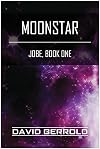
Moonstar Odyssey
by David Gerrold
On This Page
Description
She was born in the moonstar's shadow when the storms of Satlik raged their worst. Because of this, Jobe was different. The family never spoke of it, but everyone knew Jobe was special. So Jobe came to know of it, too. She had a destiny beyond that of Choice, beyond that moment when she would finally have to decide for Reethe, Mother of the World, or for Dakka, Father, Son, and Lover. For the others it was easy, but not for her, not for Jobe. So she was sent to Option, the island of show more learning, to make her choice and become who she must be. And slowly, ever so slowly, Jobe retreated from the world, from the time of decision. Then the ultimate cataclysm wracked the planet, threatening all her people had struggled to create, and Jobe came forth at last to fulfill her destiny and begin the quest that the moonstar had set for her so many years ago. Nebula award nominee for best novel of the year (1977). Originally published as Moonstar Oddessy. show lessTags
Recommendations


















Member Reviews
David Gerrold is best known for what was his very first professional sale--the script for the Star Trek episode "The Trouble with Tribbles, but he's written several science fiction novels quite a few of which have been nominated for or won Hugo or Nebula Awards. This short novel (only 159 paperback pages) is no exception, having been nominated for a Nebula Award in 1977.
Despite that recognition it's out of print, and it hasn't garnered good ratings (or any reviews) on Amazon, Goodreads or Librarything. I think part of that is that it has some unsettling material, while not quite being groundbreaking. The premise and themes remind me quite a bit of Ursula LeGuin's 1969 novel, The Left Hand of Darkness, which dealt with a race of show more hermaphrodites who are only gendered for a few days in a cycle and can be either male or female--but are always referred to as "she." In Moonstar Odyssey children are born ungendered, and when they begin adolescence can choose to be either male or female for the rest of their lives. If this isn't unsettling enough, it deals with child sexuality, since individuals approaching adolescence experiment trying on the different roles. The story centers on Jobe, someone in the throes of "Choice" while her (and all genders are always referred to with the female pronoun) planet goes awry. For quite a while in the book a reader is unsure if Jobe's people are human or mutants or genetically engineered--but we know from the first their planet is terraformed and ecologically fragile. Despite the hints of adventure in the title though, this is a very interior story, told with a mix of third and first person and including some of the planet's legends, history, and geology and ecology. It feels less of a story than LeGuin's novel and as a result might feel a bit like an uninspired copy. At least that's why I think it hasn't endured, although I really did enjoy it. show less
Despite that recognition it's out of print, and it hasn't garnered good ratings (or any reviews) on Amazon, Goodreads or Librarything. I think part of that is that it has some unsettling material, while not quite being groundbreaking. The premise and themes remind me quite a bit of Ursula LeGuin's 1969 novel, The Left Hand of Darkness, which dealt with a race of show more hermaphrodites who are only gendered for a few days in a cycle and can be either male or female--but are always referred to as "she." In Moonstar Odyssey children are born ungendered, and when they begin adolescence can choose to be either male or female for the rest of their lives. If this isn't unsettling enough, it deals with child sexuality, since individuals approaching adolescence experiment trying on the different roles. The story centers on Jobe, someone in the throes of "Choice" while her (and all genders are always referred to with the female pronoun) planet goes awry. For quite a while in the book a reader is unsure if Jobe's people are human or mutants or genetically engineered--but we know from the first their planet is terraformed and ecologically fragile. Despite the hints of adventure in the title though, this is a very interior story, told with a mix of third and first person and including some of the planet's legends, history, and geology and ecology. It feels less of a story than LeGuin's novel and as a result might feel a bit like an uninspired copy. At least that's why I think it hasn't endured, although I really did enjoy it. show less
Ratings
Members
- Recently Added By
Author Information

138+ Works 12,257 Members
David Gerrold is one of the most popular science fiction writers working today. His first professional sale, the Star Trek episode "Trouble With Tribbles," won a Hugo Award. He has written for television, published more than forty books, and had columns in six different magazines. In 1995, his novelette "The Martian Child" won both the Hugo and show more Nebula Awards. Gerrold lives in San Fernando, California, and teaches writing at Pepperdine University show less
Awards and Honors
Awards
Series
Belongs to Publisher Series
Knaur Science Fiction (704)
Common Knowledge
- Canonical title
- Moonstar Odyssey
- Original title
- Moonstar Odyssey
- Original publication date
- 1977
- People/Characters
- Jobe; Sola
- Important places
- Satlik; Option
- Dedication
- This book is for Ted Sturgeon, who showed me how to make it sing.
- First words
- "I was born--
- Last words
- (Click to show. Warning: May contain spoilers.)Not yet, anyway.
Classifications
Statistics
- Members
- 103
- Popularity
- 313,729
- Reviews
- 1
- Rating
- (2.60)
- Languages
- English, German
- Media
- Paper, Ebook
- ISBNs
- 4
- ASINs
- 2