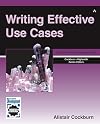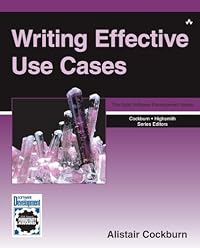
Writing Effective Use Cases
by Alistair Cockburn
On This Page
Description
Use cases have never been this easy to understand -- or this easy to create! In Writing Effective Use Cases, Alistair Cockburn offers a hands-on, soup-to-nuts guide to use case development, based on the proven concepts he has refined through years of research, development, and seminar presentations.KEY TOPICS:Cockburn begins by answering the most basic questions facing anyone interested in use cases: "What does a use case look like? When do I write one?" Next, he introduces each key element show more of use cases: actors, stakeholders, design scope, goal levels, scenarios, and more. Writing Effective Use Cases contains detailed guidelines, formats, and project standards for creating use cases -- as well as a detailed chapter on style, containing specific do's and don'ts. Cockburn shows how use cases fit together with requirements gathering, business processing reengineering, and other key issues facing software professionals. The book includes practice exercises with solutions, as well as a detailed appendix on how to use these techniques with UML.MARKET:For all application developers, object technology practitioners, software system designers, architects, and analysts. show lessTags
Recommendations
Member Reviews
The first thing I noticed is that this book is almost 25 years old. That’s an eternity in computer science, especially in a non-mathematical subject. It was written under the “waterfall” paradigm of software development, before agile took over most of the software engineering world. Instead of a page or two, waterfall specifications could require a binder of dozens, if not hundreds, of pages. This book describes “use cases” instead of the “user stories” that agile commends. Why is this book worth someone’s time? In other words, why did I choose to read it?
For two reasons. First, I’m a big fan of studying history. I’ll admit that I didn’t read every page closely in 2025, but I picked up on why agile design documents show more are organized a certain way. Knowing the history of the field allows me to understand the present better – and theoretically, be prepared for the future better.
Second, most of the literature I’ve read on user stories is overly simplistic. They don’t go into enough detail about what to choose and how. When communicating with my developers, I want to understand what possibilities can and cannot be communicated. To see the global set of options, I had to go back in time to when large design documents were the norm. Just like when someone reads Beowulf or The Canterbury Tales to understand how modern literature took its form, I can see all the glorious option that writing a user story encompasses.
Realistically, I don’t expect this book to be explored by a ton of people now. After all, it’s almost 25 years old! But thumbing through its pages enlightened me a bit as I start to communicate my ideas to the developers I work with. This was the greatest book on use cases in the waterfall era, written by the greatest expert on the subject, so I’m better primed to jump into agile practices and whatever era comes next. show less
For two reasons. First, I’m a big fan of studying history. I’ll admit that I didn’t read every page closely in 2025, but I picked up on why agile design documents show more are organized a certain way. Knowing the history of the field allows me to understand the present better – and theoretically, be prepared for the future better.
Second, most of the literature I’ve read on user stories is overly simplistic. They don’t go into enough detail about what to choose and how. When communicating with my developers, I want to understand what possibilities can and cannot be communicated. To see the global set of options, I had to go back in time to when large design documents were the norm. Just like when someone reads Beowulf or The Canterbury Tales to understand how modern literature took its form, I can see all the glorious option that writing a user story encompasses.
Realistically, I don’t expect this book to be explored by a ton of people now. After all, it’s almost 25 years old! But thumbing through its pages enlightened me a bit as I start to communicate my ideas to the developers I work with. This was the greatest book on use cases in the waterfall era, written by the greatest expert on the subject, so I’m better primed to jump into agile practices and whatever era comes next. show less
After reviewing every book I could find on use cases, this is the one that is making it into the office library. Part 1 addresses the different kinds of use case templates and the parts of those templates. Part 2 is a collection of topics related to use cases (including relating use cases to other types of requirements). Part 3 is an executive summary, or a review of the entire book.
The text was fun to read, but I expect I will get the most use from the downloadable Word template from the author's website and the list of pass/fail tests for the different template fields in the endpapers.
The text was fun to read, but I expect I will get the most use from the downloadable Word template from the author's website and the list of pass/fail tests for the different template fields in the endpapers.
Ratings
Members
- Recently Added By
Author Information

6 Works 1,124 Members
Alistair Cockburn is a renowned software expert and accomplished instructor
Series
Belongs to Publisher Series
Common Knowledge
- Canonical title
- Writing Effective Use Cases
- Original publication date
- 2000-10-15
Classifications
- Genres
- Technology, Nonfiction, General Nonfiction
- DDC/MDS
- 005.3 — Computer science, information & general works Computer science, knowledge & systems Artificial Intelligence/Virtual Reality Software
- LCC
- QA76.76 .A65 .C63 — Science Mathematics Mathematics Instruments and machines Calculating machines Electronic computers. Computer science Computer software
- BISAC
Statistics
- Members
- 541
- Popularity
- 54,716
- Reviews
- 3
- Rating
- (4.02)
- Languages
- 6 — Chinese, English, French, German, Portuguese, Russian
- Media
- Paper, Ebook
- ISBNs
- 12
- UPCs
- 1
- ASINs
- 1