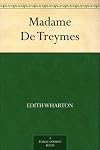
Madame de Treymes
by Edith Wharton
On This Page
Description
Edith Wharton's "Madame de Treymes" is a remarkable example of the form. It is the story of the tactical defeat but moral victory of an honest and upstanding American in his struggle to win a wife from a tightly united but feudally minded French aristocratic family. He loses, but they cheat. . . . In a masterpiece of brevity, Wharton dramatizes the contrast between the two opposing forces: the simple and proper old brownstone New York, low in style but high in principle, and the achingly show more beautiful but decadent Saint-Germain district of Paris. The issue is seamlessly joined. show lessTags
Recommendations
































Member Reviews
His sense of strangeness was increased by the surprise of his companion's next speech.
You wish to marry my sister-in-law?" she asked abruptly; and Durham's start of wonder was followed by an immediate feeling of relief. He had expected the preliminaries of their interview to be as complicated as the bargaining in an Eastern bazaar, and had feared to lose himself at the first turn in a labyrinth of “foreign” intrigue.
I started my year of reading Edith Wharton with this novella, first published in a magazine in 1906, because it was the only one of her books on the shelf last time I went to the library. The copy I read has large print, wide borders and several blank pages between chapters, and it's still a slim book that didn't take show more much more than an hour to read.
The story is about a straightforward and honourable American man who wishes to marry the estranged American wife of an aristocratic Frenchman. Although long separated from her husband, Madame de Malrive is sure that her husband's family will find a way to prevent her from getting a divorce, even though as a Protestant it is not against her religion, and she enlists her sister-in-law Madame de Treymes to help persuade the rest of the family.
It's not much of a spoiler to say that things do not go well for the protagonist. It is obvious from the beginning that the marriage will never happen, and the publishers of my book quote a review on the back cover that gives it away too. I think that the strength of this novella lies in the gloomy atmosphere and the weight of tradition and family hanging over Madame de Malrive, rather than the plot. show less
You wish to marry my sister-in-law?" she asked abruptly; and Durham's start of wonder was followed by an immediate feeling of relief. He had expected the preliminaries of their interview to be as complicated as the bargaining in an Eastern bazaar, and had feared to lose himself at the first turn in a labyrinth of “foreign” intrigue.
I started my year of reading Edith Wharton with this novella, first published in a magazine in 1906, because it was the only one of her books on the shelf last time I went to the library. The copy I read has large print, wide borders and several blank pages between chapters, and it's still a slim book that didn't take show more much more than an hour to read.
The story is about a straightforward and honourable American man who wishes to marry the estranged American wife of an aristocratic Frenchman. Although long separated from her husband, Madame de Malrive is sure that her husband's family will find a way to prevent her from getting a divorce, even though as a Protestant it is not against her religion, and she enlists her sister-in-law Madame de Treymes to help persuade the rest of the family.
It's not much of a spoiler to say that things do not go well for the protagonist. It is obvious from the beginning that the marriage will never happen, and the publishers of my book quote a review on the back cover that gives it away too. I think that the strength of this novella lies in the gloomy atmosphere and the weight of tradition and family hanging over Madame de Malrive, rather than the plot. show less
2. Madame De Treymes by Edith Wharton
published: 1906
format: Kindle ebook (calling it 87 pages)
acquired: November, read: Jan 5-15, time reading: 2:14, 1.5 mpp, rating: 3
genre/style: Henry James style semi-classic, locations: Paris, theme: Wharton
about the author: 1862-1937. Born Edith Newbold Jones on West 23rd Street, New York City. Relocated permanently to France after 1911.
Our latest in the Litsy Wharton theme, published in 1906. This was her 3rd novella, and 5th longer work for fiction, all since 1900.
A cultural clash in Paris between American New York City elite and French nobility and some intermarriage. The novel is marked by gorgeous prose and terrific characterization. Wharton does a good job of making this a nice read with a show more lot going on under the surface. But it is limited by an only ok plot, and mainly of really wealthy people being really wealthy. The cultural tension is American faux-purity and cluelessness mixing with French sophistication. Also, there is subtle of a lack of sincere emotion. But, unlike in House of Mirth, the tension is not on the wealth itself. Still, I really enjoyed this.
2022
https://www.librarything.com/topic/337810#7726305 show less
published: 1906
format: Kindle ebook (calling it 87 pages)
acquired: November, read: Jan 5-15, time reading: 2:14, 1.5 mpp, rating: 3
genre/style: Henry James style semi-classic, locations: Paris, theme: Wharton
about the author: 1862-1937. Born Edith Newbold Jones on West 23rd Street, New York City. Relocated permanently to France after 1911.
Our latest in the Litsy Wharton theme, published in 1906. This was her 3rd novella, and 5th longer work for fiction, all since 1900.
A cultural clash in Paris between American New York City elite and French nobility and some intermarriage. The novel is marked by gorgeous prose and terrific characterization. Wharton does a good job of making this a nice read with a show more lot going on under the surface. But it is limited by an only ok plot, and mainly of really wealthy people being really wealthy. The cultural tension is American faux-purity and cluelessness mixing with French sophistication. Also, there is subtle of a lack of sincere emotion. But, unlike in House of Mirth, the tension is not on the wealth itself. Still, I really enjoyed this.
2022
https://www.librarything.com/topic/337810#7726305 show less
Madame de Treymes is perhaps Edith Wharton's most Jamesian novella or short novel. Set in early Twentieth century Paris, it tells the story of a young American who becomes intrigued by a young American woman, married to a French aristocrat. He is aware that he had known her as a youth friend, Fanny Frisbee, but at that time he had no interest in her. However, when he encounters her in Paris she proves to be irresistable. He falls in love with her, hopes to achieve her divorce, so he can marry her. The key to this plot is Madame de Treymes, Fanny's sister-in-law.
As the title indicates, the novella is mainly centered on Madame de Treymes. Like James, Wharton seems to suggest that the psychology of the ancient, French aristocrats is much show more more sophisticated, and devious than that of the relatively simple American, while the latter's motives are more pure. As in James, Madame de Malrive in this novella is unhappily married to an impoverished aristocrat, however, the reasons for staying with him are quite different. Madame de Treymes reads like a light version of The Portrait of a Lady. show less
As the title indicates, the novella is mainly centered on Madame de Treymes. Like James, Wharton seems to suggest that the psychology of the ancient, French aristocrats is much show more more sophisticated, and devious than that of the relatively simple American, while the latter's motives are more pure. As in James, Madame de Malrive in this novella is unhappily married to an impoverished aristocrat, however, the reasons for staying with him are quite different. Madame de Treymes reads like a light version of The Portrait of a Lady. show less
I read this short novel (really a novella in spite of the fact that it has chapters) as an introduction to Edith Wharton's work. I chose poorly. The plot is interesting enough, concerning a gentleman who wants to marry an American woman living in Paris. The only problem is, she's separated from her current husband, and his family will not consent to a divorce so she can marry again. The novel is restrained, understated, and turn-of-the-century. And those are all bad things in this case. The characters make you feel like they are not real people -- that they are actors playing the part of characters in a book. If that sounds weird, it's on purpose. If you have never read Wharton before, this is not a good introduction to her work. If you show more have read and enjoyed other Wharton works, give this one a pass -- you haven't missed anything. show less
This novella of Edith Wharton's is a gem! In a mere 87 pages a saga unfolds. It is a saga of character, a saga of cultural identities clashing, and a saga of the meaning of love. Excellent!
Members
- Recently Added By
Author Information

378+ Works 63,640 Members
Edith Wharton was a woman of extreme contrasts; brought up to be a leisured aristocrat, she was also dedicated to her career as a writer. She wrote novels of manners about the old New York society from which she came, but her attitude was consistently critical. Her irony and her satiric touches, as well as her insight into human character, show more continue to appeal to readers today. As a child, Wharton found refuge from the demands of her mother's social world in her father's library and in making up stories. Her marriage at age 23 to Edward ("Teddy") Wharton seemed to confirm her place in the conventional role of wealthy society woman, but she became increasingly dissatisfied with the "mundanities" of her marriage and turned to writing, which drew her into an intellectual community and strengthened her sense of self. After publishing two collections of short stories, The Greater Inclination (1899) and Crucial Instances (1901), she wrote her first novel, The Valley of Decision (1902), a long, historical romance set in eighteenth-century Italy. Her next work, the immensely popular The House of Mirth (1905), was a scathing criticism of her own "frivolous" New York society and its capacity to destroy her heroine, the beautiful Lily Bart. As Wharton became more established as a successful writer, Teddy's mental health declined and their marriage deteriorated. In 1907 she left America altogether and settled in Paris, where she wrote some of her most memorable stories of harsh New England rural life---Ethan Frome (1911) and Summer (1917)---as well as The Reef (1912), which is set in France. All describe characters forced to make moral choices in which the rights of individuals are pitted against their responsibilities to others. She also completed her most biting satire, The Custom of the Country (1913), the story of Undine Spragg's climb, marriage by marriage, from a midwestern town to New York to a French chateau. During World War I, Wharton dedicated herself to the war effort and was honored by the French government for her work with Belgian refugees. After the war, the world Wharton had known was gone. Even her Pulitzer Prize-winning novel, The Age of Innocence (1920), a story set in old New York, could not recapture the former time. Although the new age welcomed her---Wharton was both a critical and popular success, honored by Yale University and elected to The National Institute of Arts and Letters---her later novels show her struggling to come to terms with a new era. In The Writing of Fiction (1925), Wharton acknowledged her debt to her friend Henry James, whose writings share with hers the descriptions of fine distinctions within a social class and the individual's burdens of making proper moral decisions. R.W.B. Lewis's biography of Wharton, published in 1975, along with a wealth of new biographical material, inspired an extensive reevaluation of Wharton. Feminist readings and reactions to them have focused renewed attention on her as a woman and as an artist. Although many of her books have recently been reprinted, there is still no complete collected edition of her work. (Bowker Author Biography) show less
Series
Belongs to Publisher Series
Work Relationships
Is contained in
Has the adaptation
Common Knowledge
- Canonical title
- Madame de Treymes
- Original title
- Madame de Treymes
- Original publication date
- 1907
- People/Characters
- Madame de Treymes; Durham; Madam de Malrive
- Important places
- París, Francia
- First words
- John Durham, while he waited for Madame de Malrive to draw on her gloves, stood in the hotel doorway looking out across the Rue de Rivoli at the afternoon brightness of the Tuileries garden.
- Last words
- (Click to show. Warning: May contain spoilers.)"Ah, you poor, good man!" she said with a sob.
- Disambiguation notice
- This is a short work containing the single novella Madame de Treymes. Please do not combine it with the Virago or other editions which contain three other novellas as well. (One edition here has a mismatch between the... (show all) title Madame de Treymes (Penguin 60s) and the ISBN 1844083586, which is one for the Virago edition and is pulling in an incorrect Virago cover. It seems best to leave it here.)
Classifications
Statistics
- Members
- 415
- Popularity
- 74,304
- Reviews
- 9
- Rating
- (3.17)
- Languages
- 6 — Catalan, English, German, Italian, Portuguese, Spanish
- Media
- Paper, Ebook
- ISBNs
- 49
- ASINs
- 13