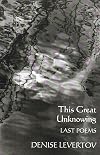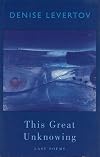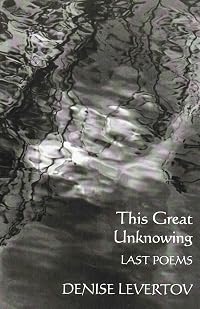
This Great Unknowing
by Denise Levertov
On This Page
Description
Few poets have possessed so great a gift or so great a body of work--when she died at 74, she had been a published poet for more than half a century. The poems themselves shine with the artistry of a writer at the height of her powers.Tags
Recommendations










Member Reviews
I find my first encounter with Denise Levertov somehow ordinary. As elusive as some of the poems are, chronologically arranged, some does not stir enough of anything to leave a mark. Though this also reflects deeply on a number of virtues and the sublimity of nature, its mysticism is not as personally transcendent as let's say Mary Oliver's whose works bower places for me despite my non-belief.
** "What patience a landscape has, like an old horse,
head down in its field.
Grey days,
air and fine rain cling, become one, hovering till at last,
languidly, rain relinquishes that embrace, consents
to fall. What patience a hill, a plain,
a band of woodland holding still, have, and the slow falling
of grey rain...Is it blind faith? Is it
merely a way to show more deeply rest? Is the horse
only resigned, or has it
some desireable knowledge, an enclosed meadow
quite other than its sodden field,
which patience is the key to? Has it already,
within itself, entered the sunwarmed shelter?"
— PATIENCE
(I very much loved Patience, Visitation Overflow, and Memory demands so much.)
As a collection I also struggle to associate it with anything which is one of my criteria in placing a poetry collection in high regard, some has softly torn a part of my soul: Szymborska's Here reminds me of the fragility of existence, O'Hara's Lunch Poems makes me fall in love with the city life again amidst the weight and demand, Neruda's The Captain's Verses (or any poetry collection of his) caresses me with sensuality and adoration whilst both Plath's Ariel: The Restored Edition (not the one rearranged by the notorious Ted Hughes!) and Bukowski's You Get So Alone At Times It Just Makes Sense let me taste the familiar grit, rawness, and dirt of living (and personal demons) every time. Nonetheless, when Levertov's poem is lucid and vivid it is a moment in itself. This does not shy me away with Levertov's works at all but rather determines me to find a collection of hers which will wholeheartedly speak to me.
Other noteworthy lines:
** "Perhaps through a lifetime what I've desired
has always been to return
to that endless giving and receiving, the wholeness
of that attention,
that once-in-a-lifetime
secret communion."
— from FIRST LOVE
** "Westering sun a mist of gold
between solemnities of crowded vertical
poplar twigs. The mountain's
wester slow is touched
weightlessly with what will be, soon,
the afterglow."
— MID-DECEMBER
** " [...] Nostalgia
comes if it must, but is not for borrowing.
I see, I know, the desecration, I taste
the degrading sickly bile of that knowledge —
but I did not witness flower or fruit,
a specific locus, an ancestral ground.
What I hold are the links the mind
forges between a vanished field of imagined trees
and their peers remembered, the shine
of stolen cherries, far off
in time and in place; and also by now perhaps
vanished, that field built over."
— from ALIENATION IN SILICON VALLEY show less
** "What patience a landscape has, like an old horse,
head down in its field.
Grey days,
air and fine rain cling, become one, hovering till at last,
languidly, rain relinquishes that embrace, consents
to fall. What patience a hill, a plain,
a band of woodland holding still, have, and the slow falling
of grey rain...Is it blind faith? Is it
merely a way to show more deeply rest? Is the horse
only resigned, or has it
some desireable knowledge, an enclosed meadow
quite other than its sodden field,
which patience is the key to? Has it already,
within itself, entered the sunwarmed shelter?"
— PATIENCE
(I very much loved Patience, Visitation Overflow, and Memory demands so much.)
As a collection I also struggle to associate it with anything which is one of my criteria in placing a poetry collection in high regard, some has softly torn a part of my soul: Szymborska's Here reminds me of the fragility of existence, O'Hara's Lunch Poems makes me fall in love with the city life again amidst the weight and demand, Neruda's The Captain's Verses (or any poetry collection of his) caresses me with sensuality and adoration whilst both Plath's Ariel: The Restored Edition (not the one rearranged by the notorious Ted Hughes!) and Bukowski's You Get So Alone At Times It Just Makes Sense let me taste the familiar grit, rawness, and dirt of living (and personal demons) every time. Nonetheless, when Levertov's poem is lucid and vivid it is a moment in itself. This does not shy me away with Levertov's works at all but rather determines me to find a collection of hers which will wholeheartedly speak to me.
Other noteworthy lines:
** "Perhaps through a lifetime what I've desired
has always been to return
to that endless giving and receiving, the wholeness
of that attention,
that once-in-a-lifetime
secret communion."
— from FIRST LOVE
** "Westering sun a mist of gold
between solemnities of crowded vertical
poplar twigs. The mountain's
wester slow is touched
weightlessly with what will be, soon,
the afterglow."
— MID-DECEMBER
** " [...] Nostalgia
comes if it must, but is not for borrowing.
I see, I know, the desecration, I taste
the degrading sickly bile of that knowledge —
but I did not witness flower or fruit,
a specific locus, an ancestral ground.
What I hold are the links the mind
forges between a vanished field of imagined trees
and their peers remembered, the shine
of stolen cherries, far off
in time and in place; and also by now perhaps
vanished, that field built over."
— from ALIENATION IN SILICON VALLEY show less
Perhaps 3½ stars. I really liked a few poems in this posthumous collection and didn't dislike any of them. However, most of the poems didn't make any strong emotional connection with me. I'm curious now to see how some of her earlier work strikes me.
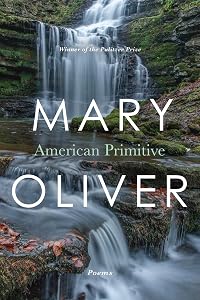
I rejoice to have found a poet I enjoy as much as I do Mary Oliver.
Ratings
Members
- Recently Added By
Author Information

81+ Works 3,109 Members
Born in Essex, England, Denise Levertov became a U.S. citizen after her marriage to Mitchell Goodman, the writer who was indicted, with Benjamin Spock and the Rev. William Sloane Coffin, for his antiwar activities. She came to New York to live in 1948. Levertov acknowledges that her writing was influenced by William Carlos Williams, Charles Olson, show more and Robert Duncan. After her first book, The Double Image (1946), was published in England in 1946, she did not produce another volume until 1957, when City Lights brought out Here and Now. In 1961 she was poetry editor for the Nation, and in 1965 she received the grant in literature from the National Institute of Arts and Letters. Her essays collected in The Poet in the World (1973) and Light Up the Cave are written with a penetrating intelligence. Winner of numerous awards and prizes, she is a poet of reverence and fierce moral drive. Denise Levertov died December 20, 1997. (Bowker Author Biography) show less
Classifications
Statistics
- Members
- 134
- Popularity
- 243,261
- Reviews
- 3
- Rating
- (3.82)
- Languages
- English
- Media
- Paper, Ebook
- ISBNs
- 4
- ASINs
- 1