The Man Who Would Be King [1975 film]
by John Huston (Director/Screenwriter), Gladys Hill (Screenwriter)
On This Page
Description
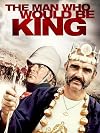
Danny Dravot and Peachy Carnehan leave 19th century India and set out for the isolated, primitive land of Kafiristan, whose people haven't seen an outsider in hundreds of years. Peachy becomes lord of the kingdom's treasury, a huge chamber spilling over with limitless gold and priceless rare jewels. Danny is first crowned king, then, declared a god.Tags
Recommendations
















Member Reviews
Members
- Recently Added By
Published Reviews
ThingScore 75
Huston's narrative is both an ironic parable about the motives and methods of imperialism and a series of gags about civilization and barbarism. When savages in war masks are hit by bullets, the image is a sick-joke history of colonialism, and when the vulgarian heroes try to civilize the tribes they conquer, they obviously have not much more than their own military conditioning to draw upon. show more Danny and Peachy are British primitives who seek to turn the savages into Englishmen by drilling them in discipline and respect for authority. Danny becomes as sanctimonious about that mission as Victoria herself, and is baffled when the natives show ingratitude...
Connerv's Danny has a beatific, innocent joy in his crazy goal even when he's half frozen en route; few actors are as unself-consciously silly as Connery is willing to be—as he enjoys being. Danny's fatuity is sumptuous as he throws himself into his first, half-embarrassed lofty gestures. Connery plays this role without his usual hairpieces, and, undisguised—bare-domed—he seems larger, more free; if baldness ever needed redeeming, he's done it for all time. Came has the Bogart role, which means he's Huston's protagonist; Peachy is the smarter of the two, the wise-guy realist, loyal to Danny even when he's depressed by Danny's childishness. We see through Peaehy's sane, saddened eyes the danger in Danny's believing himself a man of destiny, and Caine manages this with the modesty of a first-rate actor. He stays in character so convincingly that he's able to bring off the difficult last scene, rounding out the story conception, when it becomes apparent that Peachy has "gone native." show less
Connerv's Danny has a beatific, innocent joy in his crazy goal even when he's half frozen en route; few actors are as unself-consciously silly as Connery is willing to be—as he enjoys being. Danny's fatuity is sumptuous as he throws himself into his first, half-embarrassed lofty gestures. Connery plays this role without his usual hairpieces, and, undisguised—bare-domed—he seems larger, more free; if baldness ever needed redeeming, he's done it for all time. Came has the Bogart role, which means he's Huston's protagonist; Peachy is the smarter of the two, the wise-guy realist, loyal to Danny even when he's depressed by Danny's childishness. We see through Peaehy's sane, saddened eyes the danger in Danny's believing himself a man of destiny, and Caine manages this with the modesty of a first-rate actor. He stays in character so convincingly that he's able to bring off the difficult last scene, rounding out the story conception, when it becomes apparent that Peachy has "gone native." show less
added by SnootyBaronet
Lists

Great Films Based on Books
319 works; 140 members
Author Information

The son of Walter Huston, the well-known movie actor, John Huston directed numerous Hollywood films, including such classics as The Treasure of the Sierra Madre (1948), for which he won an Oscar as best director, and The Asphalt Jungle (1950). He wrote the screenplays for many of them, including the quintessential hard-boiled detective movie The show more Maltese Falcon (1941), which was also his directorial debut. Huston's protagonists are often either independent professionals whose tough exteriors hide a dedication to principle, like the detective in The Maltese Falcon, or losers whose obsession with a doomed quest leads to their destruction, like the three gold-seekers in The Treasure of the Sierra Madre. But, in his 46-year career, he would try his hand at almost everything, from the grand comedy of The African Queen (1952) to the shaggy dog tale Beat the Devil (1954), the offbeat western The Misfits (1961), the rather bloated epic The Bible (1966), and the medieval allegory, A Walk with Love and Death (1970). As he aged, his films seemed to get deeper and better, starting with The Man Who Would Be King (1975) and continuing with Wise Blood (1979) and Prizzi's Honor (1985). His final work, The Dead (1987), is an exquisite film adaptation of the short story by James Joyce. (Bowker Author Biography) show less
All Editions
Some Editions
Awards and Honors
Notable Lists
Work Relationships
Is an adaptation of
Has the adaptation
Common Knowledge
- Canonical title
- The Man Who Would Be King [1975 film]
- Original title
- The Man Who Would Be King
- Original publication date
- 1975-11-26
- People/Characters
- Daniel Dravot; Peachy Taliaferro Carnehan; Rudyard Kipling
- Important places
- India
- Important events
- 19th century; 1880s; 1885
- Related movies
- The Man Who Would Be King (1975 | IMDb)
Classifications
Statistics
- Members
- 179
- Popularity
- 182,601
- Rating
- (3.81)
- Languages
- English, French, Multiple languages, Spanish
- ISBNs
- 8
- UPCs
- 3
- ASINs
- 10