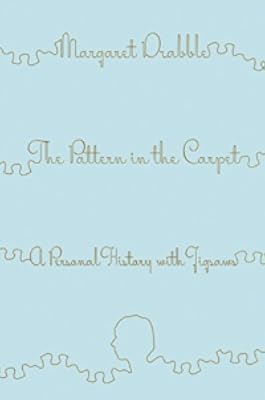
The Pattern in the Carpet: A Personal History with Jigsaws
by Margaret Drabble
On This Page
Description
The author offers an innovative mix of memoir, jigsaw-puzzle history, and the strange delights of puzzling, with sketches of her family members and her thoughts on the importance of childhood play, art, and writing.Tags
Recommendations















Member Reviews
I was rather hoping this would come in a box, like The unfortunates, but with odd-shaped pieces you have to put together in the right order to make a 300 page book. Sadly it doesn't. But that's just about the only thing that disappointed me in this gloriously wide-ranging, unpredictable, clever and sympathetic celebration of jigsaw puzzles and the author's Auntie Phyl.
Drabble shoots off down every conceivable side-track, to look into not only the history of the puzzles themselves, but the way they relate to other toys and games, as well as to crafts and adult pastimes. She examines her memories of childhood holidays at her aunt's house, a B&B in a village on the Great North Road, and of her adult relationship with her aunt in old age show more (both of which involved doing jigsaw puzzles together, of course) and tries to make sense of where the borderline falls between kitschy nostalgia and permissible aesthetic appreciation of the artefacts of the past. She's pretty sure the brass warming-pan she rescued from her aunt's house is on the wrong side of this line, somehow, but she's hanging on to it anyway.
There's a lot here about Perec and La vie: mode d'emploi, but also about Jules Verne and his use of the Goose Game, and Southey and Coleridge on their "Aunt Hill". Meanwhile, passing by on the A1 are Doctor Johnson — who might have been more relaxed if he'd agreed to play draughts sometimes — and the mad poet John Clare. Drabble finds jigsaws and jigsaw imagery in the most surprising corners of fine art and English literature, gets to put together one of John Spilsbury's original Dissected Maps in the British Library (the pieces for Scotland and Corsica are missing), and is taken on a tour of the unexpected mosaics and interlocking pieces of London by a helpful cabbie called Kevin.
This is a book that will tell you a lot of things you didn't know you needed to know, and will probably leave you with an odd urge to get out one of your old jigsaw puzzles. Apart from that, I'm not quite sure what it is for or how to classify it, but I enjoyed it very much. show less
Drabble shoots off down every conceivable side-track, to look into not only the history of the puzzles themselves, but the way they relate to other toys and games, as well as to crafts and adult pastimes. She examines her memories of childhood holidays at her aunt's house, a B&B in a village on the Great North Road, and of her adult relationship with her aunt in old age show more (both of which involved doing jigsaw puzzles together, of course) and tries to make sense of where the borderline falls between kitschy nostalgia and permissible aesthetic appreciation of the artefacts of the past. She's pretty sure the brass warming-pan she rescued from her aunt's house is on the wrong side of this line, somehow, but she's hanging on to it anyway.
There's a lot here about Perec and La vie: mode d'emploi, but also about Jules Verne and his use of the Goose Game, and Southey and Coleridge on their "Aunt Hill". Meanwhile, passing by on the A1 are Doctor Johnson — who might have been more relaxed if he'd agreed to play draughts sometimes — and the mad poet John Clare. Drabble finds jigsaws and jigsaw imagery in the most surprising corners of fine art and English literature, gets to put together one of John Spilsbury's original Dissected Maps in the British Library (the pieces for Scotland and Corsica are missing), and is taken on a tour of the unexpected mosaics and interlocking pieces of London by a helpful cabbie called Kevin.
This is a book that will tell you a lot of things you didn't know you needed to know, and will probably leave you with an odd urge to get out one of your old jigsaw puzzles. Apart from that, I'm not quite sure what it is for or how to classify it, but I enjoyed it very much. show less
This was a lot of fun, on multiple levels. It's a rather rambling book - she set out to write a history of jigsaw puzzles, but her own life and that of her Auntie Phyl kept sneaking in. And classical references, and other authors, and the romanticization of ordinary life in England a generation or two (at the time of writing) ago... Also rabbit holes about mosaics and collages and other forms of put-the-bits-together arts, and crafts. I really don't think I'd enjoy her novels - not my style - but I enjoyed her writing here quite a bit. I learned several things (including some about the history of jigsaws), looked bewilderedly at quite a lot (name-dropping authors I never heard of), and overall had a lot of fun reading. She also has show more endnotes and a bibliography, should you wish to pursue the subject(s). I was ready for it to be over before it was, but the last several chapters are quite short (and each interesting), so it kept me going to the end. show less
I received this book as a gift, along with three jigsaw puzzles. I was immediately drawn into it and had trouble putting it down. I loved the way Drabble lets one train of thought lead to another, making connections between various methods of putting things together to form patterns. She manages to tie these various things back to her own childhood influences. Her research was amazing and I now have dozens of books to dig into. She managed to touch on so many of my own interests that it was uncanny. I'm sure that the many somewhat obscure references that I "got" might just bore others who wouldn't recognize them. I loved it so much that I immediately ordered another copy to give to a jigsaw loving, Anglophile friend.
Margaret Drabble gives us the history of jigsaw puzzles in a meandering manner with lots of detours along the way. In her research (which was extensive) she found that jigsaw puzzles started out as educational toys- maps cut into countries or counties, teaching geography as they are put together. Later, picture puzzles were used as a free gift with purchase. They became immensely popular, triggering the creation of picture puzzles as things to be sold. The author relates them to the history of games in general (there have always been games), and, at the suggestion of a cab driver, to mosaics.
Drabble was introduced to jigsaw puzzles as a child by her spinster aunt Phyll, and so this memoir talks a good bit about her, and Drabble’s show more relationship with her- a relationship more loving –or at least friendlier-than what existed in Drabble’s own home, where the children were always being told to shut up and be quiet. It was a lifelong relationship; Drabble continued to visit her aunt until Phyll’s death in a senior home. She has also continued working jigsaw puzzles as a means of relaxation.
This is neither autobiography, family history, nor strict history of puzzles. It’s not in chronological order. It’s like sitting down with a very erudite friend and having a chat-quite possibly over one of those jigsaw puzzles- and bouncing back and forth between subjects as one does in conversation. It was a pleasant book to read, and it was very interesting to hear one of my favorite author’s personal voice as opposed to her fiction writing voice. Reading about how her research branched and led her down rabbit holes made me laugh- I know how that happens. And I found it reassuring that someone as educated and smart as herself still wastes time doing puzzles- it makes me feel less guilty about it! show less
Drabble was introduced to jigsaw puzzles as a child by her spinster aunt Phyll, and so this memoir talks a good bit about her, and Drabble’s show more relationship with her- a relationship more loving –or at least friendlier-than what existed in Drabble’s own home, where the children were always being told to shut up and be quiet. It was a lifelong relationship; Drabble continued to visit her aunt until Phyll’s death in a senior home. She has also continued working jigsaw puzzles as a means of relaxation.
This is neither autobiography, family history, nor strict history of puzzles. It’s not in chronological order. It’s like sitting down with a very erudite friend and having a chat-quite possibly over one of those jigsaw puzzles- and bouncing back and forth between subjects as one does in conversation. It was a pleasant book to read, and it was very interesting to hear one of my favorite author’s personal voice as opposed to her fiction writing voice. Reading about how her research branched and led her down rabbit holes made me laugh- I know how that happens. And I found it reassuring that someone as educated and smart as herself still wastes time doing puzzles- it makes me feel less guilty about it! show less
This is a rambly part-memoir, part-jigsaw-informational, part-game-history mess of a book. She acknowledges this near the end of the book:
"I have strayed far from my plan, which was to write a brief illustrated history of the jigsaw puzzle. I find myself with a bucket full of leftover tesserae, some with jagged and uneven edges encrusted with old mastic and resin, which do not fit into my original design."
But gracious - the territory she covers!. I lost count of all the authors she's read (complete with their excerpts) who mentioned anything about jigsaws (or other games), all the visits she's made to museums, libraries, the art, tapestries, movies... If there was any kind of minutiae to be found about puzzles or games, she found a show more place to put it in this book.
I didn't love it, but I finished it, which is more than I can say for the only one of her sister's books that I started and abandoned forever. show less
"I have strayed far from my plan, which was to write a brief illustrated history of the jigsaw puzzle. I find myself with a bucket full of leftover tesserae, some with jagged and uneven edges encrusted with old mastic and resin, which do not fit into my original design."
But gracious - the territory she covers!. I lost count of all the authors she's read (complete with their excerpts) who mentioned anything about jigsaws (or other games), all the visits she's made to museums, libraries, the art, tapestries, movies... If there was any kind of minutiae to be found about puzzles or games, she found a show more place to put it in this book.
I didn't love it, but I finished it, which is more than I can say for the only one of her sister's books that I started and abandoned forever. show less
This book is not quite what I expected from the description at the bookseller. While I expected some memoir to be interwoven, there was far more memoir than there was about jigsaw puzzles. My favorite portions of the book were those that dealt with the jigsaw puzzle's history, with the art work from which jigsaws are often taken, from the maps that were the earliest jigsaws, and from the depiction of the jigsaw puzzle in literature, particularly in the mystery genre. The memoir part focused on working jigsaws with her Aunt Phyl and then somehow trying to make the jigsaw a metaphor for her life. That particular aspect just didn't work. It tended to ramble a bit too much. Chapters, for the most part, were very short, lending to an overall show more choppiness in the narrative. I could tell the author was well-versed in literature, and there is a reference to her work on The Oxford Companion to English Literature in the narrative.
While I am still uncertain of why Drabble included this particular memory, I'm glad she did. As a native of Mississippi, I have seen the state depicted negatively in so much literature and non-fiction. One of Drabble's favorite tour moments occurred in my home state: "Once, years ago, on a lecture tour of Mississippi and Alabama, I was put up for a night or two in a motel just outside Hattiesburg near the University of Southern Mississippi. It was on one of those American strips, lined on both sides by gas stations and Tex-Mex diners and Baskin Robbins and small superstores. As I remember it, the motel had a wooden veranda on which were lined up some wooden rocking chairs. Sitting on one of these chairs, rocking myself gently and watching the polluting traffic pass noisily by, I was at peace. It is a surprisingly pleasant memory. I think the motel reminded me of Bryn. It is one of the best recollections I have of all those book tours and lecture tours, where time was divided between frenzied anxiety at airports and imprisoned restlessness in hotel rooms waiting for the next interview. Sitting in the slipstream, rocking, watching the world go by." show less
While I am still uncertain of why Drabble included this particular memory, I'm glad she did. As a native of Mississippi, I have seen the state depicted negatively in so much literature and non-fiction. One of Drabble's favorite tour moments occurred in my home state: "Once, years ago, on a lecture tour of Mississippi and Alabama, I was put up for a night or two in a motel just outside Hattiesburg near the University of Southern Mississippi. It was on one of those American strips, lined on both sides by gas stations and Tex-Mex diners and Baskin Robbins and small superstores. As I remember it, the motel had a wooden veranda on which were lined up some wooden rocking chairs. Sitting on one of these chairs, rocking myself gently and watching the polluting traffic pass noisily by, I was at peace. It is a surprisingly pleasant memory. I think the motel reminded me of Bryn. It is one of the best recollections I have of all those book tours and lecture tours, where time was divided between frenzied anxiety at airports and imprisoned restlessness in hotel rooms waiting for the next interview. Sitting in the slipstream, rocking, watching the world go by." show less
I wanted to like this book. It's an interesting idea: memoir, interleaved with a history of the jigsaw and related pastimes. A shared love of jigsaws drew Drabble closer to her great-aunt Phyllis.
Each part of the book is interesting in its own right: the story of Phyllis and Margaret, and their family; the discursive discussions on jigsaw history, and other pursuits that seem to tick some of the same boxes - mosaic making for instance. But it feels a lot longer than it should have been, as though Drabble hasn't been able to bear to edit out any nugget from her research.
I was determined to reach the end, and was relieved when I finally did.
Each part of the book is interesting in its own right: the story of Phyllis and Margaret, and their family; the discursive discussions on jigsaw history, and other pursuits that seem to tick some of the same boxes - mosaic making for instance. But it feels a lot longer than it should have been, as though Drabble hasn't been able to bear to edit out any nugget from her research.
I was determined to reach the end, and was relieved when I finally did.
Members
- Recently Added By
Published Reviews
ThingScore 50
“The Pattern in the Carpet” is a discursive, loosely organized mix of Drabble’s memories — some but not all of them having to do with solving puzzles — and her accounts of her own research into the history of jigsaws and other games.
added by jlelliott
Lists

Forty Days of Non-Fiction
16 works; 1 member
Author Information

68+ Works 13,798 Members
Margaret Drabble was born on June 5, 1939 in Sheffield, England. She attended The Mount School in York and Newnham College, Cambridge University. After graduation, she joined the Royal Shakespeare Company at Stratford during which time she understudied for Vanessa Redgrave. She is a novelist, critic, and the editor of the fifth edition of The show more Oxford Companion to English Literature. Her works include A Summer Bird Cage; The Millstone, which won the John Llewelyn Rhys Prize in 1966; Jerusalem the Golden, which won James Tait Black Prize in 1967; and The Witch of Exmoor. She also received the E. M. Forster award and was awarded a Society of Authors Travelling Fellowship in the 1960s and the Commander of the Order of the British Empire in 1980. (Bowker Author Biography) show less
Some Editions
Awards and Honors
Notable Lists
Common Knowledge
- Original publication date
- 2009
- People/Characters
- Margaret Drabble
- Dedication
- For Phyllis Bloor
- First words
- As she went to bed that night, she said that she wished we had been able to finish the jigsaw. 'It's a pity,' she said, as she gave up. 'It's a pity.' It was the last evening of the last summer.
- Last words
- (Click to show. Warning: May contain spoilers.)Books, too, have beginnings and endings, and they attempt to impose a pattern, to make a shape. We aim, by writing them, to make order from chaos. We fail. The admission of failure is the best that we can do. It is a form of progress.
Classifications
- Genres
- Biography & Memoir, Nonfiction, General Nonfiction
- DDC/MDS
- 793.73 — Arts & recreation Recreation, sports, and performing arts Indoor games and amusements Non-action games, puzzles [boardgames now 794] Puzzles and puzzle games
- LCC
- GV1507 .J5 .D73 — Geography, Anthropology and Recreation Recreation. Leisure Recreation. Leisure Games and amusements Parties. Party games and stunts Puzzles
- BISAC
Statistics
- Members
- 281
- Popularity
- 114,974
- Reviews
- 16
- Rating
- (3.43)
- Languages
- English
- Media
- Paper, Audiobook, Ebook
- ISBNs
- 10
- ASINs
- 4