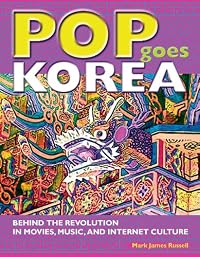
Pop Goes Korea: Behind the Revolution in Movies, Music, and Internet Culture
by Mark James Russell
On This Page
Description
"Mr. Russell's book is the first by a non-Korean to explain the rise of Korea's entertainment industries....the book could hardly be more approachable."--Wall Street Journal "For a country that traditionally received culture, especially from China but also from Japan and the United States, South Korea finds itself at a turning point in its new role as exporter.”--The New York Times From kim chee to kim chic! South Korea came from nowhere in the 1990s to become one of the biggest producers show more of pop content (movies, music, comic books, TV dramas, online gaming) in Asia--and the West. Why? Who’s behind it? Mark James Russell tells an exciting tale of rapid growth and wild success marked by an uncanny knack for moving just one step ahead of changing technologies (such as music downloads and Internet comics) that have created new consumer markets around the world. Among the media pioneers profiled in this book is film director Kang Je-gyu, maker of Korea’s first blockbuster film Shiri; Lee Su-man, who went from folk singer to computer programmer to creator of Korea’s biggest music label; and Nelson Shin, who rose from North Korea to the top of the animation business. Full of fresh analysis, engaging reportage, and insightful insider anecdotes, Pop Goes Korea explores the hallyu (the Korean Wave) hitting the world’s shores in the new century. Mark James Russell is a freelance writer who lived in Korea for 13 years, specializing in Korean pop culture. His articles have appeared in the New York Times, Wall Street Journal, Foreign Policy, Newsweek, The Hollywood Reporter, Billboard, and other publications. He has also written extensively from around Asia, from Mongolia to Japan to Thailand. He currently lives in Spain. show lessTags
Recommendations












Member Reviews
So you want to know about the phenomenal growth of the Korean film industry without getting your feet wet and actually watching any Korean films? Want to know how K Pop is taking over Asia - well teenage Asia anyway? Want to know how Super Junior can possibly work with 13 members? Want to hear how Sean Yang killed the music business and then resurrected it? This is the book for you. I don't know that I'l be listening to any more K Pop but I do think I'll try and watch a few more Korean films.
At times its repetitive, and could have done with stronger editing - its as though the author didn't expect anyone to read ALL the chapters so he keeps making the same points particularly about Korean history, filial piety etc /But a great show more introduction to Korean Pop culture. And whatever you think of The Korean Wave, it is remarkable that in 15 years Korea has changed from mainly consuming Western film and music to mainly consuming its own and exporting it. And it didn't do it through protection. A lesson there for us all show less
At times its repetitive, and could have done with stronger editing - its as though the author didn't expect anyone to read ALL the chapters so he keeps making the same points particularly about Korean history, filial piety etc /But a great show more introduction to Korean Pop culture. And whatever you think of The Korean Wave, it is remarkable that in 15 years Korea has changed from mainly consuming Western film and music to mainly consuming its own and exporting it. And it didn't do it through protection. A lesson there for us all show less
For an English language resource, this is a gem of a book. Keeping in mind that Korea has a relatively short (but very interesting) pop culture, this book covers all the bases quite nicely. It features a variety of tidbits and little known facts sprinkled throughout the book.
I applaud the author for pioneering an English language legitimate published text - a fresh break from the bloggers who dominate this field of interest. The information is as up-to-date as a book can be (pub 2008) but a slight out-of-dateness is to be expected for a text about the ever-changing pop culture. However, since the majority of the book covers the upstarts of each industry, the lack of 2009 material is unavoidable and easily forgiven.
The author's writing show more style is both a pro and a con. The writer seems to be comfortable in his knowledge of the subject but sometimes has too much of a conversational tone - almost to a fault of sounding uneducated. However, I really don't want that to sound too harsh because I believe one of his strengths is his ability to both inform and also entertain. He's got a great sense of Western humor that appears amongst this Eastern pop culture history.
I was also disappointed by the lack of photos throughout the book. The beginning has plenty of color pictures to prepare for the in-depth look that's coming ahead but the book itself is lacking accompanying photos. It would have made the biographies of Lee Byung-Hun and Lee Soon-Man more easy to follow.
My biggest complaint is the lack of Korean text. How hard would it have been to include Hanguel in the chapters? All movies, songs, TV dramas, and actors have either transliterated or romanized names which is frustrating when searching for the original source material. The least that could have been done is to include the original Korean names in parenthesis. A careless oversight.
However, I do want to conclude with saying that the author knows his stuff and has written an excellent primer on all things Korean. His background history on the PIFF (Busan International Film Festival) is impressive as is his approach to Korean movies in general (and why there is so much more to the Korean wave than 1999's Shiri). All in all, this book is well worth your time. show less
I applaud the author for pioneering an English language legitimate published text - a fresh break from the bloggers who dominate this field of interest. The information is as up-to-date as a book can be (pub 2008) but a slight out-of-dateness is to be expected for a text about the ever-changing pop culture. However, since the majority of the book covers the upstarts of each industry, the lack of 2009 material is unavoidable and easily forgiven.
The author's writing show more style is both a pro and a con. The writer seems to be comfortable in his knowledge of the subject but sometimes has too much of a conversational tone - almost to a fault of sounding uneducated. However, I really don't want that to sound too harsh because I believe one of his strengths is his ability to both inform and also entertain. He's got a great sense of Western humor that appears amongst this Eastern pop culture history.
I was also disappointed by the lack of photos throughout the book. The beginning has plenty of color pictures to prepare for the in-depth look that's coming ahead but the book itself is lacking accompanying photos. It would have made the biographies of Lee Byung-Hun and Lee Soon-Man more easy to follow.
My biggest complaint is the lack of Korean text. How hard would it have been to include Hanguel in the chapters? All movies, songs, TV dramas, and actors have either transliterated or romanized names which is frustrating when searching for the original source material. The least that could have been done is to include the original Korean names in parenthesis. A careless oversight.
However, I do want to conclude with saying that the author knows his stuff and has written an excellent primer on all things Korean. His background history on the PIFF (Busan International Film Festival) is impressive as is his approach to Korean movies in general (and why there is so much more to the Korean wave than 1999's Shiri). All in all, this book is well worth your time. show less
Ratings
Members
- Recently Added By
Lists

Music Journalism and Biography
56 works; 1 member
Author Information
3 Works 48 Members
Common Knowledge
- Important places
- South Korea
Classifications
- Genres
- Nonfiction, Art & Design, Music, Sociology, General Nonfiction
- DDC/MDS
- 302.23095195 — Social sciences Social sciences, sociology & anthropology Social interaction Communication Media (Means of communication)
- LCC
- P94.65 .K6 .R87 — Language and Literature Philology. Linguistics Communication. Mass media
- BISAC
Statistics
- Members
- 22
- Popularity
- 1,183,065
- Reviews
- 2
- Rating
- (4.25)
- Languages
- English
- Media
- Paper, Ebook
- ISBNs
- 2