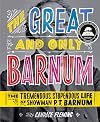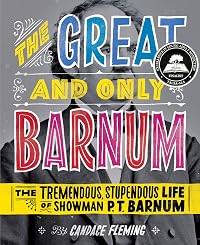
The Great and Only Barnum: The Tremendous, Stupendous Life of Showman P.T. Barnum
by Candace Fleming
On This Page
Description
Biography of P.T. Barnum, showman and founder of the Barnum & Bailey Circus. Readers can visit Barnum's American Museum; meet Tom Thumb, the miniature man (only 39 in. tall) and his tinier bride (32 in.); experience the thrill Barnum must have felt when, at age 60, he joined the circus; and discover Barnum's legacy.Tags
Recommendations







Member Reviews
Before he was the great circus showman P.T. Barnum, he was Phineas Taylor Barnum (known to friends and family as Taylor or even just Tale) – a simple country boy from a small village in Connecticut. In this book, Candace Fleming chronicles how Tale grew from helping out in the family’s farm and grocery to becoming the ultimate showman and a driving force behind the world-famous Barnum & Bailey circus.
Throughout this biography, there are numerous examples of economic concepts at work. Notably, the reader learns about Barnum’s upbringing and how he began manual labor at a young age. His parents enforced in him the notions of earning and saving money, with Barnum recalling “my father did not miss an opportunity for a financial show more lesson.” With these lessons at hand, Tale began saving pennies by age 5 and paying for his own clothing by age 7. By age 15, the elder Barnum had passed away and Tale was responsible for earning money to support the whole household.
But Barnum was never a fan of working with his hands, preferring instead to work with his head and come up with unique ways to make money. One of his schemes revolved around making candy to sell to weary and hungry volunteer soldiers after a day’s training. Another involved buying a large quantity of cheap green bottles and then offering them as prizes in a lottery at his uncle’s grocery shop. These examples, along with others, show Barnum’s almost innate understanding of human reasoning (he later wrote of the lottery incident, “People like to win, no matter how small the prize.”) and his ability to capitalize on that knowledge for his monetary gain.
In his later teen years, Barnum moved to New York City, continuing to work as a grocer’s clerk, but also learning about business with the hopes of one day running his own. Fleming writes, “He wanted one [job] where he could use his imagination and energy. He wanted to be is own boss. And he wanted to make lots of money.” Barnum engaged in various odd jobs over the years, including working in small circuses. Eventually, Barnum fell into buying and exhibiting natural curiosities – often the cringe-worthy practice of displaying people deemed as “other” enough to be astonishing – and he used all the lessons about human nature he gleaned up until this point to sell his show. For instance, his first exhibit was of Joice Heth, a slave who was reputed to be more than 160 years old and to have been originally owned by George Washington’s father. When visiting crowds started to die down, Barnum planted a false rumor that Heth was really a mechanical robot voice by Barnum himself in order to drive up ticket sales once again. Barnum concluded, “Controversy is good for business.” This early exhibit raked in money for Barnum – reportedly earning each week the equivalent of $35,000 today. He later acquired oddities and rarities to make up the exhibits in his Barnum’s American Museum, using all his past job experiences and business savvy to create an experience that astounded his museum-goers and made hundreds of thousands of dollars (the equivalent of millions today) in profits for Barnum.
After decades of running his museum, Barnum finally retired only to find himself in need of a new project to combat boredom. When he received a letter asking to become a partner in a small traveling circus, he jumped at the chance and launched a new career in the circus. He went through several partners before teaming up with James Bailey and at last the famous Barnum & Bailey Greatest Show on Earth circus was born.
Fleming has clearly done her research with this biography of P.T. Barnum, using various (and sometimes humorous) anecdotes to move the story along and provide fascinating tidbits about Barnum’s life, his family, and the stars of his museum and circus. She intersperses her writing with quotes from primary source materials including Barnum’s autobiography, personal letters, and relevant newspaper articles. The book also includes reproductions of archival materials such as photographs, engravings, advertisements, ticket stubs, and so forth. The final product is a biography so riveting that children and teens (and possibly even adults) will not want to put it down.
I reviewed this book for EconKids. show less
Throughout this biography, there are numerous examples of economic concepts at work. Notably, the reader learns about Barnum’s upbringing and how he began manual labor at a young age. His parents enforced in him the notions of earning and saving money, with Barnum recalling “my father did not miss an opportunity for a financial show more lesson.” With these lessons at hand, Tale began saving pennies by age 5 and paying for his own clothing by age 7. By age 15, the elder Barnum had passed away and Tale was responsible for earning money to support the whole household.
But Barnum was never a fan of working with his hands, preferring instead to work with his head and come up with unique ways to make money. One of his schemes revolved around making candy to sell to weary and hungry volunteer soldiers after a day’s training. Another involved buying a large quantity of cheap green bottles and then offering them as prizes in a lottery at his uncle’s grocery shop. These examples, along with others, show Barnum’s almost innate understanding of human reasoning (he later wrote of the lottery incident, “People like to win, no matter how small the prize.”) and his ability to capitalize on that knowledge for his monetary gain.
In his later teen years, Barnum moved to New York City, continuing to work as a grocer’s clerk, but also learning about business with the hopes of one day running his own. Fleming writes, “He wanted one [job] where he could use his imagination and energy. He wanted to be is own boss. And he wanted to make lots of money.” Barnum engaged in various odd jobs over the years, including working in small circuses. Eventually, Barnum fell into buying and exhibiting natural curiosities – often the cringe-worthy practice of displaying people deemed as “other” enough to be astonishing – and he used all the lessons about human nature he gleaned up until this point to sell his show. For instance, his first exhibit was of Joice Heth, a slave who was reputed to be more than 160 years old and to have been originally owned by George Washington’s father. When visiting crowds started to die down, Barnum planted a false rumor that Heth was really a mechanical robot voice by Barnum himself in order to drive up ticket sales once again. Barnum concluded, “Controversy is good for business.” This early exhibit raked in money for Barnum – reportedly earning each week the equivalent of $35,000 today. He later acquired oddities and rarities to make up the exhibits in his Barnum’s American Museum, using all his past job experiences and business savvy to create an experience that astounded his museum-goers and made hundreds of thousands of dollars (the equivalent of millions today) in profits for Barnum.
After decades of running his museum, Barnum finally retired only to find himself in need of a new project to combat boredom. When he received a letter asking to become a partner in a small traveling circus, he jumped at the chance and launched a new career in the circus. He went through several partners before teaming up with James Bailey and at last the famous Barnum & Bailey Greatest Show on Earth circus was born.
Fleming has clearly done her research with this biography of P.T. Barnum, using various (and sometimes humorous) anecdotes to move the story along and provide fascinating tidbits about Barnum’s life, his family, and the stars of his museum and circus. She intersperses her writing with quotes from primary source materials including Barnum’s autobiography, personal letters, and relevant newspaper articles. The book also includes reproductions of archival materials such as photographs, engravings, advertisements, ticket stubs, and so forth. The final product is a biography so riveting that children and teens (and possibly even adults) will not want to put it down.
I reviewed this book for EconKids. show less
Wow, P.T. Barnum was a money-grubbing publicity hound! That's how it comes off initially and his lack of involvement with his wife and daughters doesn't help. But in essence, this is a readable and wildly interesting biography about a man who knew how to strike when the iron was just hot and had his finger on the pulse of what would entertain Americans. Some of the interesting bits include the "freaks" he found for his museum and his life outside the American Museum and the circus. Now I know more about the "Barnum" in Ringling Brothers and Barnum & Bailey.
Assuming you've read nothing about his life, what do you know of P.T. Barnum? That he was a huckster and a flim-flam man? That his name was the first name in three-ring circuses for a good portion of the 20th century? That he said "There's a sucker born every minute?
That's about as much as I knew – or thought I knew – going into this biography, coupled with a skepticism that was little more than a glorified snake oil salesman. Nothing like a well-written biography intended for middle grade readers (and up) to clear the air.
First, the quote: Barnum never said it, one of his competitors did, apparently cheesed that Barnum was able to corner the market on drawing a crowd. The circuses came later in his career, built from a combination show more of his showmanship and the desire to mix the curiosities from his "museum" with a traveling show full of animal acts and clowns. In between there was his American Museum of alleged artifacts from history (many of them fake) and the type of human curiosities generally associated with traveling freak shows.
If Barnum's life seems like the natural extension of Professor Harold Hill's fast-talking salesmanship it's clear Barnum was born for the life he led. As a boy he was successful in drawing a crowd and making money from them. And what's most surprising is how genial he seems, how he never regarded the public as the "suckers" despite the importance of making money from their gullibility. He had a genuine regard for what we would probably call low entertainment and discovered that the general public didn't mind "harmless" hoaxes.
Fleming makes this a breezy read, well-documented with a strong narrative thread, and actually fun. Makes me wish there were more biographies like this when I was a kid. show less
That's about as much as I knew – or thought I knew – going into this biography, coupled with a skepticism that was little more than a glorified snake oil salesman. Nothing like a well-written biography intended for middle grade readers (and up) to clear the air.
First, the quote: Barnum never said it, one of his competitors did, apparently cheesed that Barnum was able to corner the market on drawing a crowd. The circuses came later in his career, built from a combination show more of his showmanship and the desire to mix the curiosities from his "museum" with a traveling show full of animal acts and clowns. In between there was his American Museum of alleged artifacts from history (many of them fake) and the type of human curiosities generally associated with traveling freak shows.
If Barnum's life seems like the natural extension of Professor Harold Hill's fast-talking salesmanship it's clear Barnum was born for the life he led. As a boy he was successful in drawing a crowd and making money from them. And what's most surprising is how genial he seems, how he never regarded the public as the "suckers" despite the importance of making money from their gullibility. He had a genuine regard for what we would probably call low entertainment and discovered that the general public didn't mind "harmless" hoaxes.
Fleming makes this a breezy read, well-documented with a strong narrative thread, and actually fun. Makes me wish there were more biographies like this when I was a kid. show less
In great detail and with plenty of first-hand accounts & quotes, Candace Fleming tells the story of PT Barnum, the showman who started the great Barnum & Bailey Circus. He was from Bethel, CT from a family of farmers. He was inspired by the great pranksters in his own family, as well as Hack Bailey, who taught him that 'When entertaining the public, it is best to have an elephant.' After the success of PT's first hoax, Joice Heth (the world's oldest living woman), it became apparent that PT Barnum was trading in the family business for show business. He was famous for showing 'human curiosities', like Isaac Sprague, (the human skeleton), Chang & Eng, (Siamese twins), Anna Swan (The giantress), the Fejee Mermaid, and of course, Tom show more Thumb. There are such great side-stories in this book - glimpses of what museums were like back in the 1800s, accounts of relatives, and more. One great note is that Hans Christian Anderson was in love with one of Barnum's spectacles, Jenny Lind, 'The Swedish Nightingale'. The book accounts that 'when he begged her to tell him why she didn't love him, Jenny didn't say a word. She just handed him a mirror." show less
Having read this purely for school work, I must say I enjoyed quite a bit. While not the paper museum most DK books are, the book was nonetheless interesting. Fleming crafted a focused, fun biography for those interested in the life of the greatest showman on Earth.
A wondrous reflection on one of the largest names in circus history. Fleming does an excellent job creating an exciting atmosphere that is full of accessible information. I really appreciated being about to get a lot of additional information in terms of the sidebars and photo captions. This is a great book to interest readers in reading non-fiction books.
Susan says: This is a biography of P.T. Barnum, and I learned quite a lot from it. The tone is circus-like, with a lot of exclamations and interesting sidebars. It has a great page design which I think will draw readers with its old-time feel, like an old circus poster. It's easy to read, and long enough for those 100 page plus biography reports. P.T. Barnum never wanted a traditional job, and one of the things that I did not know about him was that he really began in the business of museums, much like the Ripley's Believe it or Not museum in San Francisco. There is an index, source notes, Internet site page, etc. for kids interested in him to do more research. The only thing that I think is disappointing is that many students would not show more pick P.T. Barnum unless urged to do so. This is one where they should be urged. show less
Members
- Recently Added By
Author Information

60+ Works 11,588 Members
Awards and Honors
Awards
Distinctions
Common Knowledge
- Canonical title
- The Great and Only Barnum: The Tremendous, Stupendous Life of Showman P.T. Barnum
- People/Characters
- P. T. Barnum
- Important places
- USA; Bridgeport, Connecticut, USA; Connecticut, USA
Classifications
- Genres
- Nonfiction, Tween, Kids, Biography & Memoir
- DDC/MDS
- 791.3092 — Arts & recreation Recreation, sports, and performing arts Movies, TV, Video Circus Acts Biography And History
- LCC
- GV1811 .B3 .F55 — Geography, Anthropology and Recreation Recreation. Leisure Recreation. Leisure Circuses, spectacles, etc.
- BISAC
Statistics
- Members
- 332
- Popularity
- 95,441
- Reviews
- 24
- Rating
- (3.99)
- Languages
- English
- Media
- Paper, Audiobook, Ebook
- ISBNs
- 12
- ASINs
- 2