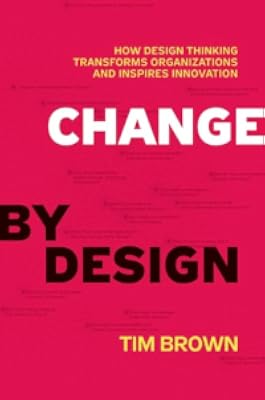
Change by Design: How Design Thinking Transforms Organizations and Inspires Innovation
by Tim Brown
On This Page
Description
In Change by Design, Tim Brown, CEO of IDEO, the celebrated innovation and design firm, shows how the techniques and strategies of design belong at every level of business. Change by Design is not a book by designers for designers; this is a book for creative leaders who seek to infuse design thinking into every level of an organization, product, or service to drive new alternatives for business and society.Tags
Recommendations






Member Reviews
In Change by Design, IDEO CEO Tim Brown fleshes out the concept of Design Thinking he introduced in a June 2008 article in the Harvard Business Review: that design is best when it’s not a tweak, made near the end of product development to fine-tune or make pretty, but rather is a substantive, beginning-to-end way of thinking; a 360-degree method of business collaboration.
I’d heard terrific things about IDEO and Brown but my first direct experience was through this book -- where I twice didn’t make it to page 50 and only now persevered to finish. It’s not a difficult read, it’s dull. There are some interesting concepts (particularly about prototyping and paying attention to customers at the extremes) and case studies show more (showcasing IDEO projects). But it’s rarely inspiring or entertaining and mostly accumulates rather than builds. In stark contrast, I’ve just finally watched clips of Brown’s presentations (for example, on creativity and play) and feel positively carbonated! My recommendation: first get familiar with Tim Brown, then let his infectious enthusiasm carry over to your reading of this book.
(Review based on an advance reading copy provided by the publisher.) show less
I’d heard terrific things about IDEO and Brown but my first direct experience was through this book -- where I twice didn’t make it to page 50 and only now persevered to finish. It’s not a difficult read, it’s dull. There are some interesting concepts (particularly about prototyping and paying attention to customers at the extremes) and case studies show more (showcasing IDEO projects). But it’s rarely inspiring or entertaining and mostly accumulates rather than builds. In stark contrast, I’ve just finally watched clips of Brown’s presentations (for example, on creativity and play) and feel positively carbonated! My recommendation: first get familiar with Tim Brown, then let his infectious enthusiasm carry over to your reading of this book.
(Review based on an advance reading copy provided by the publisher.) show less
All disciplines seem to feel they have all the answers within their own banks, this one allows for a bait box of human nature and emphasizes cross breeding, curiosity, mistakes and the art of making them, and so reeled me in. Plus I love the idea of IDEO though the biographical brass polishing tarnishes the vibe, it got a little Jim Jonesy, without mentioning religion except antidotally regarding the press, but I digress. The single most meaningful enlightenment was to resist becoming cynical! Might have gone with Humanomics as opposed to Designthinking, already taken?
If you already think, design & have an open mind, this book reads better from back to front.
If you already think, design & have an open mind, this book reads better from back to front.
I've been reading about design thinking for a few years now. In 2013, I tracked down The New Business of Design>, so I could read Tom Peters' keynote address from the 1995 45th annual International Design Conference in Aspen, which he titled "Design Mindfulness". I'm a fan of design thinking. Part of my work world involves overseeing the design of new buildings and expansions/renovations of existing buildings. Architects and engineers are wonderful folks, and they try to focus on the function and operation of the facility but they don't always go the extra distance and think of how things will be maintained. An access panel might look great on a drawing, but if the installation makes it nearly impossible to ... access ... what needs show more maintaining? Incomplete thinking. I am a mechanical engineer but I don't do design. I walk around the table asking, "Have you thought about...?"
Mr. Brown covers familiar material...nothing new here, but it is rather readable and I can recommend it. I did get a little tired of IDEO (Brown's firm) popping up every three pages or so. I would have been more impressed had Brown offered a caveat at the beginning: "My company IDEO has used all of the techniques and methods I am about to discuss many times. They work." And then only mentioned himself occasionally. Takes ego to be at the top, I get it, but sell the idea...you've already done well selling yourself.
Best point in the book is "How Can We?" Approach every design, every problem, pretty much everything that way and you might be surprised at the results. show less
Mr. Brown covers familiar material...nothing new here, but it is rather readable and I can recommend it. I did get a little tired of IDEO (Brown's firm) popping up every three pages or so. I would have been more impressed had Brown offered a caveat at the beginning: "My company IDEO has used all of the techniques and methods I am about to discuss many times. They work." And then only mentioned himself occasionally. Takes ego to be at the top, I get it, but sell the idea...you've already done well selling yourself.
Best point in the book is "How Can We?" Approach every design, every problem, pretty much everything that way and you might be surprised at the results. show less
Turns out businesses being flexible, creative, interdisciplinary, sustainable, and people-focused (rather than profit-focused) works better for everyone. Who knew.
A guide on Design Thinking (IDEO's framework), i.e. human-centered problem-solving at corporate, social/systemic and individual levels. You'll learn:
• The common innovation traps and IDEO's proven methodology to overcome them.
• Design thinking frameworks and fundamentals, including: the 3 spaces of innovation, 3 pillars to human-centered insights, and various success factors.
• Examples and practical tips for how to apply design thinking at individual, organizational, and social levels for systemic change.
Book summary at: https://readingraphics.com/book-summary-change-by-design/
• The common innovation traps and IDEO's proven methodology to overcome them.
• Design thinking frameworks and fundamentals, including: the 3 spaces of innovation, 3 pillars to human-centered insights, and various success factors.
• Examples and practical tips for how to apply design thinking at individual, organizational, and social levels for systemic change.
Book summary at: https://readingraphics.com/book-summary-change-by-design/
it's good to get inspirations about design
i want to read this book where can i download it?!
Members
- Recently Added By
Lists

Teacher Leadership
10 works; 1 member
Author Information
11 Works 687 Members
Classifications
- Genres
- Nonfiction, Business, Art & Design, General Nonfiction
- DDC/MDS
- 658.4063 — Applied science & technology Management & public relations General management Executive Managing Change Innovation
- LCC
- HD58.8 .B772 — Social sciences Industries. Land use. Labor Industries. Land use. Labor Organizational behavior, change and
- BISAC
Statistics
- Members
- 591
- Popularity
- 49,735
- Reviews
- 7
- Rating
- (3.55)
- Languages
- 5 — Chinese, English, French, German, Portuguese
- Media
- Paper, Audiobook, Ebook
- ISBNs
- 11
- UPCs
- 1
- ASINs
- 2