
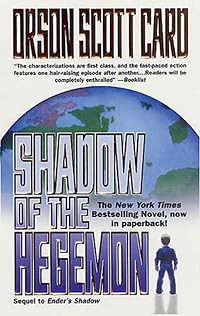
Shadow of the Hegemon
by Orson Scott Card
Ender's Game-Shadow Saga (2), Enderverse (6), Ender's Game (6)
On This Page
Description
The War is over, won by Ender Wiggin and his team of brilliant child-warriors. The enemy is destroyed, the human race is saved. Ender himself refuses to return to the planet, but his crew has gone home to their families, scattered across the globe. The battle school is no more.But with the external threat gone, the Earth has become a battlefield once more. The children of the Battle School are more than heroes; they are potential weapons that can bring power to the countries that control show more them. One by one, all of Ender's Dragon Army are kidnapped. Only Bean escapes; and he turns for help to Ender's brother Peter.
Peter Wiggin, Ender's older brother, has already been manipulating the politics of Earth from behind the scenes. With Bean's help, he will eventually rule the world.
Shadow of the Hegemon is the second novel in Orson Scott Card's Shadow Series.
. show less
Tags
Recommendations






Member Reviews
Ender Wiggin won the war against the Buggers with his elite group of child-warriors; none more brilliant than little pint-sized Bean. Only now in the 31st century, Ender's Dragon Army is in danger as people now see these same children as weapons.
Shadow of the Hegemon is considered by some to be the fifth book in the Enderverse series. Others see it as the second book in the "Shadow" series; a parallel novel to Ender's Game because we return to the character of Bean, Petra, and Peter Wiggin.
I enjoyed Shadow of the Hegemon the best because families of characters were more involved than in other installments of the series. I also appreciated that the ending to Shadow of the Hegemon was left open for a variety of plot twists in the next show more book.
As an aside, I cannot help but be reminded of "Stranger Things" when I read Ender's Game and Ender's Shadow. Children are going to save the world from aliens.
As another aside, every time someone said Achilles wants to rule the world I would hear the synth-heavy Tears for Fears song of the same name from 1985. show less
Shadow of the Hegemon is considered by some to be the fifth book in the Enderverse series. Others see it as the second book in the "Shadow" series; a parallel novel to Ender's Game because we return to the character of Bean, Petra, and Peter Wiggin.
I enjoyed Shadow of the Hegemon the best because families of characters were more involved than in other installments of the series. I also appreciated that the ending to Shadow of the Hegemon was left open for a variety of plot twists in the next show more book.
As an aside, I cannot help but be reminded of "Stranger Things" when I read Ender's Game and Ender's Shadow. Children are going to save the world from aliens.
As another aside, every time someone said Achilles wants to rule the world I would hear the synth-heavy Tears for Fears song of the same name from 1985. show less
The second novel about Bean, Ender's friend and fellow Battle School graduate. By this point Ender is gone and Bean is left on Earth to both survive and try to fend off the schemes of Ender's brother, Peter. In this novel we start to find out what happened on Earth after Ender left. While that turns out to be good material for a novel, it still feels a bit like going over old material, even if this is almost entirely new. Bean is still an engaging character, and the events of the book are plausible and interesting.
Hegemon leaves the confines of Battle School to enter a world of international politics, and as much as I love international politics, I was glad Card didn't abandon the characters and character-level plot. Bean grows, Petra grows, Peter grows (though he's relatively ancillary--he's neither protagonist nor antagonist), Achilles...doesn't really grow. In Ender's Shadow, for a few paragraphs, we actually saw into Achilles' mind. In this book, we see him act and others' evaluations of his behavior, but they add nothing new to his personality--in fact they fail to draw on the peak we got in the previous book.
Over all, this book is similar in style to the previous two and added an aspect I very much enjoy (high-level politics, not just show more individuals bickering and seeking power), but I didn't enjoy it quite as much. Achilles did not interest me, and the genius of Bean, Peter, etc. occasionally felt unbelievable to me when applied to human behavior rather than strategy. There's a point where Bean insists Achilles would have at least three back-ups--why at least three? I don't care how smart Achilles is or how well Bean knows him. Humans make decisions far too arbitrarily and options are far too varied to be predicted with that degree of specificity. Attempts to display the intelligence of the characters ranged from really good to kind of terrible.
Though not as good as Ender's Game or Ender's Shadow, this is definitely worth reading if you loved the previous two in this thread. show less
Over all, this book is similar in style to the previous two and added an aspect I very much enjoy (high-level politics, not just show more individuals bickering and seeking power), but I didn't enjoy it quite as much. Achilles did not interest me, and the genius of Bean, Peter, etc. occasionally felt unbelievable to me when applied to human behavior rather than strategy. There's a point where Bean insists Achilles would have at least three back-ups--why at least three? I don't care how smart Achilles is or how well Bean knows him. Humans make decisions far too arbitrarily and options are far too varied to be predicted with that degree of specificity. Attempts to display the intelligence of the characters ranged from really good to kind of terrible.
Though not as good as Ender's Game or Ender's Shadow, this is definitely worth reading if you loved the previous two in this thread. show less
Shadow of the Hegemon explains the political situation in Ender Universe after the end of the Formic War (the war against the buggers). This is nice, since we did not learn too much about this in the previous books, either in the original Ender's Game series or Ender's Shadow.
It does so mostly by following the lives of the two most prominent battle school cadets that have remained on Earth - Bean and Petra Arkanian, of Ender's brother Peter and of Bean's old nemesis, the psychopath Achilles. Yes, these brilliant children are still at the forefront of the global socio-political struggle for power and their personal fates are deeply interconnected with the new arrangement of power following the bugger wars.
Now, this does stretch show more credulity a little. If it does seem plausible that countries would value full battle school grads like Bean and Petra enough to kidnap them and use them as strategic planners, it beggars belief that they would allow an established psycho-kid battle school dropout, serial murderer Achilles take full command of their military. Really, are all adult military commanders and political leaders in Ender Universe so inept that a single teenager can manipulate them into letting him run their full strategic command? Even when it is completely obvious that the military strategy he employs is completely wrong and leads to defeat? Even when he betrays them and moves to a rival country, again and again? Really, Card, come on. I know he needed a bad guy but all this Achilles business is nonsense.
Otherwise, this is quite a fun read. It's a bit of Tom Clancy in Ender Universe, but without all the military equipment fetishism and with more familiar, likable characters that we know from previous books at the center of the global struggle, which makes the whole strategic maneuvering more personal to the reader. show less
It does so mostly by following the lives of the two most prominent battle school cadets that have remained on Earth - Bean and Petra Arkanian, of Ender's brother Peter and of Bean's old nemesis, the psychopath Achilles. Yes, these brilliant children are still at the forefront of the global socio-political struggle for power and their personal fates are deeply interconnected with the new arrangement of power following the bugger wars.
Now, this does stretch show more credulity a little. If it does seem plausible that countries would value full battle school grads like Bean and Petra enough to kidnap them and use them as strategic planners, it beggars belief that they would allow an established psycho-kid battle school dropout, serial murderer Achilles take full command of their military. Really, are all adult military commanders and political leaders in Ender Universe so inept that a single teenager can manipulate them into letting him run their full strategic command? Even when it is completely obvious that the military strategy he employs is completely wrong and leads to defeat? Even when he betrays them and moves to a rival country, again and again? Really, Card, come on. I know he needed a bad guy but all this Achilles business is nonsense.
Otherwise, this is quite a fun read. It's a bit of Tom Clancy in Ender Universe, but without all the military equipment fetishism and with more familiar, likable characters that we know from previous books at the center of the global struggle, which makes the whole strategic maneuvering more personal to the reader. show less
Even though you know how this story has to end if you've read Ender's Game (although you don't necessarily know how many books it will take to get there), it still sucks you in and is hard to put down. It's a fairly enjoyable read, but there are a lot of problems. It's not science fiction. It happens to take place in the future, but there are no sci-fi elements whatsoever; that's just an excuse for Card to make up whatever he feels like regarding world politics. And those politics are simplified to a level of a game of Risk. Characters can predict the future of world events based on a handful of pieces of information, which is especially unbelievable since Peter Wiggin, the supposed political genius, comes across as a complete twit in show more this book. And he and two other of the four main characters are insufferable smart asses. Even Bean comes across that way sometimes. The dialog is often terrible. Sometimes it's just awkward and unnatural. Sometimes Card uses it to frame things he wants to say to the audience, which is the most unfortunate aspect of this book. As great a storyteller as Card usually is, he's kind of a d**k, and as soon as I feel like I'm hearing his opinions rather than his characters' opinions, the book loses a lot for me. show less
In Card's last book, Ender's Shadow, Bean was born into such abject poverty and then subsequently rose up out of it against all odds to be one of Ender's most trusted companions that you forgave all of his brainy standoffishness. In Shadow of the Hegemon, our sympathies for Bean's have waned so now he just comes across as a condescending know-it-all. I didn't hate Bean. No, nothing that harsh. But he was so adept at seeing all the hidden sides of problems that the story too often annoyed me. Same with the other too-smart-for-their own-good Battle School graduates. It was like playing Trivial Pursuit and your partner reasons out all the answers before you even get the chance to struggle for the solution just a little bit. I'll admit show more there was the slightest enjoyment at watching Bean's mind work, but having him be right 99.99% of the time, and about EVERYTHING, feels like amateurish storytelling.
Overall, the story was still fun despite Bean being a smart-ass. And who doesn't miss the thrills of the zero-g battle room? Shadow of the Hegemon is classic Orson Scott Card at its core. I can picture him writing this novel like he was playing in a sandbox—imaginative play of military strategy, politics and the consequences of nations going to war with one another. show less
Overall, the story was still fun despite Bean being a smart-ass. And who doesn't miss the thrills of the zero-g battle room? Shadow of the Hegemon is classic Orson Scott Card at its core. I can picture him writing this novel like he was playing in a sandbox—imaginative play of military strategy, politics and the consequences of nations going to war with one another. show less
I opted to skip the three novels that follow Ender on his journey after the battle against the alien invaders and to instead pursue Bean's story on Earth (because I heard Ender's storyline contained mostly theology, which I'm not interested in). I forgot, however, that Valentine accompanied Ender and since she's my favorite character, I may have to give this other offshoot a try. This novel, though, involves the political and military manipulations of Bean that lead him to team up with Peter Wiggin to destroy Achilles who has taken Petra (and other Battle School graduates) captive in an attempt at world domination. It is definitely a different kind of story than Ender's Game or Shadow, but still fairly interesting. The author's show more speculations on the standings and alliances/enmities of countries a couple centuries from now is insightful. Love that America has lost actual power and that its lack of honorable leaders and populace are to blame. show less
Members
- Recently Added By
Lists

Best-selling Books by Latter-day Saints
58 works; 2 members

Blue Pyramid 1,276 Best Books of All Time
1,248 works; 32 members

Books Read in 2016
4,666 works; 199 members
Author Information

575+ Works 213,685 Members
Orson Scott Byron Walley Card, was born in 1951 and studied theater at Brigham Young University. He received his B.A. in 1975 and his M.A. in English in 1981. He wrote plays during that time, including Stone Tables (1973) and the musical, Father, Mother, Mother and Mom (1974). A Mormon, Scott served a two-year mission in Brazil before starting show more work as a journalist in Utah. He also designed games at Lucas Film Games, 1989-92. He is best known for his science fiction novels, including the popular Ender series. Well known titles include A Planet Called Treason (1979), Treasure Box (1996), and Heartfire (1998). He has also written the guide called How to Write Science Fiction and Fantasy (1990). His novel Ender's Game and its sequel Speaker for the Dead, both won Hugo and Nebula awards, making Card the only author to win both prizes in consecutive years. His titles Shadows in Flight, Ruins and Ender's Game made The New York Times Best Seller List. He is also the author of The First Formic War Series, which includes the titles Earth Unaware, Earth Afire, and Earth Awakens. (Bowker Author Biography) show less
Some Editions
Awards and Honors
Series


Belongs to Publisher Series
Work Relationships
Is contained in
Common Knowledge
- Canonical title
- Shadow of the Hegemon
- Original publication date
- 2001-01
- People/Characters
- Bean; Petra Arkanian; Peter Wiggin; Achilles de Flandres; Sister Carlotta; Alai
- Dedication
- To Charles Benjamin Card
You are always with us,
you see through all the shadows,
and we hear your strong voice
singing in our dreams - First words
- Nothing looked right in Armenia when Petra Arkanian returned home.
- Last words
- (Click to show. Warning: May contain spoilers.)"You can have it all."
- Original language
- English
Classifications
Statistics
- Members
- 8,080
- Popularity
- 1,378
- Reviews
- 49
- Rating
- (3.71)
- Languages
- 8 — Czech, English, French, Hebrew, Hungarian, Polish, Romanian, Spanish
- Media
- Paper, Audiobook, Ebook
- ISBNs
- 38
- ASINs
- 20