On This Page
Description
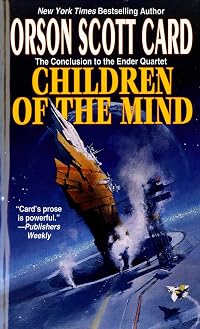
The planet Lusitania is home to three sentient species: the Pequeninos, a large colony of humans, and the Hive Queen, who was brought there by Ender Wiggin. But now, once again, the human race has grown fearful; the Starways Congress has gathered a fleet to destroy Lusitania. Ender's oldest friend, Jane, an evolved computer intelligence, can save the three sentient species of Lusitania. She has learned how to move ships outside the universe, and then instantly back to a different world, show more abolishing the light-speed limit. But it takes all the processing power available to her, and the Starways Congress is shutting down the network of computers in which she lives, world by world.Soon Jane will not be able to move the ships. Ender's children must save her if they are to save themselves.
Children of the Mind is the fourth book in Orson Scott Card's The Ender Saga.
. show less
Tags
Recommendations




Member Reviews
I gave this book the 5 stars because it is metaphysical and really challenges you to think about what it is that make a person who she or he truly is and how do we know that. (whew! what a convoluted sentence!) Are you you because of your soul? Or do your memories and experiences make you? Or is it a bit of both. Ender is the pivotal point in this whole discussion of course. And being Ender make everything a bit magnified. That is why I enjoyed this one, although the end, even though you see it coming [really good foreshadowing], still makes you sad. I don't want to make it a spoiler so read it and experience it for yourself.
I know several readers, myself included, who were blown away by Ender's Game by Orson Scott Card. They then found the sequel, Speaker for the Dead, to be equally as riveting and eagerly reached for Xenocide, book three in the series, with the highest of expectations--only to be slammed with disappointment. This otherwise serviceable book, with an original premise and interesting characters, crashes to an unsatisfying and confusing ending that combines the worst attributes of deus ex machina and sequel hooking. Back in the mid-90s, it seemed that only the most devoted of Ender fans dared to approach the fourth book, Children of the Mind. The rest of us avoided it like the descolada virus itself.
This situation may have changed over the show more ensuing decade as Card has published a number of prequel and sequel books in the Ender universe including a notable series about the life and times of Ender Wiggin's schoolmate, Bean. As the story world has expanded, characters have been fleshed out, political systems have been better defined, and the original quadrology has been reframed into a new context. Xenocide-burned readers may finally be ready to take tentative steps toward CotM--or at least that's my theory, after receiving an endorsement of the book from a friend who described it as "not as bad as everyone thought it would have to be."
So I read the book and it was, indeed, not as bad as everyone thought it would have to be--but it's no Ender's Game, either.
It helps to know that Xenocide and CotM were originally conceived as a single volume, which was divided in half when the page count climbed higher than the publisher was willing to accommodate. CotM's confusing and disjointed opening takes place only moments after Xenocide's confusing and disjointed ending, and neither book feels complete on its own. I'm sure the author did the best he could but the result still reads like a botched operation to separate conjoined twins.
CoTM starts in the middle of the action with no easy recap for those of us who haven't read the previous book in a while, so a better transition would have been appreciated. Perhaps something like I've done in this episode of Book Review Theater...
EXTERIOR - EXTRASOLAR PLANET WITH THREE MOONS IN AN ORANGE SKY, WHERE PEOPLE STROLL ALONG A BOARDWALK THAT SEPARATES A BEACH ON ONE SIDE FROM URBAN BLIGHT ON THE OTHER - LATE EVENING
A cardboard box appears from nowhere. Peter Wiggin and Si Wang-mu emerge, look around in confusion for a moment, and confront the first man passing by.
PETER: Excuse me, sir?
MAN: Yeah? Whatta you want?
PETER: I'm an extra-universally created simulation of Peter Wiggin, the late Hegemon of the Free People of Earth, under the spiritual control of Andrew "Ender" Wiggin who is and will remain, until his imminent death of old age, reviled and celebrated, respectively, as Xenocide and Speaker for the Dead.
WANG-MU: And I am Wang-mu, a former slave with artificially-enhanced intellectual capacity, ironically named after a Chinese goddess. Also ironically, the so-called free people of my society were in fact enslaved to outside powers by virtue of their genetically-crafted OCD tendencies while peasants and slaves like myself remained actually free.
PETER: With the aid of Jane, a unique [b:artificial intelligence|27543|Artificial Intelligence A Modern Approach (2nd Edition)|Stuart J. Russell|http://photo.goodreads.com/books/1167881696s/27543.jpg|1362] originally created by an alien race that's falsely presumed to be extinct at the hands of my apparent younger brother and puppetmaster, we are travelling from Wang-Mu's home world--
WANG-MU: The Planet Where Everyone Is Chinese.
PETER: Right. From Wang-Mu's home world, The Planet Where Everyone is Chinese, we were meant to find The Planet Where Everyone Is A Pacific Islander by way of The Planet Where Everyone is Japanese.
WANG-MU (looks around): With my advanced intellect, I've determined that this is not any of those worlds.
MAN: Nah. This is The Planet Where Everyone Is From New Jersey. Got a problem with that?
PETER: Not at all, my hairy knuckle-dragging friend. It would seem that Jane is playing a practical joke on us, or perhaps manipulating our journey in the same way that everyone around us seems to be constantly manipulating everyone else in some way or other.
WANG-MU: Including ourselves.
PETER: I'm sorry for taking up your time, but we really must be going. A fleet is approaching The Planet Where Everyone is Brazilian with the intention of blowing the whole thing up, not knowing yet that a cure to the dreaded species-scrambling descolada virus has been found, or that their actions would mean genocide for the last remaining Buggers as well as the native Piggies and Jane herself--who is unique enough to be considered her own species. Did I mention that Jane has the ability to pop people in and out of the universe, allowing them to create impossible objects, bring people back from the dead, and cure brain damage or deformities of the body?
WANG-MU: Which is why we must prevent Congress from shutting Jane down by persuading some influential philosophers that the events of World War II back on Earth are still relevant in space so many thousands of years later.
Peter and Wang-mu step back into the cardboard box, which promptly vanishes.
MAN: What a couple of self-important jerks!
review theater>
Something like that would have helped a lot, although the premise does seem rather silly and far-fetched when you try to boil it down to a few short paragraphs of exposition. It also reveals a major weakness of the story world: the assumption that Earth would colonize new worlds on a nation-by-nation basis and that the resulting planetary cultures would not change or evolve noticeably from their progenitors. This detail seems glaringly unrealistic in light of Card's obsession with such anthropological details as food, architecture, and language.
Ender himself hardly appears in this book, and perhaps the most memorable character from Xenocide, OCD-laden genius Han Qing-jao, is missing entirely--only represented in CotM by tantalizing excerpts from her philosophical writings, which serve as thematic chapter headers. But Qing-jao's presence would perhaps have been redundant since she is far from the series's only deep-thinking philosopher and author of impactful works that have changed the lives of billions or trillions of people. In addition to Quing-jao, this would include Ender (author of a trilogy that has stayed continuously in print for over three thousand years), Valentine and Peter (who manipulated world governments through their pseudonymous writings as Demosthenes and Locke), Aimaina Hikari (whose works inspired attempted xenocide), Grace (whose writings inspired Hikari), Malu (whose works inspired Grace), and Plikt (who, as the speaker for Ender's death, has a lock on a future bestseller as well).
Only Ender's stepdaughter, Quara, seems to lack the bug for philosophizing and authorship, so of course the other characters use her as a punching bag for their verbal abuse--which highlights another annoyance I experienced with this book. Every scene is either a dramafest of angst and confrontation or an excuse for long philosophical soliloquies that usually include at least one Shakespeare quotation. Or often, both. Almost without exception, every philosophical theory presented in the book is then subsequently picked apart and discarded as childish and simplistic compared to the unexpressed deeper thoughts that all of our genius characters are keeping to themselves. This makes for one long, emotionally draining, and often pompous book.
Bottom Line: Every reader of thought-provoking science fiction, age 10 through 110, should pick up copies of Ender's Game and Speaker for the Dead. My prior warning to avoid Xenocide is tempered somewhat, but anyone who continues onward in the series should read Xenocide and Children of the Mind together and be prepared for an exhausting and confusing ride. show less
This situation may have changed over the show more ensuing decade as Card has published a number of prequel and sequel books in the Ender universe including a notable series about the life and times of Ender Wiggin's schoolmate, Bean. As the story world has expanded, characters have been fleshed out, political systems have been better defined, and the original quadrology has been reframed into a new context. Xenocide-burned readers may finally be ready to take tentative steps toward CotM--or at least that's my theory, after receiving an endorsement of the book from a friend who described it as "not as bad as everyone thought it would have to be."
So I read the book and it was, indeed, not as bad as everyone thought it would have to be--but it's no Ender's Game, either.
It helps to know that Xenocide and CotM were originally conceived as a single volume, which was divided in half when the page count climbed higher than the publisher was willing to accommodate. CotM's confusing and disjointed opening takes place only moments after Xenocide's confusing and disjointed ending, and neither book feels complete on its own. I'm sure the author did the best he could but the result still reads like a botched operation to separate conjoined twins.
CoTM starts in the middle of the action with no easy recap for those of us who haven't read the previous book in a while, so a better transition would have been appreciated. Perhaps something like I've done in this episode of Book Review Theater...
EXTERIOR - EXTRASOLAR PLANET WITH THREE MOONS IN AN ORANGE SKY, WHERE PEOPLE STROLL ALONG A BOARDWALK THAT SEPARATES A BEACH ON ONE SIDE FROM URBAN BLIGHT ON THE OTHER - LATE EVENING
A cardboard box appears from nowhere. Peter Wiggin and Si Wang-mu emerge, look around in confusion for a moment, and confront the first man passing by.
PETER: Excuse me, sir?
MAN: Yeah? Whatta you want?
PETER: I'm an extra-universally created simulation of Peter Wiggin, the late Hegemon of the Free People of Earth, under the spiritual control of Andrew "Ender" Wiggin who is and will remain, until his imminent death of old age, reviled and celebrated, respectively, as Xenocide and Speaker for the Dead.
WANG-MU: And I am Wang-mu, a former slave with artificially-enhanced intellectual capacity, ironically named after a Chinese goddess. Also ironically, the so-called free people of my society were in fact enslaved to outside powers by virtue of their genetically-crafted OCD tendencies while peasants and slaves like myself remained actually free.
PETER: With the aid of Jane, a unique [b:artificial intelligence|27543|Artificial Intelligence A Modern Approach (2nd Edition)|Stuart J. Russell|http://photo.goodreads.com/books/1167881696s/27543.jpg|1362] originally created by an alien race that's falsely presumed to be extinct at the hands of my apparent younger brother and puppetmaster, we are travelling from Wang-Mu's home world--
WANG-MU: The Planet Where Everyone Is Chinese.
PETER: Right. From Wang-Mu's home world, The Planet Where Everyone is Chinese, we were meant to find The Planet Where Everyone Is A Pacific Islander by way of The Planet Where Everyone is Japanese.
WANG-MU (looks around): With my advanced intellect, I've determined that this is not any of those worlds.
MAN: Nah. This is The Planet Where Everyone Is From New Jersey. Got a problem with that?
PETER: Not at all, my hairy knuckle-dragging friend. It would seem that Jane is playing a practical joke on us, or perhaps manipulating our journey in the same way that everyone around us seems to be constantly manipulating everyone else in some way or other.
WANG-MU: Including ourselves.
PETER: I'm sorry for taking up your time, but we really must be going. A fleet is approaching The Planet Where Everyone is Brazilian with the intention of blowing the whole thing up, not knowing yet that a cure to the dreaded species-scrambling descolada virus has been found, or that their actions would mean genocide for the last remaining Buggers as well as the native Piggies and Jane herself--who is unique enough to be considered her own species. Did I mention that Jane has the ability to pop people in and out of the universe, allowing them to create impossible objects, bring people back from the dead, and cure brain damage or deformities of the body?
WANG-MU: Which is why we must prevent Congress from shutting Jane down by persuading some influential philosophers that the events of World War II back on Earth are still relevant in space so many thousands of years later.
Peter and Wang-mu step back into the cardboard box, which promptly vanishes.
MAN: What a couple of self-important jerks!
review theater>
Something like that would have helped a lot, although the premise does seem rather silly and far-fetched when you try to boil it down to a few short paragraphs of exposition. It also reveals a major weakness of the story world: the assumption that Earth would colonize new worlds on a nation-by-nation basis and that the resulting planetary cultures would not change or evolve noticeably from their progenitors. This detail seems glaringly unrealistic in light of Card's obsession with such anthropological details as food, architecture, and language.
Ender himself hardly appears in this book, and perhaps the most memorable character from Xenocide, OCD-laden genius Han Qing-jao, is missing entirely--only represented in CotM by tantalizing excerpts from her philosophical writings, which serve as thematic chapter headers. But Qing-jao's presence would perhaps have been redundant since she is far from the series's only deep-thinking philosopher and author of impactful works that have changed the lives of billions or trillions of people. In addition to Quing-jao, this would include Ender (author of a trilogy that has stayed continuously in print for over three thousand years), Valentine and Peter (who manipulated world governments through their pseudonymous writings as Demosthenes and Locke), Aimaina Hikari (whose works inspired attempted xenocide), Grace (whose writings inspired Hikari), Malu (whose works inspired Grace), and Plikt (who, as the speaker for Ender's death, has a lock on a future bestseller as well).
Only Ender's stepdaughter, Quara, seems to lack the bug for philosophizing and authorship, so of course the other characters use her as a punching bag for their verbal abuse--which highlights another annoyance I experienced with this book. Every scene is either a dramafest of angst and confrontation or an excuse for long philosophical soliloquies that usually include at least one Shakespeare quotation. Or often, both. Almost without exception, every philosophical theory presented in the book is then subsequently picked apart and discarded as childish and simplistic compared to the unexpressed deeper thoughts that all of our genius characters are keeping to themselves. This makes for one long, emotionally draining, and often pompous book.
Bottom Line: Every reader of thought-provoking science fiction, age 10 through 110, should pick up copies of Ender's Game and Speaker for the Dead. My prior warning to avoid Xenocide is tempered somewhat, but anyone who continues onward in the series should read Xenocide and Children of the Mind together and be prepared for an exhausting and confusing ride. show less
OK, I'll admit it: I was liking this book by the end. Very satisfying conclusion. But I never could quite accept all the different facets of the book's weirdness, so I couldn't connect with the story fully.
This final book in the Ender Quartet spends most of its time tying up loose ends from Xenocide than moving the story along. The fleet still threatens the planet Lusitania, Jane still faces imminent destruction, Miro is still angstful about his love life, and Ender's still going a bit mad. Everything is tied up neatly at the end, but by and large these latter two novels - Xenocide and Children of the Mind - feel superfluous. I admire Card for his amazing SF ideas, especially the development of the Piggies, but there wasn't much point in putting all the aiua business in the Ender universe. But that's okay. Now I know how it ends, and if I care to reread the series in the future, I'll simply stop after Speaker for the Dead.
Look - Ender was quirky, but cute.
But the rest of the books are drivel.
A sure sign of a floundering author is when the rate of new unexpected inventions matches the rate of new unexpected crisis points.
Can't cure Malaria? We'll invent faster than light travel.
Can't fix hatred? We'll invent new physics that re-defines the soul.
Give me a break.
The book is choke full of "moral dilemmas", all clumsy and contrived, as if the author just discovered the concept of a dilemma and is out to prove he can make the biggest one. My dilemma is bigger than you dilemma!
But the point of a dilemma is that you have to CHOOSE. If you resolve it by inventing new physics that allows you to eat your cake and have it too, then you're not doing it right.
In the show more dictionary, under the definition of "deus ex machina", there should be a picture of this book series. show less
But the rest of the books are drivel.
A sure sign of a floundering author is when the rate of new unexpected inventions matches the rate of new unexpected crisis points.
Can't cure Malaria? We'll invent faster than light travel.
Can't fix hatred? We'll invent new physics that re-defines the soul.
Give me a break.
The book is choke full of "moral dilemmas", all clumsy and contrived, as if the author just discovered the concept of a dilemma and is out to prove he can make the biggest one. My dilemma is bigger than you dilemma!
But the point of a dilemma is that you have to CHOOSE. If you resolve it by inventing new physics that allows you to eat your cake and have it too, then you're not doing it right.
In the show more dictionary, under the definition of "deus ex machina", there should be a picture of this book series. show less
This book was so bad that it made me want to take a star off of the first three books in the series. All of the plotlines built up throughout the series are brought to disappointing deus ex machina conclusions. The idea that if you want it, it will be is so easy and such a lazy way to resolve the plot and moral corners that the author wrote himself into. Very unsatisfying. Sometimes it's not the author's job to resolve every single issue he touches on and it's either hubris or a lack of understanding of the depth of moral, ethical and philosophical issues to try.
Never has a book been so good and so bad all at once. After finishing the first two in the Speaker series, I couldn't wait to read the conclusion. Although I did thoroughly enjoy the overall story, the pacing and focus was too spread out for me to enjoy this one in the same way.
Members
- Recently Added By
Lists

Lion's Mane Hardcover Wishlist
19 works; 1 member

Best-selling Books by Latter-day Saints
58 works; 2 members

Books Read in 2016
4,666 works; 199 members

Books Read in 2023
5,638 works; 147 members

Science Fiction and Fantasy
63 works; 4 members
Author Information

575+ Works 214,320 Members
Orson Scott Byron Walley Card, was born in 1951 and studied theater at Brigham Young University. He received his B.A. in 1975 and his M.A. in English in 1981. He wrote plays during that time, including Stone Tables (1973) and the musical, Father, Mother, Mother and Mom (1974). A Mormon, Scott served a two-year mission in Brazil before starting show more work as a journalist in Utah. He also designed games at Lucas Film Games, 1989-92. He is best known for his science fiction novels, including the popular Ender series. Well known titles include A Planet Called Treason (1979), Treasure Box (1996), and Heartfire (1998). He has also written the guide called How to Write Science Fiction and Fantasy (1990). His novel Ender's Game and its sequel Speaker for the Dead, both won Hugo and Nebula awards, making Card the only author to win both prizes in consecutive years. His titles Shadows in Flight, Ruins and Ender's Game made The New York Times Best Seller List. He is also the author of The First Formic War Series, which includes the titles Earth Unaware, Earth Afire, and Earth Awakens. (Bowker Author Biography) show less
Some Editions
Series


Belongs to Publisher Series
Work Relationships
Common Knowledge
- Canonical title
- Children of the Mind
- Original title
- Children of the Mind
- Original publication date
- 1996-08
- People/Characters
- Ender Wiggin (Andrew Wiggin); Jane the A.I.; Peter Wiggin; Valentine Wiggin; Miro; Si Wang-Mu (show all 10); Novinha; Quara; Young Val; The Hive Queen
- Important places
- Lusitania (planet); Divine Wind; Path
- Dedication
- To Barbara Bova, whose toughness, wisdom and empathy make her a great agent and an even better friend
- First words
- Si Wang-mu stepped forward.
- Last words
- (Click to show. Warning: May contain spoilers.)Only the mothertree remained in the middle fo the clearing, bathed in light, heavy with fruit, festooned with blossoms, a perptual celebrant of the ancient mystery of life.
- Original language
- English
Classifications
Statistics
- Members
- 9,933
- Popularity
- 1,013
- Reviews
- 90
- Rating
- (3.55)
- Languages
- 14 — Czech, Dutch, English, French, German, Hebrew, Italian, Japanese, Polish, Portuguese, Romanian, Slovenian, Spanish, Turkish
- Media
- Paper, Audiobook, Ebook
- ISBNs
- 53
- ASINs
- 16