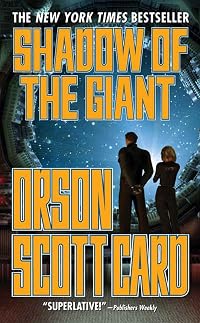
Shadow of the Giant
by Orson Scott Card
Ender's Game-Shadow Saga (4), Enderverse (9), Ender's Game (9)
On This Page
Description
The Ender Saga continues with Shadow of the Giant, which parallels the events of Ender's Game from a different character's point of view.Bean's past was a battle just to survive. He first appeared on the streets of Rotterdam, a tiny child with a mind leagues beyond anyone else. He knew he could not survive through strength; he used his tactical genius to gain acceptance into a children's gang, and then to help make that gang a template for success for all the others. He civilized them, and show more lived to grow older. Then he was discovered by the recruiters for the Battle School.
For Earth was at war - a terrible war with an inscrutable alien enemy. A war that humanity was near to losing. But the long distances of interstellar space has given hope to the defenders of Earth - they had time to train military geniuses up from childhood, forging them into an irresistible force in the high-orbital facility called the Battle School. That story is told in two books, Orson Scott Card's beloved classic Ender's Game, and its parallel, Ender's Shadow. Now, in Shadow of the Giant, Bean's story continues.
Bean was the smallest student at the Battle School, but he became Ender Wiggins' right hand, Since then he has grown to be a power on Earth. He served the Hegemon as strategist and general in the terrible wars that followed Ender's defeat of the alien empire attacking Earth. Now he and his wife Petra yearn for a safe place to build a family - something he has never known - but there is nowhere on Earth that does not harbor his enemies - old enemies from the days in Ender's Jeesh, new enemies from the wars on Earth. To find security, Bean and Petra must once again follow in Ender's footsteps. They must leave Earth behind, in the control of the Hegemon, and look to the stars.
THE ENDER UNIVERSE
Ender series
Ender's Game / Speaker for the Dead / Xenocide / Children of the Mind / Ender in Exile / Children of the Fleet
Ender's Shadow series
Ender's Shadow / Shadow of the Hegemon / Shadow Puppets / Shadow of the Giant / Shadows in Flight
The First Formic War (with Aaron Johnston)
Earth Unaware / Earth Afire / Earth Awakens
The Second Formic War (with Aaron Johnston)
The Swarm / The Hive
Ender novellas
A War of Gifts / First Meetings
. show less
Tags
Recommendations
Member Reviews
Very disappointing, very weak.
Card has succumbed to Tom Clancy's disease (which was earlier caught by Robert Heinlein) where he has come to believe that his readers desperately care about the author's views on history and religion and want them expostulated at length through every possible mechanism: through the flow of the story, through expository paragraphs, through speeches the characters recite to each other.
This would be bad enough if these views on history and religion had any content, but they are laughably weak.
In Card's world, conflict occurs because of a few bad apples that somehow manage to take control of nations; eliminate the bad apples and the national rivalries disappear.
In Card's world Christianity is unmitigated show more good; the evil things done in its name again the work of a few bad apples. Since this is a post 9/11 novel he feels free to state clearly what he only hinted at earlier, that Islam is pure evil; he never quite squares this with the bad apple theory of history, but in the case of Islam we do very much get the feeling that it's everyone causing trouble, not just the leaders at the top.
Finally we even get a gratuitous swipe at Hindus as simple-minded idolators who are stupid enough to believe that a person could be a god (when we all know that that happened 2000 years ago and isn't going to happen again until the rapture).
Of course none of this would be complete without the rah-rah-rah American exceptionalism stuff:
* it's American's who repeatedly save the world (but always in the background and without asking for thank you) even though
* good old America has nothing to do with the repeated wars of these books, and does nothing to start or exploit them, and,
* at the end, when America refuses to ally itself with every other nation on earth, well, America is special so who can blame them for that?
Card's world appears to be much like King George the Torturer's world, a world where no-one like John Perkins (Confessions of an Economic Hitman) exists, and where it's a bizarre mystery why most of the world hates America.
This is all very sad given how compelling were Ender's Game and Ender's Shadow.
In summary, if you have a mental age of 12 and don't mind the over-written weepy family stuff, it's an OK potboiler.
If you're no longer a teenager, don't waste your time. show less
Card has succumbed to Tom Clancy's disease (which was earlier caught by Robert Heinlein) where he has come to believe that his readers desperately care about the author's views on history and religion and want them expostulated at length through every possible mechanism: through the flow of the story, through expository paragraphs, through speeches the characters recite to each other.
This would be bad enough if these views on history and religion had any content, but they are laughably weak.
In Card's world, conflict occurs because of a few bad apples that somehow manage to take control of nations; eliminate the bad apples and the national rivalries disappear.
In Card's world Christianity is unmitigated show more good; the evil things done in its name again the work of a few bad apples. Since this is a post 9/11 novel he feels free to state clearly what he only hinted at earlier, that Islam is pure evil; he never quite squares this with the bad apple theory of history, but in the case of Islam we do very much get the feeling that it's everyone causing trouble, not just the leaders at the top.
Finally we even get a gratuitous swipe at Hindus as simple-minded idolators who are stupid enough to believe that a person could be a god (when we all know that that happened 2000 years ago and isn't going to happen again until the rapture).
Of course none of this would be complete without the rah-rah-rah American exceptionalism stuff:
* it's American's who repeatedly save the world (but always in the background and without asking for thank you) even though
* good old America has nothing to do with the repeated wars of these books, and does nothing to start or exploit them, and,
* at the end, when America refuses to ally itself with every other nation on earth, well, America is special so who can blame them for that?
Card's world appears to be much like King George the Torturer's world, a world where no-one like John Perkins (Confessions of an Economic Hitman) exists, and where it's a bizarre mystery why most of the world hates America.
This is all very sad given how compelling were Ender's Game and Ender's Shadow.
In summary, if you have a mental age of 12 and don't mind the over-written weepy family stuff, it's an OK potboiler.
If you're no longer a teenager, don't waste your time. show less
While reading:
-- Feels like too many plots, not enough space. Each primary plot is moving at a snails pace as he tries to give adequate details to make them work. The side dealing with Peter is detracting from the side dealing with Bean.
-- This does feel more like how the series should have gone from the beginning. The Speaker for the Dead angle never felt right to me.
Finished reading:
I've stated before that I didn't think Card was good at writing series. I stick with that assessment. He even mentioned in his acknowledgements that he's horrible at tracking time regarding his characters. This particular issue makes series difficult, since you have to know about time's passage when connecting books, or overlaying their plots.
This book show more suffers from trying to be the very end of a series, overlaying ideas from other books to complete the last few chapters. Yes, some of those views felt better with this view (though the final verdict on one character is never revealed) but it also made the book feel choppy. It also suffered from too many viewpoints, not enough focus. Alai, Petra, Bean, Virlomi, Suriyawong, Rackham, Graff, Peter... All had multiple primary chapters dedicated to their point of view. This meant all those plots either plodded along, or moved so rapidly you found a need to get to another view point to slow the book down.
With this book, the direction the parallel series took is over. And that is a good thing. I'd only recommend it for diehard Ender fans, who must read it all. Otherwise, I might recommend skipping it. show less
-- Feels like too many plots, not enough space. Each primary plot is moving at a snails pace as he tries to give adequate details to make them work. The side dealing with Peter is detracting from the side dealing with Bean.
-- This does feel more like how the series should have gone from the beginning. The Speaker for the Dead angle never felt right to me.
Finished reading:
I've stated before that I didn't think Card was good at writing series. I stick with that assessment. He even mentioned in his acknowledgements that he's horrible at tracking time regarding his characters. This particular issue makes series difficult, since you have to know about time's passage when connecting books, or overlaying their plots.
This book show more suffers from trying to be the very end of a series, overlaying ideas from other books to complete the last few chapters. Yes, some of those views felt better with this view (though the final verdict on one character is never revealed) but it also made the book feel choppy. It also suffered from too many viewpoints, not enough focus. Alai, Petra, Bean, Virlomi, Suriyawong, Rackham, Graff, Peter... All had multiple primary chapters dedicated to their point of view. This meant all those plots either plodded along, or moved so rapidly you found a need to get to another view point to slow the book down.
With this book, the direction the parallel series took is over. And that is a good thing. I'd only recommend it for diehard Ender fans, who must read it all. Otherwise, I might recommend skipping it. show less
This was an enjoyable read, and Card showed that, in some cases, heavy foreshadowing can almost replace actual character development. The book had good tie-ins to the non-Shadow Ender books and did a good job of juggling a large number of plot elements. There were parts of the book that made me uncomfortable. They were not particularly disturbing in the framework of the story, but they made me squeamish knowing (a) a little more about Card's personal beliefs than I use to and (b) that this book was written recently and, therefore, in the current political climate. It was not enough to make me dislike the book, but it was certainly noticeable.
I wish this series hadn't focused so much on the war/political side of things. I was far more interested in the personal stories, especially Bean and Petra's. I spent a good deal of this book bored with so much time dedicated to world events. But that ending. Oof. As painful as those moments are, the book would have been better with more focus on the heart-wrenching stuff. Gosh OSC, why can't you just write the book I want? :)
Although Shadow of the Giant continues many of the lackluster storylines inherited from Shadow Puppets—the hunt for Bean and Petra's "babies" being the worst offender—it also manages to not eff things up any worse than they are. Surprisingly, as the end nears, the story pivots towards a relatively strong finish. This may have saved this otherwise uneven series from oblivion.
Overall, I'm glad I read all four books. That's saying something given my impulsive habit of cutting my losses at the first sign of story trouble. Ender's Shadow kicked things off so well, and while Shadow of the Hegemon was fine, I didn't pick up Shadow Puppets right away. And that book was so underwhelming that I didn't care to find out what happened next in show more Shadow of the Giant for another ten years. Eventually, curiosity got the better of me. show less
Overall, I'm glad I read all four books. That's saying something given my impulsive habit of cutting my losses at the first sign of story trouble. Ender's Shadow kicked things off so well, and while Shadow of the Hegemon was fine, I didn't pick up Shadow Puppets right away. And that book was so underwhelming that I didn't care to find out what happened next in show more Shadow of the Giant for another ten years. Eventually, curiosity got the better of me. show less
Shadow of the Giant completes the story of the geopolitical transformation after the Formic Wars, and thus also completes the story of Peter the Hegemon and of several former battle school cadets. Well, at least as far as their Earth-wise career goes, anyway.
This is fairly interesting, but in truth, I felt it was a little bit convenient how everything just fell into place for Peter. We have this complex geopolitical situation that stretches three and a half books - powerful nations taking over half the globe, brilliant leaders forming invincible coalitions etc. Then some powerful magic from Bean, Peter and Petra and poof, we have world hegemony under a single man. Card's problem is that while his battle school children are geniuses, he show more is not. So he is left with the task of inventing ingenious plans for these children that then turn out to be not so brilliant that any smart person could not think of of. An execution of such a plan then requires that the battle school cadets on the other side fail to foresee them or make really pedestrian mistakes, hurting the whole brilliancy theme and credibility of the series in the process.
Of course, this geopolitical wrangling again serves as a backdrop to the story of Bean and Petra and their teenage pregnancy romance, which in turn serves as a vehicle of reader indoctrination into Mormon views on life, love and family. Thread carefully then, though in all fairness, this book is not the worst in the series in this regard. show less
This is fairly interesting, but in truth, I felt it was a little bit convenient how everything just fell into place for Peter. We have this complex geopolitical situation that stretches three and a half books - powerful nations taking over half the globe, brilliant leaders forming invincible coalitions etc. Then some powerful magic from Bean, Peter and Petra and poof, we have world hegemony under a single man. Card's problem is that while his battle school children are geniuses, he show more is not. So he is left with the task of inventing ingenious plans for these children that then turn out to be not so brilliant that any smart person could not think of of. An execution of such a plan then requires that the battle school cadets on the other side fail to foresee them or make really pedestrian mistakes, hurting the whole brilliancy theme and credibility of the series in the process.
Of course, this geopolitical wrangling again serves as a backdrop to the story of Bean and Petra and their teenage pregnancy romance, which in turn serves as a vehicle of reader indoctrination into Mormon views on life, love and family. Thread carefully then, though in all fairness, this book is not the worst in the series in this regard. show less
It finally happens! and it was altogether marvelous. Besides Ender's Shadow, Shadow of the Giant is the best book of the Shadow series so far. Still emotional and cleverly political. Not too sure where it could really go from here since so much was resolved in the conclusion, but I am eager to find out.
This book officially makes OSC my favorite scifi author. He has 4 amazing books, of which Ender's Game is not included, while Frank Herbert only really had 3 Dune books I loved. Thank you again, Card.
This book officially makes OSC my favorite scifi author. He has 4 amazing books, of which Ender's Game is not included, while Frank Herbert only really had 3 Dune books I loved. Thank you again, Card.
Members
- Recently Added By
Lists

Lion's Mane Hardcover Wishlist
19 works; 1 member

Best-selling Books by Latter-day Saints
58 works; 2 members
Author Information

597+ Works 214,761 Members
Orson Scott Byron Walley Card, was born in 1951 and studied theater at Brigham Young University. He received his B.A. in 1975 and his M.A. in English in 1981. He wrote plays during that time, including Stone Tables (1973) and the musical, Father, Mother, Mother and Mom (1974). A Mormon, Scott served a two-year mission in Brazil before starting show more work as a journalist in Utah. He also designed games at Lucas Film Games, 1989-92. He is best known for his science fiction novels, including the popular Ender series. Well known titles include A Planet Called Treason (1979), Treasure Box (1996), and Heartfire (1998). He has also written the guide called How to Write Science Fiction and Fantasy (1990). His novel Ender's Game and its sequel Speaker for the Dead, both won Hugo and Nebula awards, making Card the only author to win both prizes in consecutive years. His titles Shadows in Flight, Ruins and Ender's Game made The New York Times Best Seller List. He is also the author of The First Formic War Series, which includes the titles Earth Unaware, Earth Afire, and Earth Awakens. (Bowker Author Biography) show less
Some Editions
Awards and Honors
Awards
Distinctions
Series


Belongs to Publisher Series
Work Relationships
Common Knowledge
- Canonical title
- Shadow of the Giant
- Original title
- Shadow of the Giant
- Original publication date
- 2005-03-01
- People/Characters
- Peter Wiggin; Julian "Bean" Delphiki; Petra Arkanian; Alai; Achilles de Flandres; Virlomi (show all 7); Han Tzu
- Dedication
- To Ed and Kay McVey,
who are saving the world
one kindness at a time. - First words
- Han Tzu waited until the armored car was completely out of sight before he ventured out into the bicycle-and-pedestrian-packed street.
- Last words
- (Click to show. Warning: May contain spoilers.)Then she went home, leaving both her husbands behind, the one whose life had a monument and a book, and the one whose only monument was in her heart.
- Original language
- English
Classifications
Statistics
- Members
- 5,289
- Popularity
- 2,586
- Reviews
- 44
- Rating
- (3.79)
- Languages
- 8 — Czech, English, French, German, Hebrew, Polish, Romanian, Spanish
- Media
- Paper, Audiobook, Ebook
- ISBNs
- 31
- UPCs
- 1
- ASINs
- 13