On This Page
Description
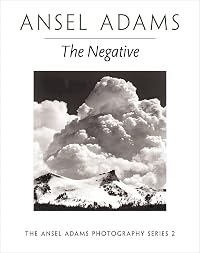
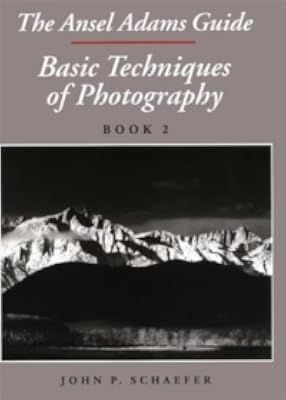
"This handbook ... has taught ... how to use film and the film development process creatively ... Anchored by a detailed discussion of Adams' Zone System and his seminal concept of visualization ... Beautifully illustrated with photographs by Adams as well as instructive line drawings"--Back cover.Tags
Recommendations

















Member Reviews
Wow. I just checked this out to see some pretty pictures, but it turns out I'm learning a lot, too. And not by reading the text, but rather just the captions to the photos. I'm not a photographer, never have been, but have learned a tiny bit over the decades from osmosis. Turns out that choosing the right emulsion and paper to make the print has a lot to do with the results; it's not just exposure, time of day, etc. Light meters come in different modes (not sure what word) like for incident light or reflective light, too.
What I love about this book is that it shows a bunch of pictures that were taken at the same time, and/or from the same place, and showing the dramatically different results Adams got.
He even shows some images that he show more admits were not done well. "In retrospect, this [choice of filter strategy] was a mistake."
If I were a photographer I would want to look over the whole series of these 'textbooks' from Adams, and maybe get into film photography, too. It seems that doing so would be both hugely frustrating (not to mention expensive) but also allow for so very much more creativity than can be done with digital cameras. Or maybe I'm wrong... maybe digital cameras can give results akin, in the hands of an artist who knows the possibilities.
I need to find a print of 'Moonrise, Hernandez, New Mexico.' The sky, with setting sun, lit clouds, and moon all at the same time is amazing enough, but the white crosses of the cemetery also came out brilliantly.
I'd probably give this four stars but I 'read' so little of this that I can't legitimately rate it.
Skimmed, May 2024 show less
What I love about this book is that it shows a bunch of pictures that were taken at the same time, and/or from the same place, and showing the dramatically different results Adams got.
He even shows some images that he show more admits were not done well. "In retrospect, this [choice of filter strategy] was a mistake."
If I were a photographer I would want to look over the whole series of these 'textbooks' from Adams, and maybe get into film photography, too. It seems that doing so would be both hugely frustrating (not to mention expensive) but also allow for so very much more creativity than can be done with digital cameras. Or maybe I'm wrong... maybe digital cameras can give results akin, in the hands of an artist who knows the possibilities.
I need to find a print of 'Moonrise, Hernandez, New Mexico.' The sky, with setting sun, lit clouds, and moon all at the same time is amazing enough, but the white crosses of the cemetery also came out brilliantly.
I'd probably give this four stars but I 'read' so little of this that I can't legitimately rate it.
Skimmed, May 2024 show less
What a brilliant book. This is a masterpiece, by a master craftsman.
While the details may have changed, the principles have not. These are timeless, and this is what he sets out to demonstrate again.
The book is laid out in the most logical manner. The section on the Zone System is a must read for any photographer.
His grasp of the subject is masterly, and so is his treatment of the subject.
While the details may have changed, the principles have not. These are timeless, and this is what he sets out to demonstrate again.
The book is laid out in the most logical manner. The section on the Zone System is a must read for any photographer.
His grasp of the subject is masterly, and so is his treatment of the subject.
Second book in a series of three about the process of the Zone System of exposure developed by Ansel Adams. An excellent description of the process of exposure of a set of negatives to produce various parametric curves which are then used to determine the optimum exposure and development of black and white film for individual photographs. Definitely required reading for those photographers wishing to learn the Zone System for producing high quality prints.
Must read for all those involved in analog photography and more...
"Este manual... ha enseñado... cómo usar la película y el proceso de revelado de forma creativa... Basado en un análisis detallado del Sistema de Zonas de Adams y su concepto fundamental de visualización... Bellamente ilustrado con fotografías de Adams, así como con instructivos dibujos lineales"
May 7, 2025Spanish
Members
- Recently Added By
Author Information

Ansel Easton Adams born on February 20, 1902 in San Francisco, California. In 1915 his father removed him from school and he was home-schooled in Greek, the English classics, algebra, and the nature that surrounded their home. His father also bought him a season pass to the Panama-Pacific Exposition, which he visited nearly every day. In 1916 the show more Adams family visited Yosemite National Park, where Adams was given his first camera. At this point in his life, Adams had planned to become a concert pianist, but he soon discovers the joys of photography. Adams' first acknowledged picture appears in 1927. In 1932, he formed the f/64 group with Edward Veston, with whom he goes on to teach his first workshop with at Yosemite, called the U. S. Camera Photogrpahic Forum. Adams began serving on the Board of the Sierra Club in 1932, a position he held until 1971. In March of 1933, Adams met Alfred Stieglitz, owner of An American Place photo gallery. Stieglitz was so impressed with Adams work that he held an exhibition for Adams in 1936. In 1943, Adams sought to contribute to the war effort by recording the lives of the American-born citizens of Japanese descent who were interned in the Manzanar War Relocation Camp. In 1949 Adams tested Polaroid cameras for Edwin Land, In 1953, Adams collaborated with Dorothea Lange on a Life commission for a photo essay on the Mormons in Utah. In 1967, he was instrumental in the foundation of the Friends of Photography. Adams was a commercial photographer for 30 years, within which he won three Guggenheim grants to photograph the national parks. In 1980, The Ansel Adams Conservation Award was established by the Wilderness Club, and Adams named as the first recipient. Ansel Adams died April 22 of heart failure aggravated by cancer. (Bowker Author Biography) In a career that spanned more than five decades, Ansel Adams was at once America's foremost landscape photographer & one of its most ardent environmentalists. (Publisher Provided) show less
Some Editions
Series

Work Relationships
Common Knowledge
- Canonical title
- The Negative
- Original publication date
- 1948
- People/Characters
- Ansel Adams
- First words
- While the photographer need not make an extensive study of the physics of light, he should nevertheless be acquainted with certain aspects of its behavior that are of importance because of their relation to his medium.
Forward: The function of this series, Basic Photo, is to present a philosophy of technique and application.
Classifications
Statistics
- Members
- 1,037
- Popularity
- 24,843
- Reviews
- 5
- Rating
- (4.24)
- Languages
- 5 — English, German, Italian, Spanish, Portuguese (Portugal)
- Media
- Paper
- ISBNs
- 7
- ASINs
- 23