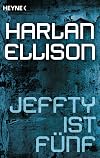
Jeffty Is Five [short fiction]
by Harlan Ellison
On This Page
Tags
Recommendations












Member Reviews
https://nwhyte.livejournal.com/3493524.html
Jeffty was the narrator's best friend as a child; but almost twenty years later, Jeffty is still five (like Oskar in The Tin Drum) and everyone else has grown up. However, Jeffty is still getting comics, hearing radio shows and even seeing films which are updates from the 1940s (the story is pretty clearly set in the early 1960s). His parents are in despair. One day Jeffty gets beaten up by older boys when he magicks their radio to only play the shows from his timeline, and his parents take the opportunity of his injuries to drown him in the bath, and the present day returns to their household. As stories go, it's much closer to horror than to science fiction; but the shock ending is told show more well, and perhaps this bit of talecraft, along with the community's affection for Ellison, helped the story over the line for the awards (and he was a Guest of Honor at the Worldcon).
Ellison was generally seen (not least by himself) as a firebrand radical leftie, but this is a very conservative story, unapologetically wishing for the old days:
“Things are better in a lot of ways. People don’t die from some of the old diseases any more. Cars go faster and get you there more quickly on better roads. Shirts are softer and silkier. We have paperback books even though they cost as much as a good hardcover used to. When I’m running short in the bank I can live off credit cards till things even out. But I still think we’ve lost a lot of good stuff. Did you know you can’t buy linoleum any more, only vinyl floor covering? There’s no such thing as oilcloth any more; you’ll never again smell that special, sweet smell from your grandmother’s kitchen. Furniture isn’t made to last thirty years or longer because they took a survey and found that young homemakers like to throw their furniture out and bring in all new, color-coded borax every seven years. Records don’t feel right; they’re not thick and solid like the old ones, they’re thin and you can bend them... that doesn’t seem right to me. Restaurants don’t serve cream in pitchers any more, just that artificial glop in little plastic tubs, and one is never enough to get coffee the right color. You can make a dent in a car fender with only a sneaker. Everywhere you go, all the towns look the same with Burger Kings and McDonald’s and 7-Elevens and Taco Bells and motels and shopping centers. Things may be better, but why do I keep thinking about the past?”
It's also striking that the story is clearly set before the Sixties really took off, but was published in the late Seventies; a gap between setting and writing that is almost the same as the gap between the narrator's childhood friendship with Jeffty and the main part of the story. I found it curiously backward-looking for an award-winner. show less
Jeffty was the narrator's best friend as a child; but almost twenty years later, Jeffty is still five (like Oskar in The Tin Drum) and everyone else has grown up. However, Jeffty is still getting comics, hearing radio shows and even seeing films which are updates from the 1940s (the story is pretty clearly set in the early 1960s). His parents are in despair. One day Jeffty gets beaten up by older boys when he magicks their radio to only play the shows from his timeline, and his parents take the opportunity of his injuries to drown him in the bath, and the present day returns to their household. As stories go, it's much closer to horror than to science fiction; but the shock ending is told show more well, and perhaps this bit of talecraft, along with the community's affection for Ellison, helped the story over the line for the awards (and he was a Guest of Honor at the Worldcon).
Ellison was generally seen (not least by himself) as a firebrand radical leftie, but this is a very conservative story, unapologetically wishing for the old days:
“Things are better in a lot of ways. People don’t die from some of the old diseases any more. Cars go faster and get you there more quickly on better roads. Shirts are softer and silkier. We have paperback books even though they cost as much as a good hardcover used to. When I’m running short in the bank I can live off credit cards till things even out. But I still think we’ve lost a lot of good stuff. Did you know you can’t buy linoleum any more, only vinyl floor covering? There’s no such thing as oilcloth any more; you’ll never again smell that special, sweet smell from your grandmother’s kitchen. Furniture isn’t made to last thirty years or longer because they took a survey and found that young homemakers like to throw their furniture out and bring in all new, color-coded borax every seven years. Records don’t feel right; they’re not thick and solid like the old ones, they’re thin and you can bend them... that doesn’t seem right to me. Restaurants don’t serve cream in pitchers any more, just that artificial glop in little plastic tubs, and one is never enough to get coffee the right color. You can make a dent in a car fender with only a sneaker. Everywhere you go, all the towns look the same with Burger Kings and McDonald’s and 7-Elevens and Taco Bells and motels and shopping centers. Things may be better, but why do I keep thinking about the past?”
It's also striking that the story is clearly set before the Sixties really took off, but was published in the late Seventies; a gap between setting and writing that is almost the same as the gap between the narrator's childhood friendship with Jeffty and the main part of the story. I found it curiously backward-looking for an award-winner. show less
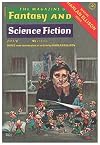
A reread - previously read in the 'Locus Awards' collection, as well as in 'The Very Best of F&SF'.
A classic, and impressively well-done. I actually disagree with the content of the story: I object to the nostalgia for 'good old days' that it rests on - but it doesn't matter. It's still incredibly moving.
Two boys are best friends. One of them grows up and does all the normal things a young man does. One of them stays five years old, both mentally and physically. They stay friends, even though their dynamic changes... and one realizes that his friend is quite literally tuned in to another time.
A classic, and impressively well-done. I actually disagree with the content of the story: I object to the nostalgia for 'good old days' that it rests on - but it doesn't matter. It's still incredibly moving.
Two boys are best friends. One of them grows up and does all the normal things a young man does. One of them stays five years old, both mentally and physically. They stay friends, even though their dynamic changes... and one realizes that his friend is quite literally tuned in to another time.
Ratings
Members
- Recently Added By
Lists

Nebula Award
111 works; 14 members
Author Information

586+ Works 30,615 Members
Harlan Ellison was born in Cleveland, Ohio on May 27, 1934. He was the author of numerous short story collections including Strange Wine; The Beast that Shouted Love at the Heart of the World; Harlan Ellison's Watching; Deathbird Stories; Repent Harlequin! Said the Ticktockman; I Have No Mouth and I Must Scream; and Stalking the Nightmare: Stories show more and Essays. He received numerous awards including the Hugo Award, the Nebula Award, the Bram Stoker Award, the Lifetime Achievement Award from the Horror Writer's Association, the Edgar Allen Poe Award, and the Grand Master Award for lifetime achievement from the Science Fiction and Fantasy Writers of America. He was inducted into the Science Fiction Hall of Fame in 2011. He published two collections of his columns on television for the Los Angeles Free Press entitled The Glass Teat and The Other Glass Teat. He edited several anthologies including Dangerous Visions: 33 Original Stories and Medea: Harlan's World. He received the Milford Award for Lifetime Achievement in Editing. He also wrote scripts for TV series including Burke's Law, The Alfred Hitchcock Hour, Voyage to the Bottom of the Sea, and The Man from U.N.C.L.E. He served as creative consultant on the new version of The Twilight Zone in the 1980s and as conceptual consultant on Babylon 5. He won the Writer's Guild of America's Award for Most Outstanding Teleplay four times. He died on June 27, 2018 at the age of 84. (Bowker Author Biography) show less
Some Editions
Awards and Honors
Awards
Work Relationships
Is contained in
Has as a student's study guide
Common Knowledge
- Canonical title
- Jeffty Is Five [short fiction]
- Original title
- Jeffty Is Five [short story]
- Original publication date
- 1977
- People/Characters*
- Jeff Kinzer (Jeffty); John Kinzer; Leona Kinzer; Donald H. Horton (Donny)
- First words*
- Als ich fünf Jahre alt war, gab es einen kleinen Jungen, mit dem ich spielte: Jeffty.
- Last words*
- (Click to show. Warning: May contain spoilers.)Bitte, jemand muß es mir sagen.
- Original language*
- Englisch
*Some information comes from Common Knowledge in other languages. Click "Edit" for more information.
Classifications
Statistics
- Members
- 40
- Popularity
- 731,750
- Reviews
- 2
- Rating
- (4.15)
- Languages
- English, German
- Media
- Paper, Ebook
- ASINs
- 3