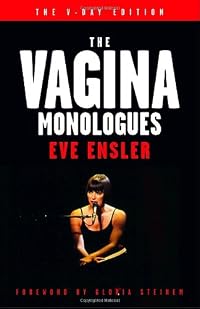
Vagina Monologues
by V
On This Page
Description
A poignant and hilarious tour of the last frontier, the ultimate forbidden zone, The vagina monologues is a celebration of female sexuality in all its complexity and mystery. Hailed as the bible for a new generation of women, it has been performed in cities all across America and at hundreds of college campuses, and has inspired a dynamic grassroots movement--V-Day--to stop violence against women. Witty and irreverent, compassionate and wise, Eve Ensler's Obie Award-winning masterpiece gives show more voice to real women's deepest fantasies and fears, guaranteeing that no one who reads it will ever look at a woman's body, or think of sex, in quite the same way again. show lessTags
Recommendations













Member Recommendations

Member Reviews
I've been hearing about this work for most of my adult life - as a touchstone for some people and a punch line for others - but I had never experienced myself. My daughter read it for one of her high school classes, and I like to read along with her so I finally had motivation to find what out what lies behind the infamous reputation. I was going to read the book without ever having seen the piece performed, but I found it was available for streaming on HBO Now and watched it first. Then I read the book immediately afterward. And except for the few pieces that relied heavily on sound effects, I preferred the written version. It was easier for me to pick out and contemplate the interesting ideas and speed through parts that interested me show more less. I like that the book includes a few performance pieces that were missing from the HBO special and this edition has uplifting correspondence from V-Day fundraiser participants. I'm very impressed and now side with those who consider this a touchstone. show less
This work created a sensation as it toured the country (and the world) for V-day celebrations. So much talk of vaginas can be offputting for women; my own discomfort raised the question: why do women find it so difficult to talk about their vaginas, when men seem to have no difficulty expounding for hours about penises? It is an artistic wake up call - the monologues talk about how women feel about their vaginas, and the message comes through loud and clear that we are not comfortable. It isn't penis envy that shows through these monologues, but rather an ambivalence and uncertainty about what it means to be a woman, about the risks of being a woman in a world designed by (and for) men, and how much we really want to talk about the one show more thing we don't want to talk about. If that makes no sense...well, read the book. show less
Once in awhile a friend gives you a book that resonates deep within you. This is such a book. Yes, the name goes for the shock value, as the author tells the stories of numerous women. I laughed, cried, thought, laughed, and cried some more. This book reminds me of why I am so proud to be a woman, and why I don't believe in shoving the truth under the cover. I want to look at it head on, know about it, and tell others about it. I want my daughter to grow up strong and confident, and I want that for all of my friends and their daughters. Being a woman is so mystical, so powerful, so wonderful, and yet bad things do happen to us, many times just because of the fact that we are women. Being a lawyer and a lawyer's wife, I well know that, show more but so many do not know and worse, don't want to know.
Not knowing won't change anything. But knowing can.
I read this book to give my thoughts to PCT Off Plaza about whether to do this play. I hope they will, but regardless of that, I hope you will read this book. Read it for yourself, and for your mom, wife, daughters, and friends. You will learn something. And your knowledge will help someone. show less
Not knowing won't change anything. But knowing can.
I read this book to give my thoughts to PCT Off Plaza about whether to do this play. I hope they will, but regardless of that, I hope you will read this book. Read it for yourself, and for your mom, wife, daughters, and friends. You will learn something. And your knowledge will help someone. show less
I wish I'd managed to see this staged. In text form, there's certainly something missing from a piece that is supposed to get us over the taboo of saying vagina out loud, only to read it silently and then not say vagina out loud. It's awesome to see how important the monologues were to the interviewees and the author regardless; a lot of the power remains, even for someone with zero experience of vagina possession. The paperback does come with explanations/backstory that rivals the length of the associated monologue at points, which is interesting but breaks the flow; I'm curious as to whether staged productions include these/whether more monologues have been added since the publication of this book.
People like to critique that which is popular. "Even though it's popular it's not good," they like to say. But here is the thing... it becomes popular for a reason. It broke rules and did so in a way that was accepted by the mainstream. And perhaps one of those rules is one you liked. Perhaps you're stuck on what you believe is "good theater" or "good writing." But in the end it is good because it touched people. It is good because it changed people. And this book which I read for the first time this year, and the play which I saw for the first time over ten years ago, are good because they change me. Present tense. The monologues come back to me when I'm having conversations with people or when I am thinking about womanhood or show more masculinity. They become a part of how I think about myself, my sisters, my wife, my nieces. Eve Ensler did something amazing. And this is one of the most well-known books about women and what it means to be a woman for good reasons. show less
This is the book version of Ensler's popular stage show, in which she talks about, well, vaginas. It features some of her own thoughts, a few anatomical facts, and several pieces based on interviews she did with other women, although it seems as if most of those stories are somewhat fictionalized, or interpreted, or maybe just paraphrased.
And... OK, first off, I have to say, I very much approve of what Ensler's trying to do with this. Like a lot of girls, I grew up with the distinct sense that my genitalia were something dirty and shameful, or at the very least something embarrassing and taboo, an implicit but fairly clear message that that particular piece of human anatomy should not be named, touched, or even thought about more than show more strictly necessary. And that ain't right. It especially ain't right in a society in which male genitalia come with associations of pride and power. (And other associations as well, of course, but those are definitely there in a way that they're not for women.) Demystifying women's bodies, making a vagina something that's nice to have and fine to acknowledge having, that's a good thing. Ensler also talks about sexual abuse and rape and genital mutilation, and these are also things that should be acknowledged and talked about and not turned away from. So, in principle, I'm all for this.
In practice, however... I have to say, most of it did very little for me. There weren't really any moments where I felt she tapped into something that I, personally, could relate to, and there's a bit too much mysticism and flowery language and weird metaphor for me. My vagina is not not a seat of power, it's not a fragrant meadow, and it doesn't wear a beret. I just cannot make myself take that sort of thing seriously. I did, somewhat to my surprise, quite like the poem about childbirth. But otherwise... Well, maybe it's better if you actually see it performed live. Or maybe I'm just not the right audience for this, whatever anatomy I happen to be possessed of. show less
And... OK, first off, I have to say, I very much approve of what Ensler's trying to do with this. Like a lot of girls, I grew up with the distinct sense that my genitalia were something dirty and shameful, or at the very least something embarrassing and taboo, an implicit but fairly clear message that that particular piece of human anatomy should not be named, touched, or even thought about more than show more strictly necessary. And that ain't right. It especially ain't right in a society in which male genitalia come with associations of pride and power. (And other associations as well, of course, but those are definitely there in a way that they're not for women.) Demystifying women's bodies, making a vagina something that's nice to have and fine to acknowledge having, that's a good thing. Ensler also talks about sexual abuse and rape and genital mutilation, and these are also things that should be acknowledged and talked about and not turned away from. So, in principle, I'm all for this.
In practice, however... I have to say, most of it did very little for me. There weren't really any moments where I felt she tapped into something that I, personally, could relate to, and there's a bit too much mysticism and flowery language and weird metaphor for me. My vagina is not not a seat of power, it's not a fragrant meadow, and it doesn't wear a beret. I just cannot make myself take that sort of thing seriously. I did, somewhat to my surprise, quite like the poem about childbirth. But otherwise... Well, maybe it's better if you actually see it performed live. Or maybe I'm just not the right audience for this, whatever anatomy I happen to be possessed of. show less
This is a series of monologues and ensemble pieces cobbled together by Eve Ensler from various interviews she had with women regarding sex, sexual violence, and vaginas. Each year the script changes, with various updates by Ensler. The updated scripts are for performance only and different than the published version. Also they are only available to the groups who are planning on performing the monologues in association with the fight against sexual and domestic violence - against women and girls.
There's some strict rules:
1. These are true stories and the performers should tell/perform them with a certain respect to the actual women who told them.
2. Usually the performance is a staged reading, with little to no direction. The performers show more do not memorize the script and read it off of index cards.
3. The entire script must be performed and it must be no longer or shorter than 90 minutes.
4. Everyone who wants to be involved should be provided with some role or means of involvement, and this should be a healing experience.
5. The directors/producers of the play should see themselves as activists first and directors second.
6. Only those people who have lived their lives with a vagina (note not necessarily born with one) may perform the roles. Roles are open to transgender women who have a vagina via medical means and women born with one. Men can be involved in other ways but not in performing the roles. (Which makes sense when you read it - the roles are definitely characters with vaginas. It would be odd for someone with a penis to perform these roles, and disrespectful to the actual women whom the roles/monologues are based.)
The monologues are rather moving. It is not a "man-hating" play as has been presumed. It's an informative piece about how our society has dealt with the concept of vagina, women, and violence against women and transgender. And I highly recommend that people of all genders either read it or if they get a chance see a performance. show less
There's some strict rules:
1. These are true stories and the performers should tell/perform them with a certain respect to the actual women who told them.
2. Usually the performance is a staged reading, with little to no direction. The performers show more do not memorize the script and read it off of index cards.
3. The entire script must be performed and it must be no longer or shorter than 90 minutes.
4. Everyone who wants to be involved should be provided with some role or means of involvement, and this should be a healing experience.
5. The directors/producers of the play should see themselves as activists first and directors second.
6. Only those people who have lived their lives with a vagina (note not necessarily born with one) may perform the roles. Roles are open to transgender women who have a vagina via medical means and women born with one. Men can be involved in other ways but not in performing the roles. (Which makes sense when you read it - the roles are definitely characters with vaginas. It would be odd for someone with a penis to perform these roles, and disrespectful to the actual women whom the roles/monologues are based.)
The monologues are rather moving. It is not a "man-hating" play as has been presumed. It's an informative piece about how our society has dealt with the concept of vagina, women, and violence against women and transgender. And I highly recommend that people of all genders either read it or if they get a chance see a performance. show less
Members
- Recently Added By
Lists

Women's Stories
88 works; 13 members

Read These Too
458 works; 9 members

Best Feminist Literature
188 works; 26 members

Banging Book Club
36 works; 1 member

My Play Collection
769 works; 3 members
Author Information

Some Editions
Awards and Honors
Awards
Work Relationships
Has the adaptation
Common Knowledge
- Canonical title
- Vagina Monologues
- Original title
- The vagina monologues
- Original publication date
- 1996
- People/Characters
- Eve Ensler
- Important events
- Third Wave Feminism
- Related movies
- The Vagina Monologues (2002 | IMDb)
- Dedication
- For Ariel, who rocks my vagina
and explodes my heart - First words
- I come from the "down there" generation.
--Foreword
I am not sure why I was chosen.
--Introduction
I bet you're worried.
--Body text - Last words
- (Click to show. Warning: May contain spoilers.)I was there when her vagina opened.
We were all there: her mother, her husband, and I,
and the nurse from the Ukraine with her whole hand
up there in her vagina feeling and turning with her rubber
glove as she talked casually to us—like she was turning on a loaded faucet.
I was there in the room when the contractions made her crawl on all fours,
made unfamiliar moans leak out of her pores and still there after hours when she just screamed suddenly
wild, her arms striking at the electric air.
I was there when her vagina changed
from a shy sexual hole
to an archaeological tunnel, a sacred vessel,
a Venetian canal, a deep well with a tiny stuck child inside,
waiting to be rescued.
I saw the colors of her vagina. They changed.
Saw the bruised broken blue
the blistering tomato red
the gray pink, the dark;
saw the blood like perspiration along the edges
saw the yellow, white liquid, the shit, the clots
pushing out all the holes, pushing harder and harder,
saw through the hole, the baby's head
scratches of black hair, saw it just there beyond
the bone—a hard round memory, as the nurse from the Ukraine kept turning and turning
her slippery hand.
I was there when each of us, her mother and I, held a leg and spread her wide pushing
with all our strength pushing
and her husband sternly counting, "One, two, three,"
telling her to focus, harder.
We looked into her then.
We couldn't get our eyes out of that place.
We forget the vagina, all of us
what else would explain
our lack of awe, our lack of wonder.
I was there when the doctor
reached in with Alice in Wonderland spoons
and there as her vagina became became a wide operatic mouth
singing with all its strength;
first the little head, then the gray flopping arm,
then the fast
swimming body, swimming quickly into our weeping arms.
I was there later when I just turned and faced her vagina.
I stood and let myself see
her all spread, completely exposed
mutilated, swollen, and torn,
bleeding all over the doctor's hands
who was calmly sewing her there.
I stood, and as I stared, her vagina suddenly
became a wide red pulsing heart.
The heart is capable of sacrifice.
So is the vagina.
The heart is able to forgine and repair.
It can change its shape to let us in.
It can expand to let us out.
So can the vagina.
It can ache for us and stretch for us, die for us
and bleed and bleed us into this difficult, wondrous world.
So can the vagina.
I was there in the room.
I remember. - Blurbers
- Steinem, Gloria
- Original language
- English US
Classifications
Statistics
- Members
- 3,605
- Popularity
- 4,486
- Reviews
- 64
- Rating
- (3.79)
- Languages
- 16 — Czech, Danish, Dutch, English, Estonian, Finnish, French, German, Hungarian, Italian, Norwegian (Bokmål), Polish, Croatian, Slovak, Spanish, Portuguese (Brazil)
- Media
- Paper, Audiobook, Ebook
- ISBNs
- 63
- UPCs
- 2
- ASINs
- 21