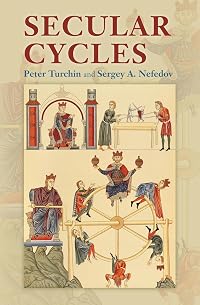
Secular Cycles
by Peter Turchin, Sergey A. Nefedov
On This Page
Description
Many historical processes exhibit recurrent patterns of change. Century-long periods of population expansion come before long periods of stagnation and decline; the dynamics of prices mirror population oscillations; and states go through strong expansionist phases followed by periods of state failure, endemic sociopolitical instability, and territorial loss. Peter Turchin and Sergey Nefedov explore the dynamics and causal connections between such demographic, economic, and political show more variables in agrarian societies and offer detailed explanations for these long-term oscillations--what the authors call secular cycles. Secular Cycles elaborates and expands upon the demographic-structural theory first advanced by Jack Goldstone, which provides an explanation of long-term oscillations. This book tests that theory's specific and quantitative predictions by tracing the dynamics of population numbers, prices and real wages, elite numbers and incomes, state finances, and sociopolitical instability. Turchin and Nefedov study societies in England, France, and Russia during the medieval and early modern periods, and look back at the Roman Republic and Empire. Incorporating theoretical and quantitative history, the authors examine a specific model of historical change and, more generally, investigate the utility of the dynamical systems approach in historical applications. An indispensable and groundbreaking resource for a wide variety of social scientists, Secular Cycles will interest practitioners of economic history, historical sociology, complexity studies, and demography. show lessTags
Recommendations
























Member Reviews
An excellent exploration of long-term cycles in agricultural societies. Even if you disagree with, or don't care about, the thesis, there is plenty of fascinating information about the structures of various European societies, from ancient Rome through Romanov Russia.
The general thesis of this book is that agricultural societies strengthen and weaken in multi-century cycles based on a modestly complex interaction of the population dynamics of the peasantry and the elite. Turchin and Nefedov provide quite a lot of data to buttress their case. One consequence of their thesis is that "golden ages" for the elites of a society are lousy times to be a peasant, while good times for the peasantry are usually times of stability, but only modest show more prosperity, for the nobility/elite of a society. show less
The general thesis of this book is that agricultural societies strengthen and weaken in multi-century cycles based on a modestly complex interaction of the population dynamics of the peasantry and the elite. Turchin and Nefedov provide quite a lot of data to buttress their case. One consequence of their thesis is that "golden ages" for the elites of a society are lousy times to be a peasant, while good times for the peasantry are usually times of stability, but only modest show more prosperity, for the nobility/elite of a society. show less
Ratings
Members
- Recently Added By
Lists

Big History
72 works; 1 member
Author Information

12 Works 1,235 Members
Peter Turchin is professor in the Department of Ecology and Evolutionary Biology and adjunct professor in the Department of Mathematics at the University of Connecticut
1 Work 108 Members
Classifications
- Genres
- Nonfiction, History, Economics, Sociology, General Nonfiction, Business
- DDC/MDS
- 304.6 — Society, government, & culture Social sciences, sociology & anthropology Factors affecting social behavior Population
- LCC
- HB849.51 .T87 — Social sciences Economic theory. Demography Economic theory. Demography Demography. Population. Vital events
- BISAC
Statistics
- Members
- 110
- Popularity
- 296,404
- Reviews
- 1
- Rating
- (4.21)
- Languages
- English
- Media
- Paper, Ebook
- ISBNs
- 3
- ASINs
- 1