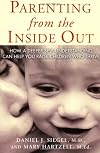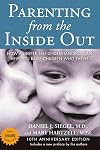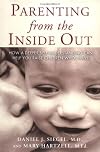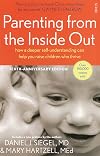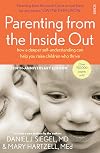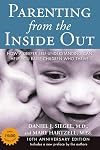
Parenting from the Inside Out: How a Deeper Self-Understanding Can Help You Raise Children Who Thrive: 10th Anniversary Edition
by Daniel J. Siegel
On This Page
Description
Explores the extent to which our childhood experiences shape the way we parent, drawing on new findings in neurobiology and attachment research and explaining how interpersonal relationships directly impact the development of the brain. Offers parents a step-by-step approach to forming a deeper understanding of their own life stories.Tags
Recommendations
Member Reviews
How your parents treated you, and how you internalized that, affects how you treat your kids. Hmm, not really a surprising statement there, is it? A lot of psychological mumbo-jumbo thrown about, complete with cross-sections of the brain. At one point in my life (fresh out of college) I would probably have found it fascinating and read each word, but now I just felt thickheaded so I skimmed and tried to pick out the key concepts. I feel like I didn't really need all that theory, I just needed to know what are some things I shouldn't do so I don't fuck up being a parent.
The few examples, like about collaborative talk, were brilliant. Don't invalidate their feelings, but try to talk it out. I also heard on a Radiolab episode that our show more internal voice when we're thinking is actually based on how our parents talked us through something. So I was pretty interested in this. Like if a child falls down and isn't injured but starts crying, don't say "You weren't hurt. You're a big boy. You shouldn't cry." but instead "Looks like you got surprised when you fell down. Are you hurt?" I wish there had been more anecdotes, so I could get the hang of how to react and talk to children. I think I get the idea, but I could really have used more examples, especially about discipline and setting limits. A summary of the concepts at the end of each chapter would have been helpful (like a For Dummies) book. Because, you know, I'm a dummy. And I doubt a sleep-deprived new parent can clear the mind fog enough to appreciate psychobabble.
My oversimplified summary: Empathize with your child, and describe back a situation to him in they way you think he/she sees it. And don't lie (saying you're fine when actually you're not), because they can pick up on nonverbal signals.
I wish there were workshops based on this where people present a scenario, have parents act, then guide them on what might be a better way to act and what to say. show less
The few examples, like about collaborative talk, were brilliant. Don't invalidate their feelings, but try to talk it out. I also heard on a Radiolab episode that our show more internal voice when we're thinking is actually based on how our parents talked us through something. So I was pretty interested in this. Like if a child falls down and isn't injured but starts crying, don't say "You weren't hurt. You're a big boy. You shouldn't cry." but instead "Looks like you got surprised when you fell down. Are you hurt?" I wish there had been more anecdotes, so I could get the hang of how to react and talk to children. I think I get the idea, but I could really have used more examples, especially about discipline and setting limits. A summary of the concepts at the end of each chapter would have been helpful (like a For Dummies) book. Because, you know, I'm a dummy. And I doubt a sleep-deprived new parent can clear the mind fog enough to appreciate psychobabble.
My oversimplified summary: Empathize with your child, and describe back a situation to him in they way you think he/she sees it. And don't lie (saying you're fine when actually you're not), because they can pick up on nonverbal signals.
I wish there were workshops based on this where people present a scenario, have parents act, then guide them on what might be a better way to act and what to say. show less
definitely has good information and things to think about. i believe in the importance of attachment, but some parts of the book i thought went too far in stressing consequences of insecure attachments. i think i am also just too exhausted right now to read and truly appreciate a book that's written like a textbook.
Jennifer - Heavy on attachment theory.
Audiobook may be available.
Librería 3. Estante 6
Jul 31, 2019Spanish
Ratings
Members
- Recently Added By
Lists

Tom's Bookstore
346 works; 2 members

Men's healing resources
747 works; 1 member

Books parents
30 works; 1 member
Author Information

33+ Works 7,181 Members
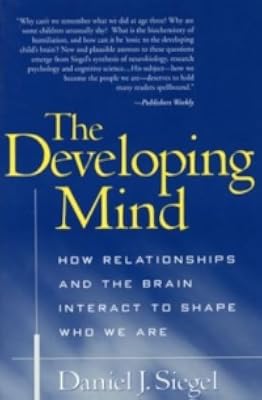
Daniel J. Siegel was born on September 2, 1957. He is a clinical professor of psychiatry at the UCLA School of Medicine and executive director of the Mindsight Institute. He received a medical degree from Harvard Medical School and his post-graduate medical education at UCLA. His training is in pediatrics and child, adolescent, and adult show more psychiatry. Siegel was the recipient of the UCLA psychiatry department's teaching award and several honorary fellowships for his work as director of UCLA's training program in child psychiatry and the Infant and Preschool Service at UCLA. He is the author of several books on parenting and child development including The Mindful Brain: Reflection and Attunement in the Cultivation of Well-Being, The Developing Mind: Toward a Neurobiology of Interpersonal Experience, Brainstorm: The Power and Purpose of the Teenage Brain, and Parenting from the Inside Out, which he co-wrote with Mary Hartzell. Siegel is known as a mindfulness expert and for his work developing the field of Interpersonal Neurobiology which is an interdisciplinary view of life experience. He is the author of Aware: The Science and Practice of Presence--The Groundbreaking Meditation Practice. (Bowker Author Biography) show less
Classifications
- Genres
- Nonfiction, General Nonfiction
- DDC/MDS
- 649.1 — Applied science & technology Home economics & family management Child rearing; home care of people with illnesses and disabilities by family and friends Parenting
- LCC
- HQ755.8 .S53272 — Social sciences The family. Marriage, Women and Sexuality The Family. Marriage. Women The family. Marriage. Home Parents. Parenthood
- BISAC
Statistics
- Members
- 731
- Popularity
- 38,601
- Reviews
- 5
- Rating
- (3.97)
- Languages
- 5 — Chinese, English, German, Italian, Spanish
- Media
- Paper, Audiobook, Ebook
- ISBNs
- 21
- ASINs
- 5