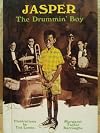
Jasper, the drummin' boy
by Margaret Taylor Burroughs
On This Page
Description
All Jasper's problems seem to stem from his strong desire to be a famous drummer like his grandfather and his mother's equally strong determination to make him a concert pianist.Tags
Member Reviews
Aww, now if this book about a Black American boy didn't make for a delightful little read for me?
Going through the pages of the first edition published in 1947, I read some parts and took a look at all of the original illustrations, which the author (also Black American) drew herself. My old-fashioned side particularly loves that style of artwork in fiction—and, yes indeed, the 1940s hairstyles and clothes!
The edition I read in full is the revised one from 1970, with a different illustrator. I noticed more dialogue added in the later edition, which better expresses where the characters are coming from. There are also further updates like the mention of "Dr. Martin Luther King Drive" (which, of course, that street wouldn't have been show more named yet back in '47, when King was still a teenager), and added references to the television, which wasn't a common household item when this book was published the first time.
There was, however, one aspect of the story that bothered me: the attitudes of some of the grownups—especially Jasper's mother. You've got adults talking about what a pain and a disruption Jasper is with all of his drumming noise, and the turn of events that suddenly changes their attitudes makes the change feel somewhat shallow and less than authentic, since the change isn't sparked by Jasper himself or by his display of real talent.
And with or without that talent, when Mrs. Anderson, exasperated with Jasper's behavior, declares to a neighborhood guest that her son "is no prize," that's disrespectful. And hurtful, I'd say, as Jasper and his friends and neighbors are all standing right there when Mrs. Anderson says it.
Like, Dear Ma'am, Dear Sir out there: Do not denigrate your own children like that.
What makes me feel a smidgen better about that incident is the fact that Mrs. Anderson's "change as a grownup" gets a little more of the story's time and attention afterward than that of the other grownups. So hers has the chance to feel more honest.
In any case, I'm certainly glad I came across this vintage kid lit. show less
Going through the pages of the first edition published in 1947, I read some parts and took a look at all of the original illustrations, which the author (also Black American) drew herself. My old-fashioned side particularly loves that style of artwork in fiction—and, yes indeed, the 1940s hairstyles and clothes!
The edition I read in full is the revised one from 1970, with a different illustrator. I noticed more dialogue added in the later edition, which better expresses where the characters are coming from. There are also further updates like the mention of "Dr. Martin Luther King Drive" (which, of course, that street wouldn't have been show more named yet back in '47, when King was still a teenager), and added references to the television, which wasn't a common household item when this book was published the first time.
There was, however, one aspect of the story that bothered me: the attitudes of some of the grownups—especially Jasper's mother. You've got adults talking about what a pain and a disruption Jasper is with all of his drumming noise, and the turn of events that suddenly changes their attitudes makes the change feel somewhat shallow and less than authentic, since the change isn't sparked by Jasper himself or by his display of real talent.
And with or without that talent, when Mrs. Anderson, exasperated with Jasper's behavior, declares to a neighborhood guest that her son "is no prize," that's disrespectful. And hurtful, I'd say, as Jasper and his friends and neighbors are all standing right there when Mrs. Anderson says it.
Like, Dear Ma'am, Dear Sir out there: Do not denigrate your own children like that.
What makes me feel a smidgen better about that incident is the fact that Mrs. Anderson's "change as a grownup" gets a little more of the story's time and attention afterward than that of the other grownups. So hers has the chance to feel more honest.
In any case, I'm certainly glad I came across this vintage kid lit. show less
Members
- Recently Added By
Author Information

13 Works 44 Members
Classifications
Statistics
- Members
- 15
- Popularity
- 1,588,919
- Reviews
- 1
- Rating
- (4.00)
- Languages
- English
- Media
- Paper
- ISBNs
- 2
- ASINs
- 2