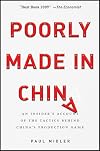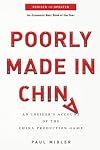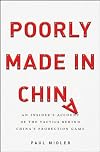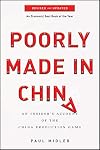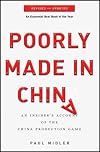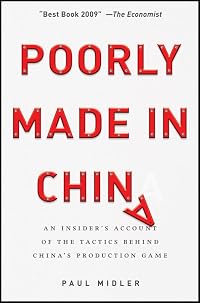
Poorly Made in China: An Insider's Account of the Tactics Behind China's Production Game
by Paul Midler
On This Page
Description
An insider reveals what can--and does--go wrong when companies shift production to China In this entertaining behind-the-scenes account, Paul Midler tells us all that is wrong with our effort to shift manufacturing to China. Now updated and expanded, Poorly Made in China reveals industry secrets, including the dangerous practice of quality fade--the deliberate and secret habit of Chinese manufacturers to widen profit margins through the reduction of quality inputs. U.S. importers don't stand show more a chance, Midler explains, against savvy Chinese suppliers who feel they have little to lose by placing consumer safety at risk for the sake of greater profit. This is a lively and impassioned personal account, a collection of true stories, told by an American who has worked in the country for close to two decades. Poorly Made in China touches on a number of issues that affect us all. show lessTags
Recommendations













Member Recommendations
Member Reviews
A great quick read about the pitfalls of the Chinese manufacturing juggernaut by a cultural sherpa living in Southern China who advises US companies and acts as their local spy and fire brigade. Using the case of an American white label bubble bath importer, Midler presents the ups and downs of a Chinese US business relationship. Most Americans are already challenged when they can't order a "quarter-pounder with cheese" or hear a foreign tongue. China exposes them to a new environment that defies the usual United Fruit business relationship in Latin America and South-East Asia where American corporations dominate both local politics and business by the power of money or, in adverse cases, a gunboat visit. In China, the power relations show more are reversed: The Americans bearing orders are (ab)used to build up Chinese industry.
Given that the prices quoted by the Chinese cannot be matched elsewhere and that no legal recourse is available, the Americans are open to a bait and switch. On a tactical level, this occurs as a disconcerting quality fade where the Chinese secretly defy order specifications and quality levels, switching ingredients, cutting corners and dumping a degraded product into the Americans' hands. If, a big if, the Americans detect the quality fade, they can refuse the batch at the risk of interrupting their supply chain. If the Americans try to play hardball, the Chinese can either sell the faulty product on the domestic market, dump it onto the Third World or find a less demanding US competitor.
On a strategic level, these joint ventures follow the pig and chicken's ham and eggs cooperation with a decidedly one-sided result: In order to pay less, the Americans surrender their manufacturing secrets and their control over the manufacturing process. As soon as the Chinese have mastered the process, they scale the business (on or off site) in order to export similar products to either new markets or to even to American competitors. Instead or rethinking (and automating) their business practices, a cheap outsourcing strategy bleeds US companies out of their competencies (which doesn't bother the technically challenged MBA CEO's). While the economic development of China is beneficial on a global level, the wholesale destruction of the US manufacturing base is a social and ecological disaster (exemplified by shipping bubble bath halfway across the planet and by risking toxic products in order to save a few pennies). As both economic and business considerations in the US continue to promote to offload balance sheet items and encourage underinvesting, this vicious circle will not slow down any time soon. Mr Midler can look forward to a lot of business despite the spotty record of his clients with their China ventures.
While Midler is no stranger to the expat lore game, I found two revelations especially interesting. Firstly, the Chinese penchant to prefer appearance over substance (sort of out-competing the masters of superficialdom) and love of improvisation marks a stark contrast to the quality conscious Japanese and reveals an almost Mediterranean flair. Secondly, the preference for front-loaded relationships to the detriment of longterm partnerships hints at an instable environment. As these two penchants are shared by America, perhaps Niall Ferguson is not so far off with his claim that the Chinese are the new Americans. After all, disrespecting European copyrights and rapidly scaling up neatly describes the American rise in the 19th century. Recommended. show less
Given that the prices quoted by the Chinese cannot be matched elsewhere and that no legal recourse is available, the Americans are open to a bait and switch. On a tactical level, this occurs as a disconcerting quality fade where the Chinese secretly defy order specifications and quality levels, switching ingredients, cutting corners and dumping a degraded product into the Americans' hands. If, a big if, the Americans detect the quality fade, they can refuse the batch at the risk of interrupting their supply chain. If the Americans try to play hardball, the Chinese can either sell the faulty product on the domestic market, dump it onto the Third World or find a less demanding US competitor.
On a strategic level, these joint ventures follow the pig and chicken's ham and eggs cooperation with a decidedly one-sided result: In order to pay less, the Americans surrender their manufacturing secrets and their control over the manufacturing process. As soon as the Chinese have mastered the process, they scale the business (on or off site) in order to export similar products to either new markets or to even to American competitors. Instead or rethinking (and automating) their business practices, a cheap outsourcing strategy bleeds US companies out of their competencies (which doesn't bother the technically challenged MBA CEO's). While the economic development of China is beneficial on a global level, the wholesale destruction of the US manufacturing base is a social and ecological disaster (exemplified by shipping bubble bath halfway across the planet and by risking toxic products in order to save a few pennies). As both economic and business considerations in the US continue to promote to offload balance sheet items and encourage underinvesting, this vicious circle will not slow down any time soon. Mr Midler can look forward to a lot of business despite the spotty record of his clients with their China ventures.
While Midler is no stranger to the expat lore game, I found two revelations especially interesting. Firstly, the Chinese penchant to prefer appearance over substance (sort of out-competing the masters of superficialdom) and love of improvisation marks a stark contrast to the quality conscious Japanese and reveals an almost Mediterranean flair. Secondly, the preference for front-loaded relationships to the detriment of longterm partnerships hints at an instable environment. As these two penchants are shared by America, perhaps Niall Ferguson is not so far off with his claim that the Chinese are the new Americans. After all, disrespecting European copyrights and rapidly scaling up neatly describes the American rise in the 19th century. Recommended. show less
First the bad:
There is one big, huge problem with this book. None of it is "falsifiable". That is a specific term to indicate that this book is entirely - entirely - comprised of the author's own experiences. While not doubting that these events happened, there is no way to see to what extent his experiences are representative of the system (China export manufacturing) as a whole.
Truly, there is not one single attempt to reference even one China-wide study, or area-wide study, or academic paper concerning any of the topics covered. Such studies would be falsifiable: someone could survey the same area, or interpret the same statistical sources for the same time, or for later, or for similar area, and find that "Well, it's more like show more this". Or, maybe they would find exactly what Paul Miller has been indicting. OK, great. But now we have something testable, something falsifiable that hasn't (or maybe 'has') been found to be incorrect.
Note: This is exactly the same problem with Das Kaptial (Marx's "Captial"). It is not falsifiable because it is comprised entirely of individual experiences, with a universal principle invented on top of each individual experience.
The Good:
This book is a great insight in to, really, another world. Yes, we have taken the Chinese as our western view of them. Now businesses are piling into China because they see it as the way forward, without even contemplating the reality of who and what they are partnering with. Let's make it clear: (1) The Chinese aren't stupid, and (2) You think you're going to rip the Chinese off!? Nope. show less
There is one big, huge problem with this book. None of it is "falsifiable". That is a specific term to indicate that this book is entirely - entirely - comprised of the author's own experiences. While not doubting that these events happened, there is no way to see to what extent his experiences are representative of the system (China export manufacturing) as a whole.
Truly, there is not one single attempt to reference even one China-wide study, or area-wide study, or academic paper concerning any of the topics covered. Such studies would be falsifiable: someone could survey the same area, or interpret the same statistical sources for the same time, or for later, or for similar area, and find that "Well, it's more like show more this". Or, maybe they would find exactly what Paul Miller has been indicting. OK, great. But now we have something testable, something falsifiable that hasn't (or maybe 'has') been found to be incorrect.
Note: This is exactly the same problem with Das Kaptial (Marx's "Captial"). It is not falsifiable because it is comprised entirely of individual experiences, with a universal principle invented on top of each individual experience.
The Good:
This book is a great insight in to, really, another world. Yes, we have taken the Chinese as our western view of them. Now businesses are piling into China because they see it as the way forward, without even contemplating the reality of who and what they are partnering with. Let's make it clear: (1) The Chinese aren't stupid, and (2) You think you're going to rip the Chinese off!? Nope. show less
Well-informed and entertaining. I was somewhat disappointed by the fact that the book, contrary to what the blurb suggests, is only based on one project: not "from one project to the next".
After reading this book, I never buy liquid soap without checking to make sure it was not imported from China. A revealing inside look at what is really going on within the Chinese economic boom.
An interesting read and honestly not too shocking to anyone who's ever loved and lost a product that ended up under Chinese manufacturing.
After you read this book you would be less inclined to use food products and stuff like shampoos and soaps that are MADE IN CHINA.
After you read this book you would be less inclined to use food products and stuff like shampoos and soaps that are MADE IN CHINA.
Members
- Recently Added By
Author Information
2 Works 229 Members
Paul Midler has over twenty years of experience related to Asia, and in his manufacturing career, he has worked directly with hundreds of Chinese suppliers in a broad range of industries. He holds an MBA from the Wharton School of Business and a master's in international studies from the University of Pennsylvania's Lauder Institute. Poorly Made show more in China is his first book. show less
Awards and Honors
Distinctions
Common Knowledge
- Important places
- China
Classifications
- Genres
- Economics, Nonfiction, Business, General Nonfiction
- DDC/MDS
- 338.4 — Society, Government, and Culture Economics Production Secondary industries and services
- LCC
- HD9736 .C62 .M53 — Social sciences Industries. Land use. Labor Industries. Land use. Labor Special industries and trades Manufacturing industries
- BISAC
Statistics
- Members
- 219
- Popularity
- 148,397
- Reviews
- 9
- Rating
- (3.77)
- Languages
- English
- Media
- Paper, Audiobook, Ebook
- ISBNs
- 10
- ASINs
- 3