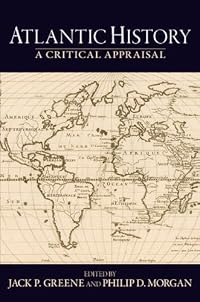
Atlantic History: A Critical Appraisal
by Jack P. Greene
On This Page
Description
This title offers an incisive look at how interpretations of the Atlantic world have changed over time and from a variety of national perspectives. This volume discusses key areas of the Atlantic world, including the British, Dutch, French, Iberian, and African Atlantic, as well as the movement of ideas, peoples, and goods.Tags
Recommendations


























Member Reviews
In their introduction, Philip D. Morang and Jack P. Greene write, “Atlantic history is an analytic construct and an explicit category of historical analysis that historians have devised to help them organize the study of some of the most important developments of the early modern era: the emergence in the fifteenth century and the subsequent growth of the Atlantic basin as a site for demographic, economic, social, cultural, and other forms of exchange among and within the four continents surrounding the Atlantic Ocean – Europe, Africa, South America, and North America – and all the islands adjacent to those continents and in that ocean” (pg. 3). They continue, “Pan-Atlantic webs of association linked people, objects, and show more beliefs across and within the region. Though always fragmented, the early modern Atlantic world came to be increasingly united through a density and variety of connections” (pg. 8). Furthermore, “borderland areas, transfrontier regions, places where natives and newcomers collided and often none ruled, formed another vector of Atlantic history. Such places gave rise to entangled histories” (pg. 13).
Joyce E. Chaplin writes, “The history of the Atlantic’s contemporary meanings occurred in three stages. In the first, Europeans thought of the Atlantic as a geographic space to get across, a rather belated idea that contradicted an ancient suspicion that the ocean was not a real space at all. In the second stage, the peoples in the post-Columbian countries that faced the Atlantic thought of that ocean as a space in which to make or imagine physical connections, both among different places and among different natural forces. In the last stage, people emphasized the Atlantic’s value as a route elsewhere, especially when the Pacific became a new destination for them” (pg. 36).
Trevor Burnard writes, “Greater British and Atlantic history developed together at roughly the same time (the early 1970s) and at least partly for the same reasons, including a desire to move away from what was perceived as the increasingly narrow parochialism of studies of small British or American towns and parishes, and a concomitant insistence that British history had been distinct from European history because of the particular importance of imperial expansion in British history and in British self-definition” (pg. 115). He argues, “Perhaps the single most important advance attributable to the Atlantic perspective has been its encouragement of the incorporation of Africans and Native Americans into the making of colonial British America” (pg. 121). An additional advantage of this study “is that it redresses American and British exceptionalism. To study the British Atlantic without recognizing that British actions were shaped and constrained by the actions of other imperial polities, notably the Spanish and French empires, is no longer intellectually sustainable” (pg. 124).
Amy Turner Bushnell writes, “The areas of neo-European mastery in the Americas were small and slow-growing: until the late nineteenth century more than half of the habitable hemisphere (defined as everything this side of the permanent frost line) remained under indigenous control. Meanwhile, between the island-like settler enclaves and the Indian nations’ vast territories, closed to outsiders, lay the frontiers, where neo-European and Indian societies met on relatively even terms, neither side having a monopoly of violence and each side trying to change the other for the better” (pg. 191). She argues, “Indigenous peoples shaped the course of Atlantic history in the Americas by subordination, interaction, or opposition. From the perspective of colonial history, they can be divided into three categories. In the first group were the incorporated peoples inside of empire, occupying niches in colonial encounters and peripheries. In the second group were the peoples on the frontiers of empire, reconciled or contested, the difference being that on a reconciled frontier, pacified natives interacted with pacified missionaries, traders, and soldiers, both sides achieving their ends without resorting to violence, whereas on a contested ground, negotiation was apt to give way to armed conflict” (pg. 194). Finally, “The third group consisted of the autonomous peoples outside of empire, opposing the neo-Europeans with their own weapons” (pg. 194).
Philip D. Morgan argues, “A voluntary partnership best captures the relationship between African traders and rulers and European merchants and ship captains. Africans called the tune in many aspects of this relationship, even if overall Europeans benefited the most from their exchanges” (pg. 225). He continues, “the volume of Atlantic trade, no matter how rapidly it was growing, was not large enough to have transformed Africa’s economy, although arguably the social and political effects of Atlantic integration were more dramatic than the economic – and more negative than positive. But even so, much of the continent’s development continued along lines dictated by its own traditions and imperatives” (pg. 232). Morgan concludes, “Africa was a full partner in the merging Atlantic world, but much of the continent was unaffected by Atlantic influences and, indeed, was oriented in other directions. In the early modern era, Africans were more important to the Atlantic world than the Atlantic world was to Africans” (pg. 241).
Carla Rahn Phillips argues, “Although the concept of an Atlantic world remains useful for understanding the nineteenth century and beyond, it was a far different Atlantic world from the one bracketed at one end by the fifteenth-century voyages of exploration and at the other end by the era of the Atlantic revolutions” (pg. 250). Jack P. Greene writes, “While the emergence of the Atlantic perspective has served to undermine traditional national frameworks, the multicultural turn has thus largely functioned to reinforce them” (pg. 301). He continues, “The new interest in the non-English colonial histories of areas in the United States points logically in the direction of the desirability of a broad hemispheric perspective that, by promoting broad comparative analysis across both the South and North American hemispheres and their adjacent islands, might actually enhance the prospects for transcending national frameworks. Moreover, a hemispheric perspective also seems to offer better prospects for achieving one of the unfulfilled promises of the Atlantic perspective, the possibility of drawing conclusions” (pg. 301). He cautions, “the primary obstacle to the development of a hemispheric perspective is, of course, the dense historiographies that, especially in recent decades, have emerged in the study of all areas of the Americas, historiographies that require enormous time and energy to master” (pg. 301). show less
Joyce E. Chaplin writes, “The history of the Atlantic’s contemporary meanings occurred in three stages. In the first, Europeans thought of the Atlantic as a geographic space to get across, a rather belated idea that contradicted an ancient suspicion that the ocean was not a real space at all. In the second stage, the peoples in the post-Columbian countries that faced the Atlantic thought of that ocean as a space in which to make or imagine physical connections, both among different places and among different natural forces. In the last stage, people emphasized the Atlantic’s value as a route elsewhere, especially when the Pacific became a new destination for them” (pg. 36).
Trevor Burnard writes, “Greater British and Atlantic history developed together at roughly the same time (the early 1970s) and at least partly for the same reasons, including a desire to move away from what was perceived as the increasingly narrow parochialism of studies of small British or American towns and parishes, and a concomitant insistence that British history had been distinct from European history because of the particular importance of imperial expansion in British history and in British self-definition” (pg. 115). He argues, “Perhaps the single most important advance attributable to the Atlantic perspective has been its encouragement of the incorporation of Africans and Native Americans into the making of colonial British America” (pg. 121). An additional advantage of this study “is that it redresses American and British exceptionalism. To study the British Atlantic without recognizing that British actions were shaped and constrained by the actions of other imperial polities, notably the Spanish and French empires, is no longer intellectually sustainable” (pg. 124).
Amy Turner Bushnell writes, “The areas of neo-European mastery in the Americas were small and slow-growing: until the late nineteenth century more than half of the habitable hemisphere (defined as everything this side of the permanent frost line) remained under indigenous control. Meanwhile, between the island-like settler enclaves and the Indian nations’ vast territories, closed to outsiders, lay the frontiers, where neo-European and Indian societies met on relatively even terms, neither side having a monopoly of violence and each side trying to change the other for the better” (pg. 191). She argues, “Indigenous peoples shaped the course of Atlantic history in the Americas by subordination, interaction, or opposition. From the perspective of colonial history, they can be divided into three categories. In the first group were the incorporated peoples inside of empire, occupying niches in colonial encounters and peripheries. In the second group were the peoples on the frontiers of empire, reconciled or contested, the difference being that on a reconciled frontier, pacified natives interacted with pacified missionaries, traders, and soldiers, both sides achieving their ends without resorting to violence, whereas on a contested ground, negotiation was apt to give way to armed conflict” (pg. 194). Finally, “The third group consisted of the autonomous peoples outside of empire, opposing the neo-Europeans with their own weapons” (pg. 194).
Philip D. Morgan argues, “A voluntary partnership best captures the relationship between African traders and rulers and European merchants and ship captains. Africans called the tune in many aspects of this relationship, even if overall Europeans benefited the most from their exchanges” (pg. 225). He continues, “the volume of Atlantic trade, no matter how rapidly it was growing, was not large enough to have transformed Africa’s economy, although arguably the social and political effects of Atlantic integration were more dramatic than the economic – and more negative than positive. But even so, much of the continent’s development continued along lines dictated by its own traditions and imperatives” (pg. 232). Morgan concludes, “Africa was a full partner in the merging Atlantic world, but much of the continent was unaffected by Atlantic influences and, indeed, was oriented in other directions. In the early modern era, Africans were more important to the Atlantic world than the Atlantic world was to Africans” (pg. 241).
Carla Rahn Phillips argues, “Although the concept of an Atlantic world remains useful for understanding the nineteenth century and beyond, it was a far different Atlantic world from the one bracketed at one end by the fifteenth-century voyages of exploration and at the other end by the era of the Atlantic revolutions” (pg. 250). Jack P. Greene writes, “While the emergence of the Atlantic perspective has served to undermine traditional national frameworks, the multicultural turn has thus largely functioned to reinforce them” (pg. 301). He continues, “The new interest in the non-English colonial histories of areas in the United States points logically in the direction of the desirability of a broad hemispheric perspective that, by promoting broad comparative analysis across both the South and North American hemispheres and their adjacent islands, might actually enhance the prospects for transcending national frameworks. Moreover, a hemispheric perspective also seems to offer better prospects for achieving one of the unfulfilled promises of the Atlantic perspective, the possibility of drawing conclusions” (pg. 301). He cautions, “the primary obstacle to the development of a hemispheric perspective is, of course, the dense historiographies that, especially in recent decades, have emerged in the study of all areas of the Americas, historiographies that require enormous time and energy to master” (pg. 301). show less
Ratings
Members
- Recently Added By
Lists

Bibliography of How the Old World Ended by Jonathan Scott
308 works; 1 member
Author Information

55+ Works 1,366 Members
Jack P. Greene is Andrew W. Mellon Professor in the Humanities Emeritus at Johns Hopkins University, where he founded the Program in Atlantic History and Culture. He is coeditor, with Philip D. Morgan, of Atlantic History: A Critical Reappraisal and the author of Interpreting Early America: Historiographical Essays (Virginia).
Series
Belongs to Publisher Series
Common Knowledge
- Canonical title
- Atlantic History: A Critical Appraisal
Classifications
- Genres
- History, Nonfiction, General Nonfiction
- DDC/MDS
- 909.09821072 — History & geography History World history Other Geographic Classifications Other Classifications Ocean And Sea Basins The West; the Atlantic region
- LCC
- D206 .A86 — History of Europe, Asia, Africa and Oceania History (General) Modern history, 1453-
- BISAC
Statistics
- Members
- 87
- Popularity
- 362,197
- Reviews
- 1
- Rating
- (3.40)
- Languages
- English
- Media
- Paper, Ebook
- ISBNs
- 4
- ASINs
- 1