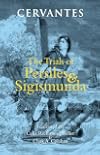
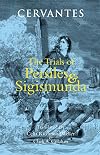
The Trials of Persiles and Sigismunda
by Miguel de Cervantes Saavedra
On This Page
Description
Cervantes died in Madrid after spending his final days working on this last example of his sense of humor.
Tags
Recommendations


















Member Reviews
So this is a love story supposedly, with innumerable sup-plots. Every time a new character shows up we get yet another tangent. Whats odd is that not only do the actual characters get bored with some of the sub-stories but the author apologises to the reader at least ten times about how repetitive it can get.. and then continues on in the same way as before :( .
Most of the plots involve someone being forced into a marriage they don't want. The people who can't take no for an answer being both men and women but mostly men of course. This leads to one of the ironic highlights because the main love tale when you finally learn all the facts isn't exactly Romeo and Juliette thats all i'll say :) .
The main plot starts in the middle and is show more filled out bit by bit in flashback which is a good technique i felt.
Other items in the plus column are that the sub-plots or episodes in the main plot are all very short. So if you don't like something don't worry it won't be there for long. The story is also quite random or at least unpredictable in its turns, which i generally consider a good thing.
The best thing about the book however is its world building, which bares about as much relation to real history or geography as that of Robert E.Howards stories do :D .
A low 3 stars, its a mess, but enjoyable enough. show less
Most of the plots involve someone being forced into a marriage they don't want. The people who can't take no for an answer being both men and women but mostly men of course. This leads to one of the ironic highlights because the main love tale when you finally learn all the facts isn't exactly Romeo and Juliette thats all i'll say :) .
The main plot starts in the middle and is show more filled out bit by bit in flashback which is a good technique i felt.
Other items in the plus column are that the sub-plots or episodes in the main plot are all very short. So if you don't like something don't worry it won't be there for long. The story is also quite random or at least unpredictable in its turns, which i generally consider a good thing.
The best thing about the book however is its world building, which bares about as much relation to real history or geography as that of Robert E.Howards stories do :D .
A low 3 stars, its a mess, but enjoyable enough. show less
Cervantes, Obra completa 18. Con disquete
LOS TRABAJOS DE PERSILES Y SEGISMUNDA ; VIAJE DEL PARNASO
Mar 7, 2025Spanish
H1.32.6
Mar 6, 2021Catalan
Ratings
Members
- Recently Added By
Lists

My TBR
371 works; 3 members

Books in The Club Dumas
72 works; 1 member
Author Information

1,783+ Works 50,676 Members
Miguel de Cervantes Saavedra was born in Alcala de Henares, Spain, in 1547. In 1585, a few months after his marriage to Catalina de Salazar, he published his first major work as an author, the pastoral novel La Galatea which was poorly received. Cervantes became a tax collector in Granada in 1594, but was imprisoned in 1597 due to money problems show more with the government. Folklore maintains that while in prison, he wrote his most famous novel, Don Quixote, which was an immediate success upon publication in 1605. After several years of writing short novels and plays, Cervantes was spurred to write the sequel to Don Quixote in 1615 when an unauthorized sequel appeared to great acclaim. Though Cervantes' sequel was rushed and flawed, Don Quixote remains a powerful symbol that has endured to present times in many forms. Cervantes died on April 22, 1616, at the age of 69. (Bowker Author Biography) show less
Some Editions
Awards and Honors
Series
Belongs to Publisher Series
Common Knowledge
- Canonical title
- The Trials and Tribulations of Persiles and Sigismunda.; The Trials of Persiles and Sigismunda
- Original title
- Los trabajos de Persiles y Sigismunda
- Original publication date
- 1617
- People/Characters
- Periandro (Persiles); Auristela (Sigismunda); Corsicurbo; Cloelia; Arnaldo, Prince of Denmark; Taurisa (show all 85); Bradamiro; Ricla; Transila; Rutilio; Rosanio; Don Sebastian de Soranto; Pedro Tenorio; Renato; Eusebia; Libsomiro; Sinibaldo; Alberto; Don Francisco Pizarro; Don Juan de Orellana; Feliciana of the voice; Luis Antonio; Leonora; Don Diego de Parroes; Manuel de Sousa Continho; Mauricio; Ladislao; Lady Rosamunda; Clodio; King Policarpo; Sinforosa; Policarpa; Cenotia; Carino; Selvina; Sancho Pedro; Don Duarte de Sosa; Dona Guiomar de Sosa; Luisa; Martina; Ortel Banedre; Leoncia; Solercio; Leopoldino, King of Danea; Sulpicia; Cratilo, King of Bituania; Lampidio; Alonso; Belarmina; Don Dominico; Claricia; Lorena; Rubertino; Count Lamberto of Scotland; Lady Ruperta; Claudinio Rubicon; Croriano Rubicon; Soldino; Sir Alejandro Castrucho; Isabel Castrucho; Andrea Marulo; Juan Bautista Marulo; Zabulón; Clementa Cobena; Pedro Cobena; Tozuelo; Diego de Villasenor; Bartolomé; Jarife; Rafaela; Ambrosia Augustin; Don Bernardo Augustin; Contratio de Arbolanchez; Duke of Nemurs; Deleasir; Feliz Flora; Magsimino, King of Thyle; Eustoquia, Queen of Thyle; Seráfido; Eusebia, Queen of Frisland; Abuid; Mansés; Hipolita; Pirro; Julia
- Important places
- Norway; Lisbon, Portugal; Rome, Italy
Classifications
- Genres
- Fiction and Literature, General Fiction, Romance
- DDC/MDS
- 863.3 — Literature & rhetoric Spanish Literature Spanish fiction Spanish Golden Age (1499-1681)
- LCC
- PQ6327 .P4 — Language and Literature French, Italian, Spanish and Portuguese literatures Spanish literature Individual authors and works to 1700
- BISAC
Statistics
- Members
- 219
- Popularity
- 148,425
- Reviews
- 4
- Rating
- (4.24)
- Languages
- 8 — Czech, English, French, German, Hebrew, Italian, Romanian, Spanish
- Media
- Paper, Ebook
- ISBNs
- 51
- ASINs
- 8