On This Page
Description
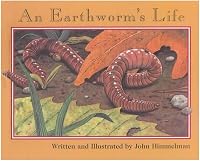
Describes, in simple text and illustrations, the daily activities and life cycle of the earthworm.Tags
Recommendations





Member Reviews
Summary:
This informational book is about the life of an earthworm. Itshows how the worms are 'hidden under our feet.' It shows the egg case where the young ones are formed and that after two months the young ones crawl out of the egg case. Earthworms tunnels through the soil and feed on dead leaves at night. They also eat soil and passed out this soil in piles of round balls, called castings on top of the soil. The book highlights how worms are fully grown by fall and eat dead plants until winter. They escape the mole and is strong enough to tug away from hungry birds. the rainy season chases the earthworm to the surface where it walks the surface of the ground until it finds a safer place to dwell. In this case a boy finds the show more earthworm on a basketball court and throws it into a garden.
Personal Reaction:
I was very impressed by this book and I found it very interesting. I especially liked how the graphic seemed so real. an example is seen on the first page where its states that earthworms walk beneath our feet. There was a picture of a barefoot at the surface of the soil as well as the earthworm below tunneling through the soil. I think kids would love that and even see the importance of shoes on their feet. What drew my attention was the part in this book that explained what happens after the earthworm passes out the digested soil. I am sure when i was younger I was sp amazed at those piles of balls on the ground, I amuzingly played with it. If I only knew it was the faeces of worm I am sure I would have never played in it. I also liked the glossary at the end which would help to develop children's vocabulary in a fun loving fashion.
Extensions:
This book can be used in Science as an introduction to a lesson on the life cycle of earthworms. For an activity, students can be asked to draw a labelled diagram of the life cycle of earthworms and display it in the Science corner. It can also be used in a word recognition lesson for reading where children can be asked to fill in the new words learnt from this book in blank spaces. Sentences from this book can be used just to open children's minds to applying these words to their vocabulary. show less
This informational book is about the life of an earthworm. Itshows how the worms are 'hidden under our feet.' It shows the egg case where the young ones are formed and that after two months the young ones crawl out of the egg case. Earthworms tunnels through the soil and feed on dead leaves at night. They also eat soil and passed out this soil in piles of round balls, called castings on top of the soil. The book highlights how worms are fully grown by fall and eat dead plants until winter. They escape the mole and is strong enough to tug away from hungry birds. the rainy season chases the earthworm to the surface where it walks the surface of the ground until it finds a safer place to dwell. In this case a boy finds the show more earthworm on a basketball court and throws it into a garden.
Personal Reaction:
I was very impressed by this book and I found it very interesting. I especially liked how the graphic seemed so real. an example is seen on the first page where its states that earthworms walk beneath our feet. There was a picture of a barefoot at the surface of the soil as well as the earthworm below tunneling through the soil. I think kids would love that and even see the importance of shoes on their feet. What drew my attention was the part in this book that explained what happens after the earthworm passes out the digested soil. I am sure when i was younger I was sp amazed at those piles of balls on the ground, I amuzingly played with it. If I only knew it was the faeces of worm I am sure I would have never played in it. I also liked the glossary at the end which would help to develop children's vocabulary in a fun loving fashion.
Extensions:
This book can be used in Science as an introduction to a lesson on the life cycle of earthworms. For an activity, students can be asked to draw a labelled diagram of the life cycle of earthworms and display it in the Science corner. It can also be used in a word recognition lesson for reading where children can be asked to fill in the new words learnt from this book in blank spaces. Sentences from this book can be used just to open children's minds to applying these words to their vocabulary. show less
The book is about a life cycle of an earthworm. It starts with how the earthworm leaves an egg case in a burrow. Two months later an earthworm hatches out. Earthworms feed on dead worms and leaves . By the fall the earthworm is fully grown. The explains what the earth worm doesthe rest of the year in the winter the worm goes to sleep and wakes up in the spring.
The book had nice large pictures and explained clearly the lifecycle of an earthworm. It would be a good book to read for science.
Extension Ideas 1. In the classroom I would have an earthworm farm and let the children watch it grow. The students can also draw and write one sentence about what they observed each day about the earthworm.
2. I would also have the students draw on a show more construction paper the stage of the life of an earthworm.They can also color a picture of an earthworm. show less
The book had nice large pictures and explained clearly the lifecycle of an earthworm. It would be a good book to read for science.
Extension Ideas 1. In the classroom I would have an earthworm farm and let the children watch it grow. The students can also draw and write one sentence about what they observed each day about the earthworm.
2. I would also have the students draw on a show more construction paper the stage of the life of an earthworm.They can also color a picture of an earthworm. show less
This is an informational book about the life cycle of an earthworm. The book begins with an earthworm leaving its egg case underground and goes thru a year in the life of a worm.
I can see how this book can be very useful in teaching about earthworms. It wasn’t boring and had rather good pictures.
Extension Ideas:
I would have my students do a unit on earthworms. We would begin our own worm farm. I would have my students draw four different pictures of four different stages of a worm’s life and write a sentence about each stage.
I can see how this book can be very useful in teaching about earthworms. It wasn’t boring and had rather good pictures.
Extension Ideas:
I would have my students do a unit on earthworms. We would begin our own worm farm. I would have my students draw four different pictures of four different stages of a worm’s life and write a sentence about each stage.
This is good for any worm life cycle studies. Simple narrative nonfiction.
This book goes through the life cycle of a worm. It begins with the egg case in the ground and continues through a whole year of life.
This book has nice illustrations that go along with each stage of a worm’s life. It explains the stages in a simple way the children will understand.
This will be a good book to use if you are studying worms or life cycles.
Extension Ideas:
1) Have a worm farm so the class can watch the worm’s life cycle.
2) Have the children illustrate the life cycle of a worm. This could be made like a book or you could have construction paper folded into squares and opened up. On each square they could draw a step in the life cycle.
This book has nice illustrations that go along with each stage of a worm’s life. It explains the stages in a simple way the children will understand.
This will be a good book to use if you are studying worms or life cycles.
Extension Ideas:
1) Have a worm farm so the class can watch the worm’s life cycle.
2) Have the children illustrate the life cycle of a worm. This could be made like a book or you could have construction paper folded into squares and opened up. On each square they could draw a step in the life cycle.
Summary: This book tells all about a worms life. Starting with how the worm lives underground. It lays its eggs underground in a burrow, and when the baby hatches it will stay underground all winter untill spring rains bring it to surface. They also feed off of soil and dead leaves.
Personal reaction: In my oppinon this book was extremely informational. I feel like it was about a 5th grade level or higher.
Classroom extension: 1- I could go get some earthworms fromt he store and show the children the general outlook.
2- we could draw the earthworm's structure and what it does during what season.
Personal reaction: In my oppinon this book was extremely informational. I feel like it was about a 5th grade level or higher.
Classroom extension: 1- I could go get some earthworms fromt he store and show the children the general outlook.
2- we could draw the earthworm's structure and what it does during what season.
This is an informational book on earthworm’s. It is a great reference book that covers so much of the life of an earthworm. It contains wonderful illustrations of the daily activities of an earthworm. This book is designed for curious nature lovers just starting to read on their own. This is also part of the Nature Upclose Series. I can relate to this book for all the information that it has to offer the reader.
Extension Activities
Vocabulary: Have the students brainstorm a list of words from the book. Discuss the appropriateness of each word. Write these words on chart paper.
Family Poetry: As an at-home activity, have each student work with a family member to write a poem about some part of the life of an earthworm. Then let each show more student his or her poem with the class This activity connects reading and writing between the home and the classroom. show less
Extension Activities
Vocabulary: Have the students brainstorm a list of words from the book. Discuss the appropriateness of each word. Write these words on chart paper.
Family Poetry: As an at-home activity, have each student work with a family member to write a poem about some part of the life of an earthworm. Then let each show more student his or her poem with the class This activity connects reading and writing between the home and the classroom. show less
Members
- Recently Added By
Author Information

67+ Works 7,632 Members
John Himmelman was born in Kittery, Maine. He received a BFA from the School of Visual Arts in 1981. He wrote Talester the Lizard while taking a course in writing and illustrating children's books and it became his first published book. To pay the bills, he worked as a cook and then as a carpenter, working on his books at night. It took about six show more years before he could make a full time living writing and illustrating children's books. He has written and illustrated over 70 children's books, many with nature-related themes. His books include Discovering Moths, Discovering Amphibians, Guide to Night Singing Insects of the Northeast, and Cricket Radio: Tuning In To the Night-Singing Insects. (Bowker Author Biography) show less
Series

Common Knowledge
- Canonical title
- An Earthworm's Life
Classifications
Statistics
- Members
- 609
- Popularity
- 47,918
- Reviews
- 11
- Rating
- (3.80)
- Languages
- English
- Media
- Paper
- ISBNs
- 4