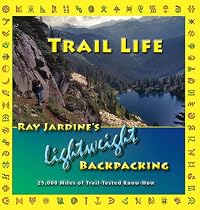
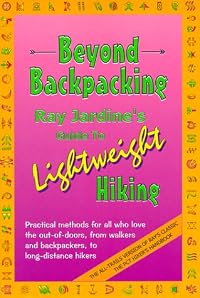
Trail Life: Ray Jardine's Lightweight Backpacking
by Ray Jardine
On This Page
Description
'Trail Life' is for all hikers, at all levels of experience, from beginners to the most advanced.Tags
Recommendations















Member Recommendations


Member Reviews
It is much more efficient to travel through the wilderness in a way that works with the changing conditions, being sensitive to them, instead of using an array of tools to isolate oneself from one's environment.
Why does one want to travel through the wilderness? One interesting question: can one be in the wilderness without traveling through it? One of Jardine's methods is to cook in one place, near water, but then to sleep at a higher elevation, away from water. So that involves a certain amount of daily movement already. Then, too, wilderness implies a significant distance from food supplies - Jardine is not discussing living off the land. So being in the wilderness involves periodic trips to supply points.
Jardine and his wife take show more very long trips, like a month or two at maybe 30 miles per day. The Appalachian Trail, the Pacific Crest Trail - end to end. To cover such distances in one season of good weather, one would need to move quickly, and therefore keep one's load quite light. Jardine's book tells us how he did it, covering very many aspects of his approach. It's a very intelligent book. He has worked out his technique, and shares with us the logic behind what he does along with the details.
Jardine is definitely unconventional, at least he himself doesn't much follow convention - though it seems he often enough establishes convention! And he advises us to follow his underlying method, which is to figure out for yourself what you need and then just do what you need to do without getting wrapped up in other people's angles, especially the angles of outdoor product marketing. Jardine recommends sewing your own tent, sleeping covers, clothes, etc. He stops short of making his own shoes, but he is not deterred from cutting shoes up or modifying them radically to make them serve his purposes.
It's an inspiring book! I don't envision any thousand mile hikes for myself, but the idea of becoming more sensitive to the environment and working with it to be more efficient and enhance one's experience, this is a great approach for live in general. And more particularly, for spending time in the wilderness. My imagination runs less toward walking all day and more toward meditation, but still with enough traveling to get to and from supply points etc. Perhaps sticking with a single supply point and just exploring all the terrain within just a dozen hours or so of travel, spread across a few days. Jardine's logic could easily be adapted to some such alternate approach to wilderness travel. show less
Why does one want to travel through the wilderness? One interesting question: can one be in the wilderness without traveling through it? One of Jardine's methods is to cook in one place, near water, but then to sleep at a higher elevation, away from water. So that involves a certain amount of daily movement already. Then, too, wilderness implies a significant distance from food supplies - Jardine is not discussing living off the land. So being in the wilderness involves periodic trips to supply points.
Jardine and his wife take show more very long trips, like a month or two at maybe 30 miles per day. The Appalachian Trail, the Pacific Crest Trail - end to end. To cover such distances in one season of good weather, one would need to move quickly, and therefore keep one's load quite light. Jardine's book tells us how he did it, covering very many aspects of his approach. It's a very intelligent book. He has worked out his technique, and shares with us the logic behind what he does along with the details.
Jardine is definitely unconventional, at least he himself doesn't much follow convention - though it seems he often enough establishes convention! And he advises us to follow his underlying method, which is to figure out for yourself what you need and then just do what you need to do without getting wrapped up in other people's angles, especially the angles of outdoor product marketing. Jardine recommends sewing your own tent, sleeping covers, clothes, etc. He stops short of making his own shoes, but he is not deterred from cutting shoes up or modifying them radically to make them serve his purposes.
It's an inspiring book! I don't envision any thousand mile hikes for myself, but the idea of becoming more sensitive to the environment and working with it to be more efficient and enhance one's experience, this is a great approach for live in general. And more particularly, for spending time in the wilderness. My imagination runs less toward walking all day and more toward meditation, but still with enough traveling to get to and from supply points etc. Perhaps sticking with a single supply point and just exploring all the terrain within just a dozen hours or so of travel, spread across a few days. Jardine's logic could easily be adapted to some such alternate approach to wilderness travel. show less
The ideas in this book are 5/5, but the writing is more like 3/5. Ray tends to repeat himself, or is just plain boring to read sometimes. However, his ideas are incredible, and the book will serve as a reference guide for years to come. I skimmed a lot... but also found a lot of it useful.
Ratings
Members
- Recently Added By
Author Information
7 Works 265 Members
Classifications
Statistics
- Members
- 39
- Popularity
- 744,622
- Reviews
- 2
- Rating
- (4.06)
- Languages
- English
- Media
- Paper
- ISBNs
- 1