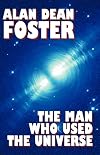
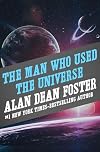
The Man Who Used the Universe
by Alan Dean Foster
On This Page
Description
No one knows the true motives of Kees vaan Loo-Macklin. He's a mastermind criminal who gave up his place at the head of the dark underworld to become a legitimate member of Evenwaith's cities. But soon he was reaching out to powerful enemies-the slimy aliens called the Nuel. Loo-Macklin negotiates an illusory peace agreement and gains precious alien secrets in the process. Is he after peace, power or pure evil? With enemy starships beginning to amass, we won't have to wait long to find out.Tags
Recommendations















Member Reviews
*** beware spoilers ***
A racy read in which our protagonist, hired gun for a local protection racket, takes over his boss's syndicate, gradually worms his way up the criminal system and the layers of "illegal" status ranks, builds an interplanetary crime empire, and then breaks into "legal" business, using the kind of organizational skills which enable businessmen to hide their dealings in layers of shell companies and offshore tax havens, plus uncanny psychological intuition, long-term secret planning. and the strategic use of blackmail, extreme violence, and almost complete emotional detachment. Driven only by his desire for control over his own destiny (reacting against a childhood of bullying and parental neglect), he becomes the show more first human to make a full commercial agreement with the rival empire of the Nuel (delightfully depicted as a molluscan race so slimily repulsive that they have a collective paranoia about it). He plays human and alien interests against each other in an ever-more complex system of bluffs and double bluffs, and ends up saving both civilizations from conflict and invasion almost as an accidental side-effect of his personal obsession. Maybe there's some sort of message about how good leaders must eschew loyalty or even morality in relation to individuals in order to achieve a greater good for all; but mainly, it's just a fun SF novel.
MB 8-x-2012 show less
A racy read in which our protagonist, hired gun for a local protection racket, takes over his boss's syndicate, gradually worms his way up the criminal system and the layers of "illegal" status ranks, builds an interplanetary crime empire, and then breaks into "legal" business, using the kind of organizational skills which enable businessmen to hide their dealings in layers of shell companies and offshore tax havens, plus uncanny psychological intuition, long-term secret planning. and the strategic use of blackmail, extreme violence, and almost complete emotional detachment. Driven only by his desire for control over his own destiny (reacting against a childhood of bullying and parental neglect), he becomes the show more first human to make a full commercial agreement with the rival empire of the Nuel (delightfully depicted as a molluscan race so slimily repulsive that they have a collective paranoia about it). He plays human and alien interests against each other in an ever-more complex system of bluffs and double bluffs, and ends up saving both civilizations from conflict and invasion almost as an accidental side-effect of his personal obsession. Maybe there's some sort of message about how good leaders must eschew loyalty or even morality in relation to individuals in order to achieve a greater good for all; but mainly, it's just a fun SF novel.
MB 8-x-2012 show less
Kees vaan Loo-Macklin, a brilliant criminal mastermind who goes legit. He negotiates a tricky, suspicious peace with the enemy Nuel aliens, using their advanced secrets to secure power while raising questions about his true, potentially sinister, motives.
A born killer and highly intelligent criminal prodigy, he transitions from leading the intergalactic underworld to operating within legitimate society. Kees initiates a peace treaty with the Nuel, a move allowing him to gain forbidden technology and secrets from them in exchange for an illusion of peace.
A born killer and highly intelligent criminal prodigy, he transitions from leading the intergalactic underworld to operating within legitimate society. Kees initiates a peace treaty with the Nuel, a move allowing him to gain forbidden technology and secrets from them in exchange for an illusion of peace.
Not my kind of thing at all, but I am interested in Foster's writing. And once I got going in this, I found it almost compulsively readable. Very 'manly' though, ruthless politics & weapons & the very few women as either accessories or bitches etc.
Several reviewers mentioned aliens... I've barely glimpsed them, at p. 70 out of 243... we'll see....
---
ok, p. 100 we meet the key aliens and they swiftly become much more interesting characters than The Man.
I do like the "What If" that is What if business owners realized that healthy and happy employees would be more productive? Kees figures it out, and turns a world that is a polluted hell-hole into one with parks and gardens for all to enjoy.
But a lot of this is something that a fan of show more Ayn Rand would enjoy, too, and it makes me uncomfortable. Well, I'm nearly done now, actually....
---
Ok done.
Yeah, I'm still not a fan of political intrigue. At least in this case the SF element was important... it would not have been as interesting as if it were written as if it were ordinary Earth history.
But at least Foster didn't lose me; I was able to keep track. And it was a clever tale. And, yes, the aliens were cool.
It's not great literature by any means, and is in some ways written almost at a teen level. But I respect that a lot of readers love it, and if you're interested and can borrow a copy from your library or otherwise get it cheap, go for it.
2.5 stars rounded up because Foster educated me, by giving the man a memorial on one of the worlds in the story, [a:Jorge Amado|52683|Jorge Amado|https://images.gr-assets.com/authors/1441324886p2/52683.jpg]. show less
Several reviewers mentioned aliens... I've barely glimpsed them, at p. 70 out of 243... we'll see....
---
ok, p. 100 we meet the key aliens and they swiftly become much more interesting characters than The Man.
I do like the "What If" that is What if business owners realized that healthy and happy employees would be more productive? Kees figures it out, and turns a world that is a polluted hell-hole into one with parks and gardens for all to enjoy.
But a lot of this is something that a fan of show more Ayn Rand would enjoy, too, and it makes me uncomfortable. Well, I'm nearly done now, actually....
---
Ok done.
Yeah, I'm still not a fan of political intrigue. At least in this case the SF element was important... it would not have been as interesting as if it were written as if it were ordinary Earth history.
But at least Foster didn't lose me; I was able to keep track. And it was a clever tale. And, yes, the aliens were cool.
It's not great literature by any means, and is in some ways written almost at a teen level. But I respect that a lot of readers love it, and if you're interested and can borrow a copy from your library or otherwise get it cheap, go for it.
2.5 stars rounded up because Foster educated me, by giving the man a memorial on one of the worlds in the story, [a:Jorge Amado|52683|Jorge Amado|https://images.gr-assets.com/authors/1441324886p2/52683.jpg]. show less
The Man Who Used The Universe by Alan Dean Foster: This book is a science fiction novel about a human civilization that has spread over a group of planets and their antagonistic relationship with the slimy Nuel aliens who reside on another group of planets. Their xenophobic struggles with each other provide lots of intrigue, tension and violence. Just when the situation seems to be improving, another predator species mounts an attack that appears to be catastrophic. The book is populated by interesting characters, twists and turns of plot, and engrossing action. However, the most interesting aspects of this book are the covert manipulations that guided the development of the human and Nuel civilizations. I enjoyed this book very much.
I need to reread this to do a full review. The bad guy turned good guy, or is he still a bad guy? The plot revolves around figuring out what exactly he's up to, and whether its in his best interest, or all humanity.
Utilitarian writing but the best villain I've ever seen. The ultimate in villain motivation.
God, this guy is prolific - I assume he's actually a pen-name for a group of authors.
God, this guy is prolific - I assume he's actually a pen-name for a group of authors.
Loo-Macklin rises from a low ranked criminal to the highest regarded individual in an interesting and easy to read way.
Members
- Recently Added By
Talk Discussions
Past Discussions
SF a rich man who fakes a hostile alien invasion in Name that Book (September 2011)
Author Information

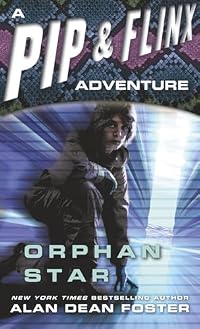
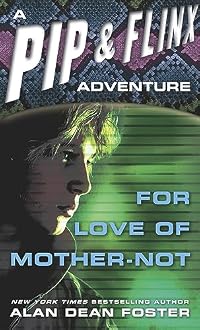
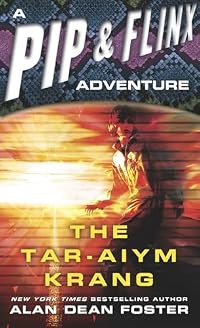
Bestselling science fiction writer Alan Dean Foster was born in New York City in 1946, but raised mainly in California. He received a B.A. in Political Science from UCLA in 1968, and a M.F.A. in 1969. Foster enjoys traveling because it gives him opportunities to meet new people and explore new places and cultures. This interest is carried over to show more his writing, but with a twist: the new places encountered in his books are likely to be on another planet, and the people may belong to an alien race. Foster began his career as an author when a letter he sent to Arkham Collection was purchased by the editor and published in the magazine in 1968. His first novel, The Tar-Aiym Krang, introduced the Humanx Commonwealth, a galactic alliance between humans and an insectlike race called Thranx. Several other novels, including the Icerigger trilogy, are also set in the world of the Commonwealth. The Tar-Aiym Krang also marked the first appearance of Flinx, a young man with paranormal abilities, who reappears in other books, including Orphan Star, For Love of Mother-Not, and Flinx in Flux. Foster has also written The Damned series and the Spellsinger series, which includes The Hour of the Gate, The Moment of the Magician, The Paths of the Perambulator, and Son of Spellsinger, among others. Other books include novelizations of science fiction movies and television shows such as Star Trek, The Black Hole, Starman, Star Wars, and the Alien movies. Splinter of the Mind's Eye, a bestselling novel based on the Star Wars movies, received the Galaxy Award in 1979. The book Cyber Way won the Southwest Book Award for Fiction in 1990. His novel Our Lady of the Machine won him the UPC Award (Spain) in 1993. He also won the Ignotus Award (Spain) in 1994 and the Stannik Award (Russia) in 2000. He is the recipient of the Faust, the IAMTW Lifetime achievement award. Alan Dean Foster's Star Wars: The Force Awakens, was a 2015 New York Times bestseller. (Bowker Author Biography) show less
Some Editions
Awards and Honors
Awards
Common Knowledge
- Canonical title
- The Man Who Used the Universe
- Original publication date
- 1983
- People/Characters
- Kees vaan Loo-Macklin; Chaheel Riens
- Dedication
- For Dick and Marge Green, who helped move the Lazy Unicorn, with love and thanks.
- First words
- It's very odd, the protection racket.
- Last words
- (Click to show. Warning: May contain spoilers.)"Naturally I will help you in any way I can."
- Original language
- English
Classifications
Statistics
- Members
- 539
- Popularity
- 54,999
- Reviews
- 8
- Rating
- (3.40)
- Languages
- English, German
- Media
- Paper, Audiobook, Ebook
- ISBNs
- 16
- ASINs
- 12