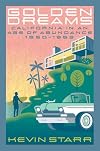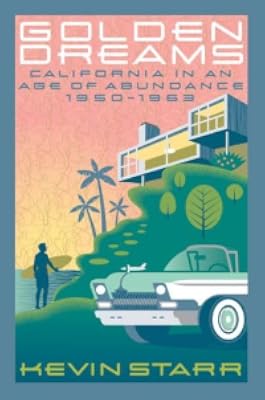
Golden Dreams: California in an Age of Abundance, 1950-1963
by Kevin Starr
Americans and the California Dream (Book 8)
On This Page
Description
A narrative tour de force that combines wide-ranging scholarship with captivating prose, Kevin Starr's acclaimed multi-volume Americans and the California Dream is an unparalleled work of cultural history. In this volume, Starr covers the crucial postwar period--1950 to 1963--when the California we know today first burst into prominence. Starr brilliantly illuminates the dominant economic, social, and cultural forces in California in these pivotal years. In a powerful blend of telling show more events, colorful personalities, and insightful analyses, Starr examines such issues as the overnight creation show lessTags
Recommendations











Member Reviews
Mid-century California is one of the one of the most important times and places in American history. This all the more so because it wasn't marked by war or economic crisis, but seemingly continuous growth and progress on a scale not only unprecedented but unrepeatable - over the 1950-1963 timeframe the book concentrates on, the state expanded by nearly two-thirds, which meant a net of an astonishing half-million people per year. I was originally drawn to this book because I live in Texas, and here there's an annoying narrative of Texas on the upswing contrasted with California's seeming decline, a partisan argument about governmental philosophies masked as impartial demographic statistics. Not knowing much about California other than show more that it's huge and that it's the inevitable comparison point for anything Texas does, I was curious what lessons, if any, could be drawn from California's own ascendancy to center stage of the national debate a few decades ago.
It turns out that there's quite a bit to learn. Starr has done a tremendous job synthesizing vast amounts of research on California's transformation into the most American part of America, a position it's never really relinquished. He talks about the booming of the major cities and the blossoming of the minor towns. He analyzes trends in music and its composers, movies and their stars, architecture and its designers, and literary movements and their authors. He notes the vast demographic trends and the ubiquitous cultural innovations. He chronicles the politics of water usage and the struggles over freeway construction. He connects the growth of the super-cities with the solitary wildernesses they encroached on. He profiles the civic leaders and the restive outcasts, the cops and the criminals, the ordinary citizens and the pioneering artists, the religious figures and the radical environmentalists, the trailblazing progressives and the reactionary conservatives. As the legendary lazy grade school book report has it, California emerges as "a land of many contrasts".
Those contrasts are inevitable in a state so large, which left plenty of room for misfits and outcasts. I found the sections discussing Brubeck and the jazz scene, or Robinson Jeffers and the loose assortment of poets scattered around Big Sur, or David Brower and the environmentalist movement riveting. Maybe there is no such thing as a true cultural consensus, or maybe any social process that generates a consensus will automatically generate a backlash. While millions were busy filling up the San Fernando Valley, a few found refuge far from development, or made their own accommodations with the often-messy process of settling down. Texas has its outposts of freethinkers and hippies, but it's difficult to say if we're located at similar points on our respective growth curves.
As much as the state's contrasts, though, I was interested in his portrayal of its consensuses, particularly California's invention of the American middle class and its accompanying postwar cultural and economic characteristics. While obviously Californians as a whole have never agreed on everything, and many individual items like the suburb or the automobile were invented elsewhere, it's not much of an oversimplification to observe that it was in that state that the "American way of life" reached its most complete definition: the decent house with a nice yard, good schools, family-friendly entertainment, the option to have a flashy car, and so on. Starr unearths all kinds of little details about that lifestyle that I'd never thought about before. One example is his discussion of bowling, which as a mass recreational activity was essentially invented in Southern California. That not only explains all the bowling in The Big Lebowski, a quintessentially Southern Californian film, but also sheds new light on pioneering works like Robert Putnam's treatise on social capital Bowling Alone. The tiki craze, for another example, which I vaguely remembered from South Pacific, was a lot more iconic than I had thought.
Of course, the question of what made California so good at embodying American-ness could come down to any one of its many upsides - the weather, the scenery, the variety - but it seems like the main key to its success was pretty simple: cheap land, leading to cheap houses, which not only let normal people raise their families comfortably and affordably, but also built demand for jobs. I reached the end of the book and I came back to my original comparison between California and Texas. To what extent are the denizens of 1950s California a good comparison group for 2010s Texans? Well, there are as many points of analogy as you want there to be - both states grew rapidly because they offered something attractive to people at the time. Texas even at its peak never boomed to the same extent that California did, but we live in different times. To paraphrase Goldwater, Texas offers "an echo, not a choice".
I will say that reading this book reinforced vague notions I'm still pondering about how many bitter contemporary arguments over tax structures and regulatory stances might be distant sideshows in terms of what makes a state successful or not. Make it easy enough to start a family and you're halfway there (counterexamples like nearly free Rust Belt houses notwithstanding), regardless of what other economic development policies a state government tinkers with. I do think that California's philosophy towards infrastructure, both physical like the epochal water and transportation projects, or human infrastructure like its world-class university system, is far more inspiring than Texas' desultory half-privatized muddles. Maybe someday we'll have our own shift in priorities - California's transformation from the homeland of Nixon and Reagan to a Democratic stronghold might come sooner in Texas than we think.
Until then, Starr's work is phenomenal in and of itself, and while I probably won't chase down all seven other volumes he's produced in this series, I've benefited tremendously from his work, just as the US has benefited from the success of its (still) most populous and most emblematic state. show less
It turns out that there's quite a bit to learn. Starr has done a tremendous job synthesizing vast amounts of research on California's transformation into the most American part of America, a position it's never really relinquished. He talks about the booming of the major cities and the blossoming of the minor towns. He analyzes trends in music and its composers, movies and their stars, architecture and its designers, and literary movements and their authors. He notes the vast demographic trends and the ubiquitous cultural innovations. He chronicles the politics of water usage and the struggles over freeway construction. He connects the growth of the super-cities with the solitary wildernesses they encroached on. He profiles the civic leaders and the restive outcasts, the cops and the criminals, the ordinary citizens and the pioneering artists, the religious figures and the radical environmentalists, the trailblazing progressives and the reactionary conservatives. As the legendary lazy grade school book report has it, California emerges as "a land of many contrasts".
Those contrasts are inevitable in a state so large, which left plenty of room for misfits and outcasts. I found the sections discussing Brubeck and the jazz scene, or Robinson Jeffers and the loose assortment of poets scattered around Big Sur, or David Brower and the environmentalist movement riveting. Maybe there is no such thing as a true cultural consensus, or maybe any social process that generates a consensus will automatically generate a backlash. While millions were busy filling up the San Fernando Valley, a few found refuge far from development, or made their own accommodations with the often-messy process of settling down. Texas has its outposts of freethinkers and hippies, but it's difficult to say if we're located at similar points on our respective growth curves.
As much as the state's contrasts, though, I was interested in his portrayal of its consensuses, particularly California's invention of the American middle class and its accompanying postwar cultural and economic characteristics. While obviously Californians as a whole have never agreed on everything, and many individual items like the suburb or the automobile were invented elsewhere, it's not much of an oversimplification to observe that it was in that state that the "American way of life" reached its most complete definition: the decent house with a nice yard, good schools, family-friendly entertainment, the option to have a flashy car, and so on. Starr unearths all kinds of little details about that lifestyle that I'd never thought about before. One example is his discussion of bowling, which as a mass recreational activity was essentially invented in Southern California. That not only explains all the bowling in The Big Lebowski, a quintessentially Southern Californian film, but also sheds new light on pioneering works like Robert Putnam's treatise on social capital Bowling Alone. The tiki craze, for another example, which I vaguely remembered from South Pacific, was a lot more iconic than I had thought.
Of course, the question of what made California so good at embodying American-ness could come down to any one of its many upsides - the weather, the scenery, the variety - but it seems like the main key to its success was pretty simple: cheap land, leading to cheap houses, which not only let normal people raise their families comfortably and affordably, but also built demand for jobs. I reached the end of the book and I came back to my original comparison between California and Texas. To what extent are the denizens of 1950s California a good comparison group for 2010s Texans? Well, there are as many points of analogy as you want there to be - both states grew rapidly because they offered something attractive to people at the time. Texas even at its peak never boomed to the same extent that California did, but we live in different times. To paraphrase Goldwater, Texas offers "an echo, not a choice".
I will say that reading this book reinforced vague notions I'm still pondering about how many bitter contemporary arguments over tax structures and regulatory stances might be distant sideshows in terms of what makes a state successful or not. Make it easy enough to start a family and you're halfway there (counterexamples like nearly free Rust Belt houses notwithstanding), regardless of what other economic development policies a state government tinkers with. I do think that California's philosophy towards infrastructure, both physical like the epochal water and transportation projects, or human infrastructure like its world-class university system, is far more inspiring than Texas' desultory half-privatized muddles. Maybe someday we'll have our own shift in priorities - California's transformation from the homeland of Nixon and Reagan to a Democratic stronghold might come sooner in Texas than we think.
Until then, Starr's work is phenomenal in and of itself, and while I probably won't chase down all seven other volumes he's produced in this series, I've benefited tremendously from his work, just as the US has benefited from the success of its (still) most populous and most emblematic state. show less
Ratings
Members
- Recently Added By
Published Reviews
ThingScore 88
Starr writes lucid and stylish prose, and the sheer size and power of this true-life tale open the eyes wide. The density of fact, the very weight of names and titles and dates, although beautifully managed, leave the reader stunned. That seldom detracts from this masterpiece, which tells of another imaginative masterpiece that just happens to be our most populous and richest state.
added by Shortride
Starr is a lumper, not a splitter, and in this 500-plus-page history of 14 years, he lovingly and exhaustively chronicles such topics as the byzantine political, fund-raising, and public-relations effort to build Los Angeles’s Music Center...; the evolution of the surfing, rock-climbing, and hot-rod subcultures; Zen Buddhism’s pervasive influence on California art and design; the show more California Water Plan of 1957...; and, in deadly detail, the career of Dave Brubeck. But neither this installment nor the series as a whole succumbs to muddle, because Starr consistently returns to his leitmotif: the California dream. show less
added by Shortride
Author Information

32+ Works 2,682 Members
Kevin Starr was born in San Francisco, California on September 3, 1940. He received a bachelor's degree in English from the University of San Francisco in 1962. After serving two years in the Army in West Germany, he received a master's degree in 1965 and a PhD in English and American literature in 1969 from Harvard University. He returned to San show more Francisco in 1973 and served as an aide and speechwriter to Mayor Joseph Alioto. After being appointed city librarian, he received a master's degree in library science from the University of California, Berkeley, in 1974. He wrote a column for The San Francisco Examiner and was appointed a professor of urban and regional planning at the University of Southern California in 1989. In 1994, Governor Pete Wilson named him state librarian, a post he held for 10 years. He wrote numerous book about the history of California including the eight-volume California Dream series, California, Golden Gate: The Life and Times of America's Greatest Bridge, and Continental Ambitions: Roman Catholics in North America, the Colonial Experience. In 2006, he received the National Humanities Medal for his work as a scholar and historian from President George W. Bush. He died from a heart attack on January 14, 2017 at the age of 76. (Bowker Author Biography) show less
Awards and Honors
Awards
Distinctions
Series

Common Knowledge
- Canonical title
- Golden Dreams: California in an Age of Abundance, 1950-1963
- Important places
- California, USA
- First words
- As far as the understanding of history is concerned, decades can be arbitrary. (Preface)
As the single largest and most comprehensive postwar suburban development in California, the San Fernando Valley conveniently functions as a case study of the demographic and housing dynamics transforming California in the 19... (show all)50s. (1, San Fernando: Homes and Happiness in Residential Subdivisions) - Last words
- (Click to show. Warning: May contain spoilers.)From this prospective the year 1960, with its dramatic disturbances, possesses in retrospect prophetic suggestions of things to come. (17, Cool, Not Cool: Headlines and Transitions)
- Publisher's editor
- Meyer, Sheldon
- Blurbers
- Gioria, Dana; See, Carolyn; Jackson, Kenneth T.; Robinson, Forrest; Davis, Mike; Deverell, William
- Original language
- English
- Canonical DDC/MDS
- 979.4053
- Canonical LCC
- F866.2
Classifications
- Genres
- History, Nonfiction, General Nonfiction
- DDC/MDS
- 979.4053 — History & geography History of North America Great Basin and Pacific Slope region of United States California General California History
- LCC
- F866.2 — Local History of the United States, Canada and Latin America United States local history California
- BISAC
Statistics
- Members
- 167
- Popularity
- 195,489
- Reviews
- 1
- Rating
- (4.06)
- Languages
- English
- Media
- Paper, Audiobook, Ebook
- ISBNs
- 5
- UPCs
- 1
- ASINs
- 3