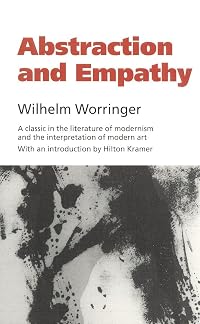
Abstraction and Empathy
by Wilhelm Worringer
On This Page
Description
Wilhelm Worringer's landmark study in the interpretation of modern art, first published in 1908, has seldom been out of print. Its profound impact not only on art historians and theorists but also for generations of creative writers and intellectuals is almost unprecedented. Starting from the notion that beauty derives from our sense of being able to identify with an object, Worringer argues that representational art produces satisfaction from our "objectified delight in the self," show more reflecting a confidence in the world as it is--as in Renaissance art. By contrast, the urge to abstraction, as exemplified by Egyptian, Byzantine, primitive, or modern expressionist art, articulates a totally different response to the world: it expresses man's insecurity. Thus in historical periods of anxiety and uncertainty, man seeks to abstract objects from their unpredictable state and transform them into absolute, transcendental forms. Abstraction and Empathy also has a sociological dimension, in that the urge to create fixed, abstract, and geometric forms is a response to the modern experience of industrialization and the sense that individual identity is threatened by a hostile mass society. Hilton Kramer's introduction considers the influence of Worringer's thesis and places his book in historical context. show lessTags
Recommendations
































Member Reviews
I'm reviewing this book under the caveat that, because art isn't really my area of expertise, I feel like I didn't retain all that much of it.
Worringer's study, a publication of his doctoral thesis, is certainly well-conceived, arguing in favor of a binary between the empathy invoked by realistic art and the fears and inadequacies that appear as a result of the abstraction that appears in medieval and modern art.
The book is obviously geared towards those with a strong background in art history, though his inclusion of examples relating to history and literature are useful for broadening his argument. The practical section is the more useful of the two, elucidating through example the somewhat ponderous theoretical section (which, I have show more no doubt, would be more of a breeze for the art-inclined). Ultimately, the recapitulations of his argument and its major points do keep things grounded, even when the text feels as if it's going to veer off over the layman's head.
Influential, for sure, and especially for those studying the modernist aesthetic, but this is a very specialized work and should be approached cautiously by those outside of the realm of its reach. show less
Worringer's study, a publication of his doctoral thesis, is certainly well-conceived, arguing in favor of a binary between the empathy invoked by realistic art and the fears and inadequacies that appear as a result of the abstraction that appears in medieval and modern art.
The book is obviously geared towards those with a strong background in art history, though his inclusion of examples relating to history and literature are useful for broadening his argument. The practical section is the more useful of the two, elucidating through example the somewhat ponderous theoretical section (which, I have show more no doubt, would be more of a breeze for the art-inclined). Ultimately, the recapitulations of his argument and its major points do keep things grounded, even when the text feels as if it's going to veer off over the layman's head.
Influential, for sure, and especially for those studying the modernist aesthetic, but this is a very specialized work and should be approached cautiously by those outside of the realm of its reach. show less
Ratings
Members
- Recently Added By
Author Information

24 Works 248 Members
Some Editions
Series
Belongs to Publisher Series
Common Knowledge
- Canonical title
- Abstraction and Empathy
- Original title
- Abstraktion und Einfühlung
- Original publication date
- 1907
Classifications
Statistics
- Members
- 122
- Popularity
- 267,954
- Reviews
- 1
- Rating
- (3.50)
- Languages
- 9 — Catalan, Dutch, English, French, German, Italian, Japanese, Spanish, Turkish
- Media
- Paper, Ebook
- ISBNs
- 18
- ASINs
- 3